|
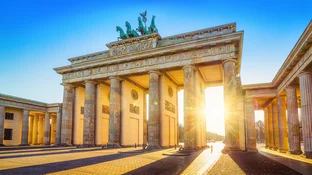
AttractionsThe best street for strolling in eastern Berlin is the famous Unter den Linden, beginning at Brandenburg Gate. Alexanderplatz, named for Russian Czar Alexander I, was the center of activity in the old East Berlin. This square has brightened considerably since reunification, though aesthetically speaking it's got a long way to go. Neon lights and bright murals now coexist alongside the dull and fading GDR-era structures, and street musicians and small markets give the area new life. The massive 335m (1,100-ft.) Fernsehturm (TV tower; tel. 030/2423333) on Alexanderplatz is the second-highest structure in Europe. It's worthwhile to take the 40-second elevator ride to the observation platform, 186m (610 ft.) above the city. From this isolated vantage, you can clearly distinguish most landmarks, and on the floor above, you can enjoy cake and coffee in the revolving Tele-Café. The elevator to the top costs 8€ ($10) for adults and 4€ ($5.20) students, free for children 16 and under. The tower is open daily March to October 9am to midnight and November to February daily 10am to midnight. At the foot of the Fernsehturm stands Berlin's second-oldest church, the brick Gothic Marienkirche (St. Mary's Church), Karl-Liebknecht-Strasse 8 (tel. 030/2424467), dating from the 15th century. Inside you can see the painting Der Totentanz (The Dance of Death), painted in 1475, and then discovered in 1860 beneath a layer of whitewash in the church's entrance hall. Also worth seeing is the marble baroque pulpit carved by Andreas Schlüter (1703). The cross on the top of the church annoyed the Communist rulers of the former East Germany -- its golden form was always reflected in the windows of the Fernsehturm. The church is open Monday to Thursday 10am to noon and 1 to 6pm, Friday to Sunday noon to 4pm. At Rosenthaler Strasse 40-41, the trendy rebuilt Hackersche Höfe has risen from the ashes of World War II to become a chic place for dining, drinking, going to the theater, or patronizing fashionable boutiques and art galleries. Originally these Hacke warehouses were constructed beginning in 1905 as shining examples of Berlin's take on Art Nouveau industrial architecture. Heavily damaged in Allied bombing raids, all nine interconnecting courtyards are new again, with shiny white tiles interspersed with Moorish mosaic designs. Also at this location are a theater and a movie house. The Top Museums The great art collections of old Berlin suffered during and after World War II. Although many paintings were saved by being stored in salt mines, many larger works were destroyed by fire. Part of the surviving art stayed in the east, including a wealth of ancient treasures that remind us of the leading role played by German archaeologists during the 19th and early 20th centuries. The paintings that turned up in the west, and were passed from nation to nation in the late 1940s, have nearly all been returned to Berlin. Charlottenburg Palace & Museums -- Charlottenburg lies just west of the Tiergarten. Plan on spending the day here; the area contains several museums as well as the royal apartments. After seeing the main attractions, you can enjoy a ramble through Schlossgarten Charlottenburg. These formal gardens look much as they did in the 18th century. A grove of cypresses leads to a lake with swans and other waterfowl. North of the palace stands the Mausoleum, which holds the tombs of King Friedrich Wilhelm II and Queen Luise -- sculpted by Rauch -- as well as several other interesting funerary monuments of the Prussian royal family. The Historic Nikolai Quarter The historic Nikolaiviertel (U-Bahn: Klosterstrasse) was restored in time for the city's 750th anniversary in 1987. Here, on the banks of the Spree River, is where Berlin was born. Many of the medieval and baroque buildings in the neighborhood were completely and authentically reconstructed after World War II. Subsequently, some of the city's old flavor has been recaptured here. The area is named for the Nikolaikirche (Church of St. Nicholas), Nikolaikirchplatz, off Spandauerstrasse (tel. 030/24724529). The church, the oldest in Berlin, was originally constructed in the 14th century on the remains of a 13th-century Romanesque church. The restored building now displays the finds of postwar archaeological digs; during the reconstruction, 800-year-old skeletons were found. It's open daily from 10am to 6pm. Admission to the church and tower is free. Other Architectural Sights Just north of the Tiergarten is the Hansaviertel, or Hansa Quarter (U-Bahn: Hansaplatz). The architecture of this area was an outgrowth of the great INTERBAU 1957 (International Builder's Exhibition), when architects from 22 nations designed buildings for the totally destroyed quarter. The diversity here is exciting: 50 architects took part, including Gropius, Niemeyer, and Duttman. Le Corbusier also submitted a design for an apartment house for INTERBAU 1957, but the structure was so gigantic that it had to be built near the Olympic Stadium (U-Bahn: Olympia-Stadion). The Corbusier House, called Strahlende Stadt (radiant city), is one of Europe's largest housing complexes -- its 530 apartments can house up to 1,400 people. Typical of the architect's style, this tremendous building rests on stilts. The architects of rebuilt Berlin were also encouraged to design centers for the performing arts. One of the most controversial projects was the Kongresshalle (Congress Hall), on John-Foster-Dulles-Allee, in the Tiergarten, just west of Brandenburg Gate (S-Bahn: Unter den Linden). This building was conceived as the American contribution to INTERBAU 1957. The reinforced concrete structure has an 18m-high (60-ft.) vaulted ceiling that reminds some viewers of an oversize flying saucer. Berliners immediately christened it "The Pregnant Oyster." The building today is used mainly for conventions. More successful was the Philharmonie, new home of the Berlin Philharmonic, at Matthäikirchstrasse, and its adjacent chamber-music hall, next to the Tiergarten. The tentlike roof arches up in a bold curve, and the gold-colored facade glitters. One of the city's tallest buildings sits in the midst of the city's busiest area. The 22-story Europa Center, just across the plaza from the Kaiser Wilhelm Memorial Church at Breitscheidplatz (U-Bahn: Kurfürstendamm), is the largest self-contained shopping center and entertainment complex in Europe. This town-within-a-town opened in 1965 on the site of the legendary Romanisches Café, once a gathering place for actors, writers, and artists in the flamboyant 1920s. Berliners dubbed it "Pepper's Manhattan," after its owner, K. H. Pepper. In addition to three levels of shops, restaurants, nightclubs, bars, and cinemas, it contains dozens of offices, a parking garage, and an observation roof. At the Tauentzienstrasse entrance, you can find two pieces of the former Berlin Wall. The building is open daily 9am to midnight (to 10pm in winter). Admission to the observation roof is 2€ ($2.60). The Best Sightseeing Deal The CityTourCard gives you free entry to more than 50 museums in Berlin, a free trip up the Fernsehturm (Berlin Television Tower), and reduced fare on BVG tours. The card is sold at all BVG and S-Bahn (urban rail) ticket counters and at some 200 hotels, and it's also available from automatic vending machines run by the BVG. Ticket holders may take children ages 5 and younger free. The cost is 40€ ($52) for 72 hours. Night of Shame Best visited at night, as it is more evocative then, Bebelplatz is a square along Unter den Linden, in Berlin-Mitte, approached just before you reach Staatsoper. Here is an eloquent memorial to the notorious Nazi book burning that took place here on the night of May 10, 1933. Through a window set in the pavement, you can look below to a small library lined with empty bookshelves. Some 25,000 books were burned, all by authors considered enemies of the Third Reich. Nearby is a plaque with the prophetic words of the poet Heinrich Heine. In 1820 he wrote, "Where books are burned, in the end people will burn." The Heartbeat of Berlin The Potsdamer Platz Arcades contain 140 specialty shops, restaurants, and cafes, inviting you to shop and relax in a civilized urban atmosphere. One of the most visited attractions at the center is the Sony Center am Potsdamer Platz (tel. 030/2575-500), with two cinemas -- the CineStar Multiplex and the CineStar IMAX 3-D. The 10-story office building offers a panoramic view that embraces the Philharmonie, the Kulturforum, and the Tiergarten. Around Marlene-Dietrich-Platz, prominent companies offer an entire range of leisure and entertainment facilities. They include the Berlin IMAX-Theater, the Stella Musical-Theater, the Grand Hyatt Hotel, the Madison City Suites, the Berlin Casino, and the Cine-Max cinema center. A New Wall Berliners aren't likely to forget the Berlin Wall any time soon, but just in case, their government has reconstructed a partial stretch of the Wall at Bernauer Strasse and Ackerstrasse (U-Bahn: Bernauer Strasse), at a cost of 1.43 million euros. The 70m-long (230-ft.) memorial consists of two walls that include some of the fragments of the original wall (those fragments not bulldozed away or carried off by souvenir hunters). The memorial is mostly made of mirrorlike stainless steel. Slits allow visitors to peer through. A steel plaque reads, "In memory of the division of the city from 13 August 1961 to 9 November 1989." Critics have called the construction "a sanitized memorial," claiming it does little to depict the 255 people shot trying to escape. Ode to the Murdered Jews of Europe You might call it "concrete memory." A few hundred yards from Checkpoint Charlie, the Stiftung Denkmal für die ermordeten Juden Europas (Memorial to the Murdered Jews of Europe) now occupies a vast site in the center of Berlin, with 2,711 gravestonelike columns. Located in the former East Berlin, just south of the Brandenburg Gate, the memorial was opened on May 10, 2005, 2 days after the 60th anniversary of V-E Day, signaling the ending of World War II in Europe. The official address is Stresemannstrasse 90 (tel. 030/26394336). The memorial lies at the edge of the Grosser Tiergarten between Ebertstrasse and Wilhelmstrasse. Take the S-Bahn to Unter den Linden. Admission is free. Peter Eisenman was the architect who designed the controversial site, filled with claustrophobic pathways through the slabs, some of which are 4.5m (15 ft.) long. The American architect deliberately placed many of the dark gray slabs, with their knife sharp edges, off-kilter, evoking tombstones in an unkept graveyard. Wandering through the memorial is like getting lost in a maze. James Young, a professor at the University of Massachusetts, called it "The Venus's flytrap of Holocaust memorials." Under heavy guard, the memorial is open 24 hours a day. Underneath the monument are four large rooms containing exhibits that document Nazi crimes against humanity. Marker identifies Hitler's Bunker For the first time since World War II, the notorious bunker of the Third Reich was marked publicly. The Führer Bunker, as it was called, was where Hitler staged his last stand, committing suicide on April 30, 1945, as Soviet troops encircled the bunker. Stalin had issued orders to bring Hitler to Moscow alive. "History can be good or bad, but even if it's about a devil, people must be informed of history," said former SS Staff Sgr. Rochus Misch, a Hitler bodyguard who lived in the bunker with him and attended the unveiling of the marker in June of 2006. For decades, Berlin officials refused to mark the site, fearing it would become a place of pilgrimage for neo-Nazis. Misch dispelled the widely circulated myth that the bunker had 12 floors and an underground highway that Hitler used to cruise the city underground. The bunker was constructed in 1935 and was fortified by walls 14 feet thick. The bunker is not intact under the parking lot that covers it. Soviet soldiers blew up most of the bunker in the 1980s, and the foundation and walls were filled with rubble. The marker bears graphics, photographs, and a chronology of events in both German and English. The location of the bunker is at the corner of In den Ministergarten and Gertrude Kolmar Strasse near the Potsdamer Platz. In Memory of . . . At the corner of Lewetzov and Jagow streets is a Jewish War Memorial to the many Berliners who were deported -- mostly to their deaths -- from 1941 until the end of the war in 1945. The memorial is a life-size sculpture of a freight car with victims being dragged into it. Behind it is a 15m (50-ft.) structure listing the dates of the various death trains and the number of prisoners shipped out. The memorial stands on the site of a former synagogue destroyed by the Nazis.
Click the names below for more detailed information.
Note: This information was accurate when it was published, but can change without notice. Please be sure to confirm all rates and details directly with the companies in question before planning your trip.
|
|
|||||||||||||||||||||||||||||||||||||||||||||||||||||||||||||||||||||||||||||||||||||||||||||||||||||||||||||||||||||||||||||||||||||||||||||||||||||||||||||||||||||||||||||||||||||||||||||||||||||||