|
Château de Versailles
|
||||||||||||||||||||||||||||||||||||||||||||||||||||||||||||||||||||||||||||||||||||||||||||||||||||||||||||||||||||||||||||||||||||||||||||||||||||||||||||||||||||||||||||||||||||||||||||||||||||||||||||||||||||||||||||||||||||||||||||||||||||||||||||||||||||||||||||||||||||||||||||||||||||||||||||||||||||||||||||||||||||||||||||||||||||||||||||||||
| Hours | Palace Apr-Oct Tues-Sun 9am-6:30pm; Nov-Mar Tues-Sun 9am-5:30pm. Trianons and Le Hameau Tues-Sun noon-6pm. Grounds daily dawn-dusk | ||
| Location | Place d'Armes | ||
| Phone | 01-30-83-78-00 | ||
| Web site | www.chateauversailles.fr | ||
| Prices | Palace 14€ adults; 10€ adults after 4pm, seniors 60 and older, and ages 18-25. Both Trianons and Le Hameau 9€ adults; 5€ adults after 3:30pm, seniors 60 and older, and ages 18-25. Everything free for children 17 and younger | ||
Frommer's Review
Within 50 years, the Château de Versailles was transformed from Louis XIII's hunting lodge into an extravagant palace. Begun in 1661, its construction involved 32,000 to 45,000 workmen, some of whom had to drain marshes and move forests. Louis XIV set out to build a palace that would be the envy of Europe and created a symbol of opulence copied, yet never duplicated, the world over.
Wishing (with good reason) to keep an eye on the nobles of France, Louis XIV summoned them to live at his court. Here he amused them with constant entertainment and lavish banquets. To some he awarded such tasks as holding the hem of his robe. While the aristocrats played at often-silly intrigues and games, the peasants on the estates sowed the seeds of the Revolution.
When Louis XIV died in 1715, his great-grandson Louis XV succeeded him and continued the outrageous pomp, though he is said to have predicted the outcome: "Après moi, le déluge" ("After me, the deluge"). His wife, Marie Leszczynska, was shocked by the blatant immorality at Versailles.
The next monarch, Louis XVI, found his grandfather's behavior scandalous -- in fact, on gaining the throne, he ordered that the "stairway of indiscretion" (secret stairs leading to the king's bedchamber) be removed. The well-intentioned but weak king and his queen, Marie Antoinette, were well liked at first, but the queen's frivolity and spending led to her downfall. Louis and Marie Antoinette were at Versailles on October 6, 1789, when they were notified that mobs were marching on the palace. As predicted, le déluge had arrived.
Napoleon stayed at Versailles but never seemed fond of it. Louis-Philippe (who reigned 1830-48) prevented the destruction of the palace by converting it into a museum dedicated to the glory of France. To do that, he had to surrender some of his own riches. Decades later, John D. Rockefeller contributed toward the restoration of Versailles, and work continues today.
The magnificent Grands Appartements are in the Louis XIV style; each bears the name of the allegorical painting on the ceiling. The best-known and largest is the Hercules Salon, with a ceiling painted by François Lemoine depicting the Apotheosis of Hercules. In the Mercury Salon (with a ceiling by Jean-Baptiste Champaigne), the body of Louis XIV was put on display in 1715; his 72-year reign was one of the longest in history.
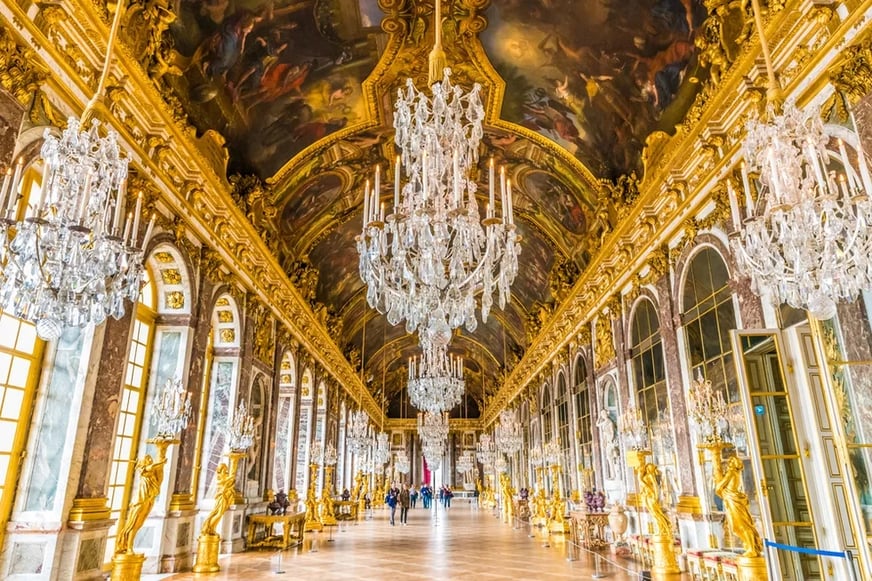
The most famous room at Versailles is the 71m-long (233-ft.) Hall of Mirrors. Begun by Mansart in 1678 in the Louis XIV style, it was decorated by Le Brun with 17 arched windows faced by beveled mirrors in simulated arcades. On June 28, 1919, the treaty ending World War I was signed in this corridor. The German Empire was proclaimed here in 1871.
The royal apartments were for show, but Louis XV and Louis XVI retired to the Petits Appartements to escape the demands of court etiquette. Louis XV died in his bedchamber in 1774, a victim of smallpox. In a second-floor apartment, which you can visit only with a guide, he stashed away first Mme de Pompadour and then Mme du Barry. Attempts have been made to return the Queen's Apartments to their appearance in the days of Marie Antoinette, when she played her harpsichord in front of special guests.
Louis XVI had a sumptuous Library, designed by Jacques-Ange Gabriel. Its panels are delicately carved, and the room has been restored and refurnished. The Clock Room contains Passement's astronomical clock, encased in gilded bronze. Twenty years in the making, it was completed in 1753. The clock is supposed to keep time until the year 9999. At age 7, Mozart played for the court in this room.
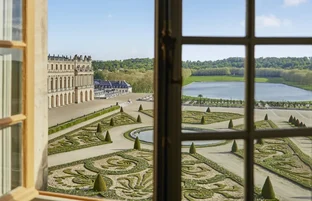
Gabriel designed the Opéra for Louis XV in 1748, though it wasn't completed until 1770. In its heyday, it took 3,000 candles to light the place. Hardouin-Mansart built the harmoniously gold-and-white Royal Chapel in 1699, dying before its completion. Louis XVI married Marie Antoinette here in 1770, while he was the Dauphin. Spread across 100 hectares (247 acres), the Gardens of Versailles were laid out by landscape artist André Le Nôtre. At the peak of their glory, 1,400 fountains spewed forth. The Buffet is an exceptional fountain, designed by Mansart. One fountain depicts Apollo in his chariot pulled by four horses, surrounded by Tritons rising from the water. Le Nôtre created a Garden of Eden using ornamental lakes and canals, geometrically designed flower beds, and avenues bordered with statuary. On the mile-long Grand Canal, Louis XV used to take gondola rides with his favorite of the moment.
Developments within the sprawling infrastructure created by the monarchs of France include Les Grandes Ecuries (the Stables), avenue Rockefeller, immediately opposite the château's main front facade, where the horses and carriages of the kings were housed. Visitors can watch a team of up to a dozen students, with their mounts, strut their stuff during hour-long riding demonstrations within the covered, 17th-century amphitheater of the historic stables. Horse lovers will appreciate the equestrian maneuvers that this riding school shows off during these presentations, but they shouldn't go with any expectations that the horsemanship will re-create exclusively 17th- and 18th-century styles. With a painted backdrop that reflects a circus theme, and with costumes that are colorful and artful but not exclusive to Versailles during its heyday, the focus is on showmanship and equestrian razzmatazz rather than exact replication of period costumes or riding styles. Each demonstration lasts about an hour. Demonstrations are conducted Tuesday to Thursday, and Saturday and Sunday, at 11:15am. There's an additional presentation every Saturday and Sunday at 2pm. Depending on what's happening, the price of tickets can vary, perhaps 20€ to 25€. There are no discounts for students or seniors, but children 9 and younger, accompanied by an adult, enter free. For additional information, contact the château directly at tel. 01-30-83-78-00.
Incidentally, participation in this event provides the only official way a visitor to Versailles can easily gain entrance to the stables, which contain a warren of narrow stalls for horses, as well as a large space with a plastered ceiling that's used as the amphitheater for displays of horsemanship.
On Christmas 1999, one of the worst storms in France's history destroyed some 10,000 historic trees on the grounds. Blowing at 161kmph (100 mph), gusts uprooted 80% of the trees planted during the 18th and 19th centuries. They included pines from Corsica planted during Napoleon's reign, tulip trees from Virginia, and a pair of junipers planted in honor of Marie Antoinette. Still, much remains to enchant you, and the restored gardens get better every month.
Note: This information was accurate when it was published, but can change without notice. Please be sure to confirm all rates and details directly with the companies in question before planning your trip.
| Back to Top |
| RSS | |||||||
|
Frommer's Paris 2010
Author: Darwin Porter |
Related Titles:
|
|||||||||||||||||||||
| 0 stars | Frommer's Recommended | |
| 1 stars | Frommer's Highly Recommended | |
| 2 stars | Frommer's Very Highly Recommended | |
| 3 stars | Frommer's Exceptional |
Frommer's ranks every hotel, restaurant, attraction, shop, and nightlife establishment it reviews for quality, value, service, amenities, and special features using a star-rating scale, an expression of the strong compare-and-contrast opinions that are a brand hallmark.
Other ratings provide stars based primarily on price and amenities; the Frommer's star rating is meant to quantify the kind of intangible, experiential elements that help travelers make informed decisions.
The "baseline" recommendation is zero stars--every hotel, restaurant, attraction, shop, and nightlife establishment that Frommer's chooses to review is recommended; otherwise, we simply wouldn't include it.