Things To Do in A Coruna
Bookstore

Available as paperback
and as e-book.
A Coruna Attractions
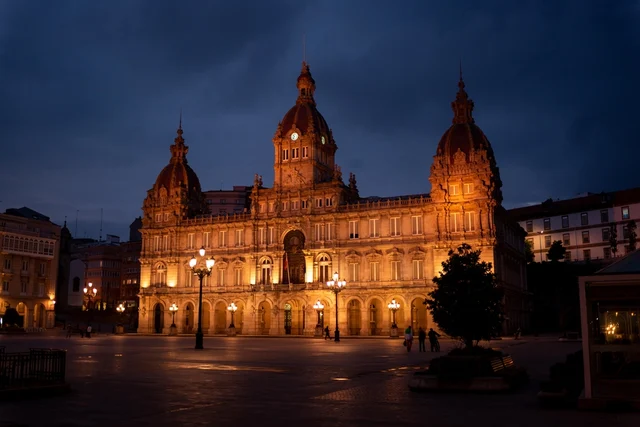
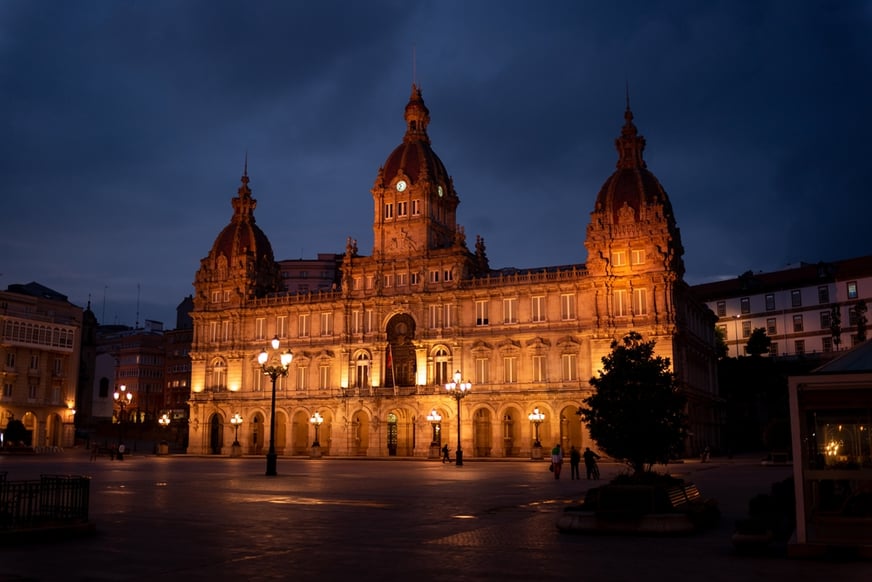
A Coruña's Old Town is ideal for a stroll. Plaza de María Pita (pictured above) divides the Old Town from the newer city. María Pita, a local housewife, was said to have spotted the approach of Drake's troops. Risking her own life, she fired a cannon shot to alert the citizens to an imminent invasion. For that act of heroism, she is revered to this day.
You can take a stroll through the Jardines de Méndez Núñez, between the harbor and Los Cantones (Cantón Grande and Cantón Pequeño). Facing the police station and overlooking the port, the gardens are in the very center of town and make for a restful interlude during your sightseeing.
The cobbled Plazuela de Santa Bárbara -- a tiny, tree-shaded plaza flanked by old houses and the high walls of the Santa Bárbara convent -- also merits a visit.
Jardín de San Carlos, along Paseo del Parrote, dates from 1843 and is near the Casa de la Cultura. This garden grew on the site of an old fortress that once guarded the harbor. It contains the tomb of Gen. Sir John Moore, who fought unsuccessfully against the troops of Napoleon. He retreated with his British forces to A Coruña, where he was shot in a final battle. These gardens now make an ideal picnic spot.
Iglesia de Santa María del Campo, Calle de Santa María, is a 13th-century church with an elaborately carved west door, modeled in the traditional Romanesque-Gothic style. Beneath its rose window you'll see a Gothic portal from the 13th or 14th century. The tympanum is carved with a scene depicting the Adoration of the Magi.
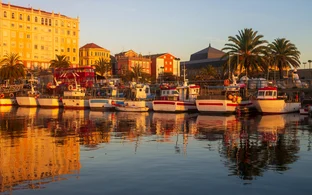
The second-largest port in Spain, A Coruña is a popular vacation resort that gets very crowded in July and August. Riazor Beach, right in town, is a good, fairly wide beach, but the best one is Santa Cristina, about 5km (3 miles) outside town.

12 Results
- Zoo/Aquarium
Acuarium Finisterrae
Few subjects are so dear to the hearts of Galegos as the ocean and its creatures, and one of the exhibits here is literally the ocean, on the other side of a glass wall. Fish swim by and crabs scuttle across the ocean floor. The underwater experience is amplified in an exhibit room… - Natural Attraction
Ascensor Panorámico Monte San Pedro
This glass elevator climbs 100m (328 ft.) to the top of a small mountain at the western edge of town -- a great spot for sunsets or for looking down on the Torre de Hércules. - Religious Site
Convento da Santa Bárbara
The cobbled Prazuela de Santa Bárbara is a tiny, tree-shaded plaza flanked by old houses and the high walls of the Santa Bárbara convent. The Clarisas nuns (Poor Clares) are cloistered, but you might hear them singing their prayers at midday services, and you can purchase pastries… - Museum
Domus
The so-called “House of Man” is intended to provoke curiosity—starting with its unusual curved building designed by Japanese architect Arata Isozaki. The museum bills itself as the “first interactive museum in the world devoted to the human being.” It explores such concrete subjects… - Natural Attraction
Elevador Panorámico Monte San Pedro
This glass elevator climbs 100m (328 ft.) to the top of a small mountain at the western edge of town—a great spot for sunsets or for looking down on the Torre de Hércules. - Park/Garden
Jardines de Méndez Núñez
The tourist office only half-jokingly refers to these lovely gardens and walking paths near the fishing port as the city’s living room. They were created on land reclaimed from the sea in the mid-19th century, making them some of the city’s oldest gardens. In May and June, the scent… - Park/Garden
Jardín de San Carlos
These gardens near the Casa de la Cultura date from 1843 and cover the site of an old fortress that once guarded the harbor. Their views make the gardens a terrific picnic spot. Within the gardens is the tomb of Gen. John Moore, a British commander who fought unsuccessfully against… - Brewery/Museum
MEGO - Mundo Estrella Galicia
This is Spain’s first (and last we looked, only) museum about beer. Estrella Galicia is one of the country’s largest beer producers and this “museum” in its home city offers a dizzying variety of tour and tasting opportunities, including an ecotour excursion to the brewery and hop… - Museum
Museo Arqueológico e Histórico Castillo de Santo Antón
The sturdy stone castillo was built in the 16th century to fortify the harbor after Drake’s raid, and later held prisoners and sailors who arrived in port with infectious diseases. It became a museum in 1968. All its artifacts were found locally. Some date back to the mysterious… - Landmark
Praza (Plaza) de María Pita
This plaza divides the Old Town from the newer city and honors the memory of the woman who helped save many of A Coruña’s citizens from slaughter by the English. According to legend, she spotted the approach of Drake’s troops, and, risking her own life, fired a cannon to alert the… - Religious Site
Santa María del Campo
This 13th-century church can only be viewed from the exterior, but it offers extraordinarily beautiful architectural details. The west door is elaborately carved in the traditional Romanesque-Gothic style. Beneath its rose window you’ll see a Gothic portal from the 13th or 14th… - Landmark
Torre de Hércules
Europe’s oldest working lighthouse, this structure at the tip of A Coruña’s peninsula was first erected by the Romans in the 2nd century, although continued modernization has obscured its origins. A climb to the top provides great views of A Coruña’s bay and port. The tower is…
A Coruna Nightlife
Some of the most appealing bars in A Coruña are atmospheric holes in the wall with a local clientele and decor that has remained virtually unchanged since the late 20th century. Start your evening at Mesón La Rueda, Capitán Troncoso, 8 (tel. 98-122-86-71; daily 1–4pm and 8pm–midnight), which is known for tapas. The late-night scene hasn’t quite recovered from the pandemic, but Playa Club disco, Andén de Riazor (tel. 98-127-75-14) has reduced programming, mainly in the summer and at holidays. It sits on an oceanfront terrace near Playa Riazor and rarely opens before 10pm.