Bookstore
Available as paperback
and as e-book.
Avila Attractions
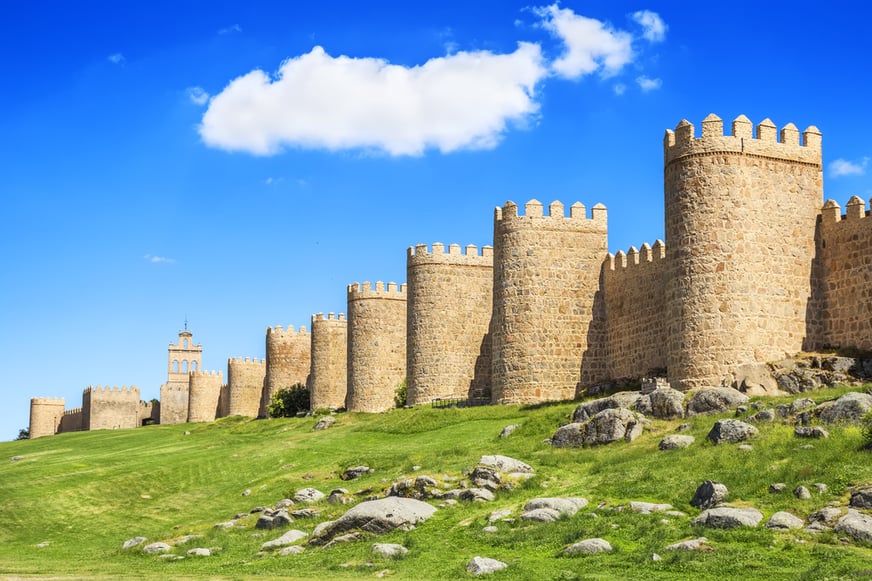
A Cubist jumble of Gothic convents and palaces slumping down the top of a hill, entirely surrounded by imposing, castellated stone walls, Ávila is the perfect stage set of a Castilian city. It seems a unified whole, making a stronger impression than its individual parts. No visitor can—or should—miss the Murallas, or walls. After that, let your heart and devotion dictate which of the holy spots to visit. For a panoramic view of the city walls as invading armies from the south would have seen them, take the 2km (1.2mi) walk to the Los Cuatro Postes observation point across the Rio Adaja. Note that the city has begun an intensive program of wheelchair accessibility, including the Puente Adaja access point to the walls.
About those walls: Begun on orders of Alfonso VI as part of the general reconquest of Spain from the Moors, the 11th-century Walls of Avila, built over Roman fortifications, took 9 years to complete. They average 10m (33 ft.) in height and have 88 semicircular towers and more than 2,300 battlements. Of the nine gateways, the two most famous are the St. Vincent and the Alcázar, both on the eastern side. In many respects, the walls are best viewed from the west. Whatever your preferred point of view, you can drive along their entire length: 2km (1 1/2 miles).

7 Results
- Religious Site
Basílica de San Vicente
One of Spain’s finest Romanesque churches, this faded sandstone basilica with a huge nave and three apses stands outside the medieval ramparts—a defiant Christian structure built to claim the high ground in the name of the cross. Its fiercely moralistic carvings, especially on the… - Religious Site
Carmelitas Descalzas de San José (Barefoot Carmelites of St. Joseph)
Also known as the Convento de las Madres (Convent of the Mothers), this is the first convent founded by Santa Teresa in 1562 when she began her reform of the Carmelite order. There are two churches: a primitive one, where the first Carmelite nuns took the habit; and one built by… - Cathedral
Catedral del Salvador
Built into the old ramparts of Avila, this cold, austere cathedral and fortress (begun in 1099 under Alfonso VI) bridges the gap between the Romanesque and the Gothic and, as such, enjoys a certain distinction in Spanish architecture. One local writer compared it to a granite… - Religious Site
Convento de Santa Teresa
This 17th-century convent and baroque church, 2 blocks southwest of the Plaza de la Victoria, is at the site of St. Teresa's birth. To the right of the convent is the tiny Sala de Reliquias exhibiting some of her relics, including a finger from her right hand, the sole of one of her… - Historic Site
Murallas de Avila (Walls of Avila)
Avila’s defensive walls are among the best preserved in Europe. They were begun in 1190 on orders of Alfonso VI as part of the re-conquest of Spain. Since the builders used the foundations of an earlier Roman fortification, they were able to complete the brown-granite construction in… - Museum
Museo Teresiano
Located below the Convento de Santa Teresa, which was built on the site of her childhood home, this scholarly museum preserves the garden where Teresa recalled her childhood joy at playing with her siblings. Among the museum’s more striking artifacts are painted portraits of Teresa… - Religious Site
Real Monasterio de Santo Tomás
This 15th-century Gothic monastery was once the headquarters of the Inquisition in Avila. For 3 centuries, it housed the tomb of Torquemada, the first general inquisitor, whose zeal in organizing the Inquisition made him a notorious figure in Spanish history. Legend has it that after…