Casa Batlló

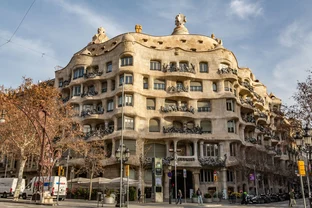
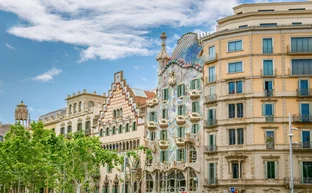
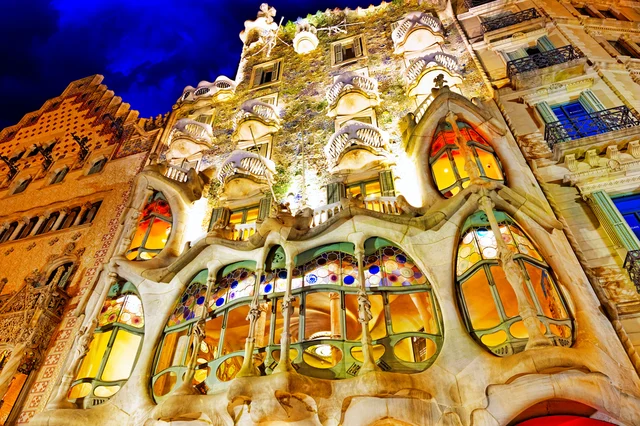
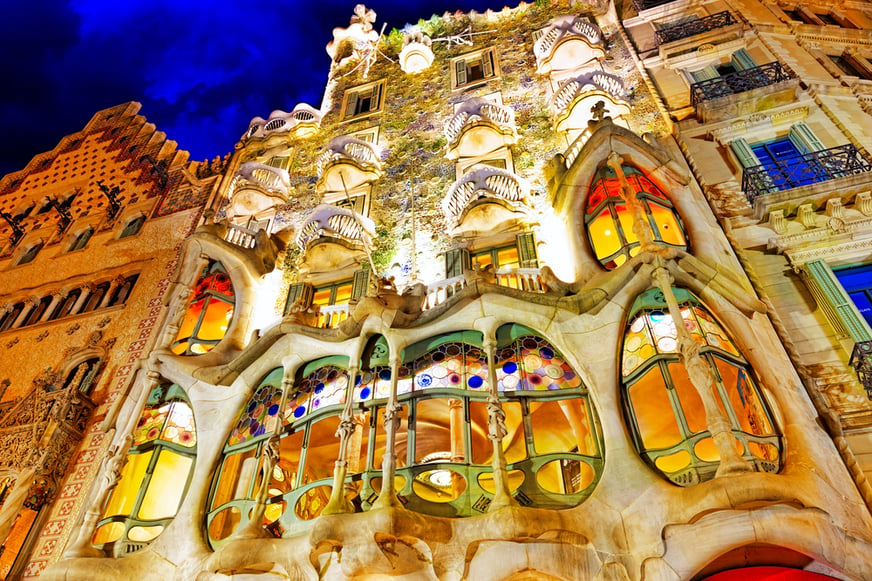
Next door to Casa Amatller is Gaudí’s extraordinary 1905 creation for the textile tycoon Josep Batlló, who gave the architect free rein to create “a paradise on earth.” The facade’s sinuous curves give the structure a lush organic appeal, and the balconies, like those at La Pedrera, seem to be sculpted ocean waves. Floral references in the ornamentation turn more faunalike as the building rises, with the roof evoking the scaly skin of a dragon.
The designs, while outlandish, emphasize functionality in a way that was well ahead of its time. Beautifully crafted interior doors, banisters, and brass handles are fluid and tactile. Señor Batlló’s office has a little nook with two benches and a stove for warmth—perfect for a courting couple to sit on one side and their chaperone on the other. Even this smallest of the rooms has a skylight to let in natural light.
In the main living room overlooking Passeig de Gràcia, the décor mimics the marine world—eddies swirl in the ceiling and even the ventilation system seems inspired by fish gills. As you climb the spiral staircase of the central light well, the blue tiles become progressively darker and the windows smaller to adjust for sunlight. The undulating roof evokes the backbone of the dragon slain by Sant Jordi (St. George), patron saint of Catalunya. The chimneypots, bent to avoid backdrafts, are decorated with Gaudí’s trademark broken tiles (trencadís).
In summer, the roof terrace hosts live music events, and there’s an immersive light and sound show in a basement gallery that seems unnecessary given the wonder of the real thing. Tickets for the basic tour are expensive—the building is privately owned and receives no subsidy—but it’s worth the outlay.
Next door to Casa Amatller is Gaudí’s extraordinary 1905 creation for the textile tycoon Josep Batlló, who gave the architect free rein to create “a paradise on earth.” The facade’s sinuous curves give the structure a lush organic appeal, and the balconies, like those at La Pedrera, seem to be sculpted ocean waves. Floral references in the ornamentation turn more faunalike as the building rises, with the roof evoking the scaly skin of a dragon.
The designs, while outlandish, emphasize functionality in a way that was well ahead of its time. Beautifully crafted interior doors, banisters, and brass handles are fluid and tactile. Señor Batlló’s office has a little nook with two benches and a stove for warmth—perfect for a courting couple to sit on one side and their chaperone on the other. Even this smallest of the rooms has a skylight to let in natural light.
In the main living room overlooking Passeig de Gràcia, the décor mimics the marine world—eddies swirl in the ceiling and even the ventilation system seems inspired by fish gills. As you climb the spiral staircase of the central light well, the blue tiles become progressively darker and the windows smaller to adjust for sunlight. The undulating roof evokes the backbone of the dragon slain by Sant Jordi (St. George), patron saint of Catalunya. The chimneypots, bent to avoid backdrafts, are decorated with Gaudí’s trademark broken tiles (trencadís).
In summer, the roof terrace hosts live music events, and there’s an immersive light and sound show in a basement gallery that seems unnecessary given the wonder of the real thing. Tickets for the basic tour are expensive—the building is privately owned and receives no subsidy—but it’s worth the outlay.
Details
Bookstore

Available as paperback
and as e-book.