Palau de la Música Catalana

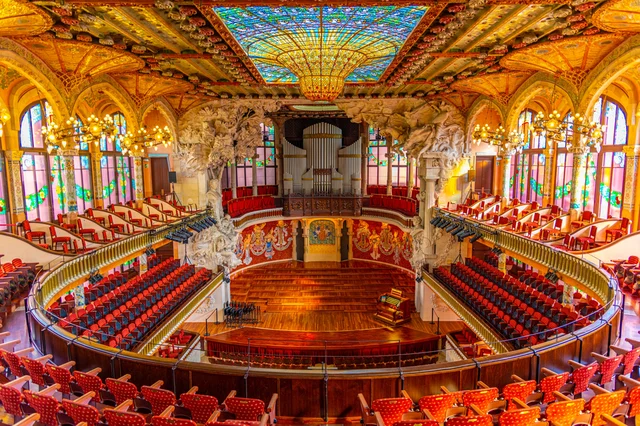
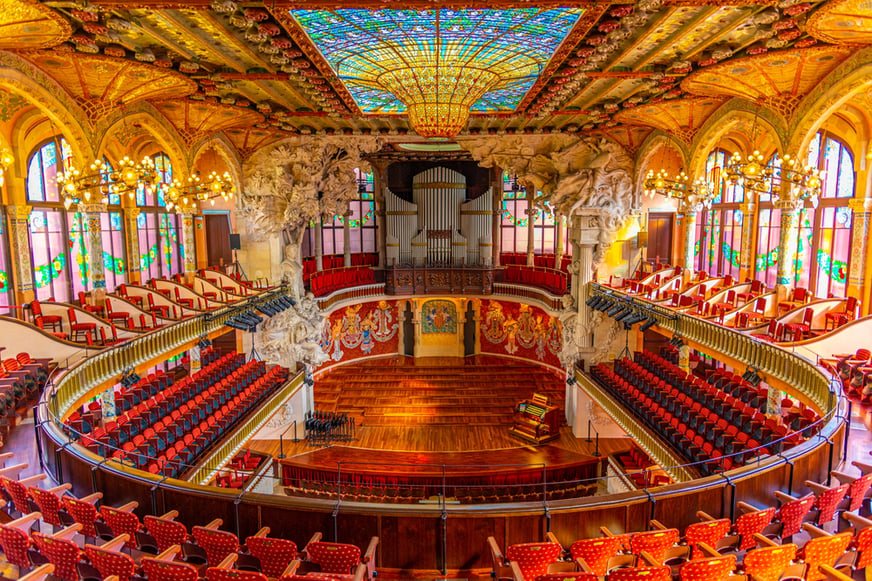
One of the most magical of all the Modernista buildings, this is Lluís Domènech i Montaner’s masterpiece. Commissioned by the Orfeó Català choral music society, the architect laid the first stone in 1905 on St. George’s Day (May 5, the feast of Catalunya’s patron saint). It finally opened in 1908—a marvel of stained glass, ceramics, statuary, ornate wrought iron, and carved stone. In the architect’s signature style, the facade features exposed brick combined with colorful ceramic mosaics. The sculptures are symbolic and, frankly, nationalistic. The stone prow, a work by Miquel Blay, is an allegory of popular music with two boys and two old men embracing a nymph while St. George protects them with the Catalan flag. Inside, the vaults of the foyer are lined with Valencian tiles. The concert hall itself is topped with an enormous stained-glass skylight representing a circle of female angels surrounding the sun as a choir—quite appropriate for a choral society.
You can buy a ticket for a self-guided tour from a machine in the foyer or pay a little extra for an hour-long guided tour. There’s also a lovely café you can visit without a ticket. But the best way to enjoy this UNESCO-listed building to its magnificent maximum is to attend a concert—the acoustics are superb. Arrive early, take you seat, and gawp.
One of the most magical of all the Modernista buildings, this is Lluís Domènech i Montaner’s masterpiece. Commissioned by the Orfeó Català choral music society, the architect laid the first stone in 1905 on St. George’s Day (May 5, the feast of Catalunya’s patron saint). It finally opened in 1908—a marvel of stained glass, ceramics, statuary, ornate wrought iron, and carved stone. In the architect’s signature style, the facade features exposed brick combined with colorful ceramic mosaics. The sculptures are symbolic and, frankly, nationalistic. The stone prow, a work by Miquel Blay, is an allegory of popular music with two boys and two old men embracing a nymph while St. George protects them with the Catalan flag. Inside, the vaults of the foyer are lined with Valencian tiles. The concert hall itself is topped with an enormous stained-glass skylight representing a circle of female angels surrounding the sun as a choir—quite appropriate for a choral society.
You can buy a ticket for a self-guided tour from a machine in the foyer or pay a little extra for an hour-long guided tour. There’s also a lovely café you can visit without a ticket. But the best way to enjoy this UNESCO-listed building to its magnificent maximum is to attend a concert—the acoustics are superb. Arrive early, take you seat, and gawp.
Details
Bookstore
Available as paperback
and as e-book.