Parc Güell

Gaudí began this magical park in Gràcia as a real-estate venture for his patron, the industrialist Eusebi Güell. Although the plan never came to fruition, Gaudí did complete several public areas of what is perhaps his most outlandish achievement.
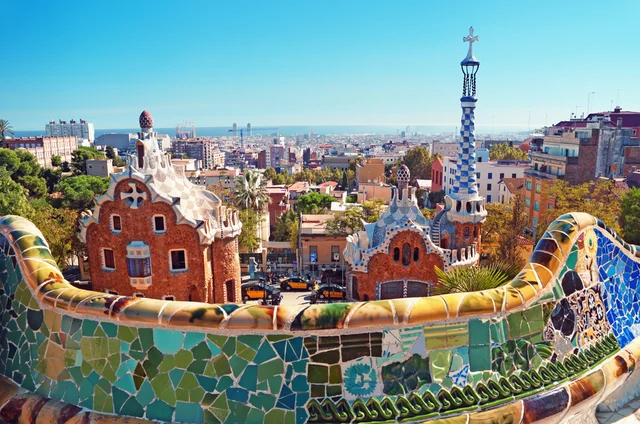
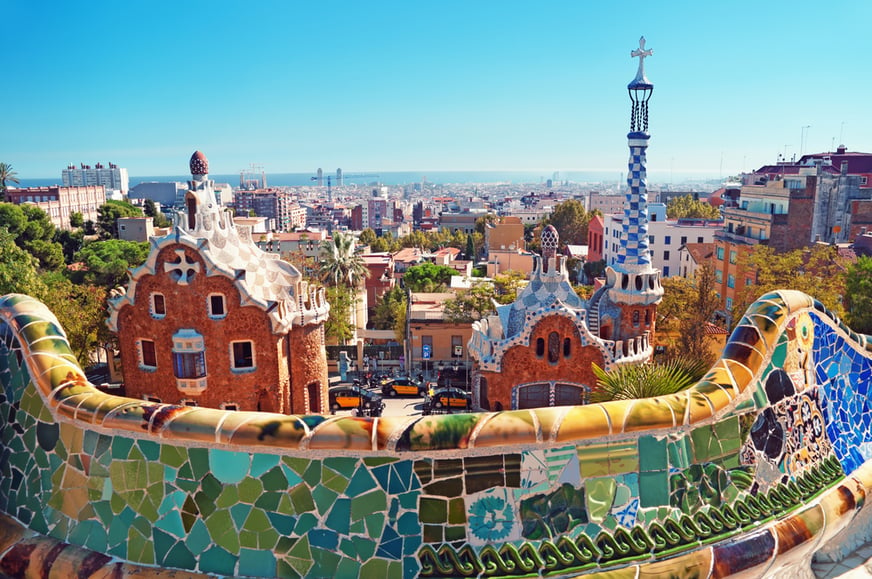
The Plaza de la Natura is fronted by the colorful, undulating Serpentine Bench decorated with Gaudí’s trademark ceramic fragments (trencadís). It is one of Barcelona’s most recognizable landmarks, with Instagram-friendly views across the city. Supporting the plaza from below are the 86 Doric columns of the Hipostyle Room, originally intended as a marketplace. The columns are hollow, part of Gaudí’s ingenious drainage system that uses the mouth of the multi-colored mosaic dragon on the Monumental Staircase as its overflow.
For maximum dramatic effect, start your visit at the less busy entrance on Carretera de Carmel and wander around the hilly park before making your way to the plaza, saving the dragon as your finale at the Carrer d’Olot entrance.
A lack of buyers led the real estate venture to be abandoned in 1914 and only two of the planned 60 houses were ever built. One of them (designed by Ramón Berenguer, not Gaudí) serves as the Casa-Museu Gaudí. The museum, which was the architect’s home during the last 20 years of his life, contains furniture, drawings, and other memorabilia.
Book tickets for Park Güell online well in advance—they sell out early at all times of the year—and note that the Casa-Museu requires a separate ticket. Before you leave, check out the small, fairytale buildings at the gate which contain an exhibition space and a well-stocked shop with tasteful souvenirs.
Gaudí began this magical park in Gràcia as a real-estate venture for his patron, the industrialist Eusebi Güell. Although the plan never came to fruition, Gaudí did complete several public areas of what is perhaps his most outlandish achievement.
The Plaza de la Natura is fronted by the colorful, undulating Serpentine Bench decorated with Gaudí’s trademark ceramic fragments (trencadís). It is one of Barcelona’s most recognizable landmarks, with Instagram-friendly views across the city. Supporting the plaza from below are the 86 Doric columns of the Hipostyle Room, originally intended as a marketplace. The columns are hollow, part of Gaudí’s ingenious drainage system that uses the mouth of the multi-colored mosaic dragon on the Monumental Staircase as its overflow.
For maximum dramatic effect, start your visit at the less busy entrance on Carretera de Carmel and wander around the hilly park before making your way to the plaza, saving the dragon as your finale at the Carrer d’Olot entrance.
A lack of buyers led the real estate venture to be abandoned in 1914 and only two of the planned 60 houses were ever built. One of them (designed by Ramón Berenguer, not Gaudí) serves as the Casa-Museu Gaudí. The museum, which was the architect’s home during the last 20 years of his life, contains furniture, drawings, and other memorabilia.
Book tickets for Park Güell online well in advance—they sell out early at all times of the year—and note that the Casa-Museu requires a separate ticket. Before you leave, check out the small, fairytale buildings at the gate which contain an exhibition space and a well-stocked shop with tasteful souvenirs.
Details
Bookstore

Available as paperback
and as e-book.