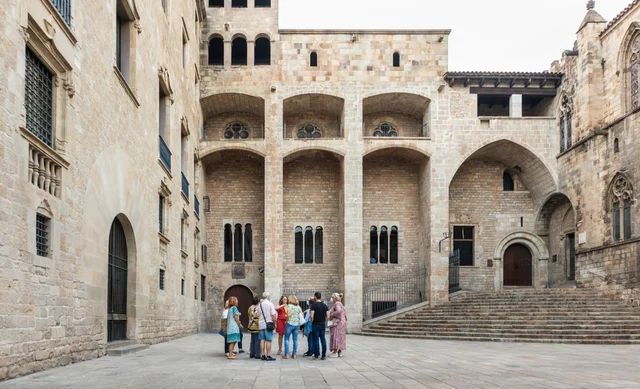
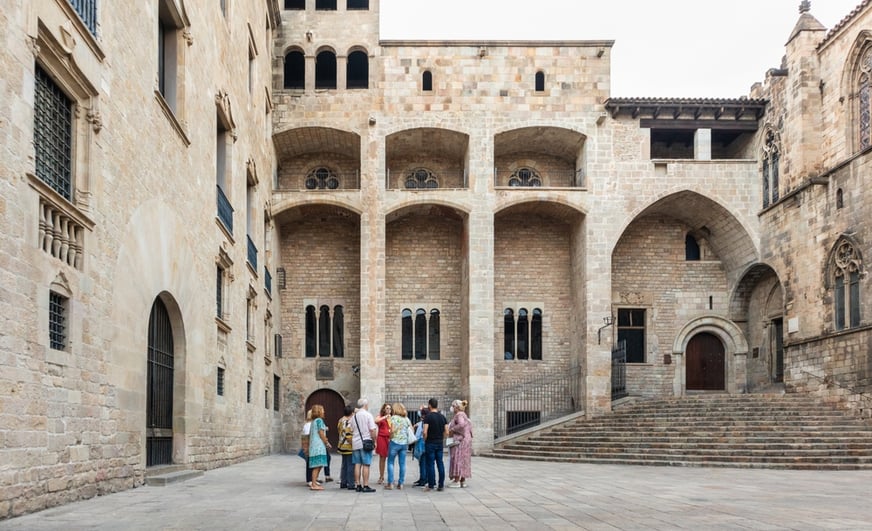
Museu d’Història de Barcelona, Plaça del Rei

It’s a good idea to visit MUHBA’s main site early in your stay, as it gives a vivid introduction to the origins of the city. The museum is set within the Casa Padellàs, a merchant’s palace from 1498 that was moved here stone by stone in the 1930s, and the 11th-century Palau Reial Major, It’s set in part of the 11th-century Palau Reial Major, palace of the kings of Aragón and Catalunya (also in this palace complex: the Museu Frederic Marès).
But the real treat is nearly an acre of Roman ruins of the city of Barcino which lie beneath the palaces. They were discovered in the 1920s when the nearby thoroughfare of Via Laietana was being built. Underground walkways allow you to visit the remains of Roman homes, a dye shop, fish sauce (garum) factory, and winery, accompanied by an informative audio guide. Toward the end of the tour, you’ll reach the remains of the medieval bishop’s palace and the foundations of Barcelona’s Gothic cathedral. Although they are partially visible from Plaça del Rei, the last remaining Roman walls and defensive towers of Barcino—a section from the A.D. 4th-century second enclosure—are easier to make out from the museum’s other side, on Plaça Ramon Berenguer on Via Laietana. Embedded within the wall are the royal chapel of Santa Ágata and a 14th-century segment of the Palau Reial.
Tickets for this excellent museum give you access to fifteen MUHBA sites across the city
It’s a good idea to visit MUHBA’s main site early in your stay, as it gives a vivid introduction to the origins of the city. The museum is set within the Casa Padellàs, a merchant’s palace from 1498 that was moved here stone by stone in the 1930s, and the 11th-century Palau Reial Major, It’s set in part of the 11th-century Palau Reial Major, palace of the kings of Aragón and Catalunya (also in this palace complex: the Museu Frederic Marès).
But the real treat is nearly an acre of Roman ruins of the city of Barcino which lie beneath the palaces. They were discovered in the 1920s when the nearby thoroughfare of Via Laietana was being built. Underground walkways allow you to visit the remains of Roman homes, a dye shop, fish sauce (garum) factory, and winery, accompanied by an informative audio guide. Toward the end of the tour, you’ll reach the remains of the medieval bishop’s palace and the foundations of Barcelona’s Gothic cathedral. Although they are partially visible from Plaça del Rei, the last remaining Roman walls and defensive towers of Barcino—a section from the A.D. 4th-century second enclosure—are easier to make out from the museum’s other side, on Plaça Ramon Berenguer on Via Laietana. Embedded within the wall are the royal chapel of Santa Ágata and a 14th-century segment of the Palau Reial.
Tickets for this excellent museum give you access to fifteen MUHBA sites across the city
Details
Bookstore
Available as paperback
and as e-book.