Frank Peters / Shutterstock
Planning a trip to Berlin
At a BERLIN infostore you can find information, buy the money-saving Berlin Welcome Card, bus and subway tickets, and half-price music and theater tickets. Berlin has five walk-in infostores:
The infostores operate an information line (tel. 030-25-00-25) and, of course, a website, which has the address for all of the infostores in the city.
Getting There
BY PLANE
Most international flights arrive at Berlin-Brandenburg International Airport (BER), 20km (12 miles) from the city center. The new airport (opened 2020) has a rail station under the main terminal, so you can reach the center of Berlin in 20 minutes. For current information on BBI and the two airports currently serving Berlin, go to www.berlin-airport.de.
Schönefeld airport, 18km (11 miles) southeast of the center was once its own airport (SXF) but is now Terminal 5 at Brandenburg (BER). It connects with destinations across Europe, Asia, and Africa, and is served by low-cost airlines like easyJet, Ryanair, and others. Its train station is Berlin Schönefeld Flughafen.
Airport Express trains (RE9; 29 min.) to Berlin Brandenburg Airport, which includes terminals 1 and 2, run roughly every 15 minutes from Berlin Hauptbahnhof. A regular S-Bahn service (S45 and S9) departs from the airport and takes about 45 minutes to reach central Berlin. Alternatively take the Airport Express train, departing every half-hour from 4:30am to 11pm and taking about 30 minutes to reach Hauptbahnhof (Berlin’s main train station), stopping en route at Ostbahnhof, Alexanderplatz, and Friedrichstrasse. Tickets for either service cost 3.20€ and can be purchased from the machines on the platforms. Expect to pay around 40€ for the 45-minute taxi journey into town.
Tegel (TXL) airport, 8km (5 miles) northwest of the center, served European and long-haul destinations. It closed in October 2020.
BY TRAIN
You can reach Berlin by train from everywhere in Europe. Long-distance high-speed trains arrive at and depart from the Hauptbahnhof (main train station), Europa Platz 1 (tel. 0800-15-07-090 for train schedules; www.hbf-berlin.de), Europe’s newest and largest train station. Unless you arrive by a local, regional train, you’ll be pulling into this new, user-friendly terminal. On the main floor there’s a BERLIN infostore, the name given to Berlin’s tourist information centers. Whether you’re staying in western or eastern Berlin, getting to your hotel from the Hauptbahnhof couldn’t be easier. The entrance to the S-Bahn (elevated train) is on the second floor of the station; the entrance to the U-Bahn (subway or underground train) is on the first floor, and there are buses right outside.
BY CAR
Four Autobahn (freeway) routes enter Berlin from western Germany; three enter from the east. The drive from Frankfurt or Munich takes about 8 hours, depending on traffic. After you’re in Berlin, however, a car is a nuisance. Unless you know this huge city well, getting around by public transportation is far easier than by car
Orientation
City Layout
Berlin is one of the largest and most complex cities in Europe. Because it's so spread out, you'll need to depend on public transportation. No visitor should try to explore more than two neighborhoods a day, even superficially.
The center of activity in the western part of Berlin is the 4km-long (2 1/2-mile) Kurfürstendamm, called the Ku'Damm by Berliners, who seem to have a habit of irreverently renaming every street and building in the city. Along this wide boulevard you'll find the best hotels, restaurants, theaters, cafes, nightclubs, shops, and department stores. It's the most elegant and fashionable spot in Berlin, but, like much of the city, it combines chic with sleaze in places. Walkers can stop off at one of the popular cafes lining the boulevard.
From the Ku'Damm, you can take Hardenbergstrasse, which crosses Bismarckstrasse and becomes Otto-Suhr-Allee, which will lead to the Schloss Charlottenburg area and its museums, a major sightseeing area. The Dahlem Museums are in the southwest of the city, often reached by going along Hohenzollerndamm.
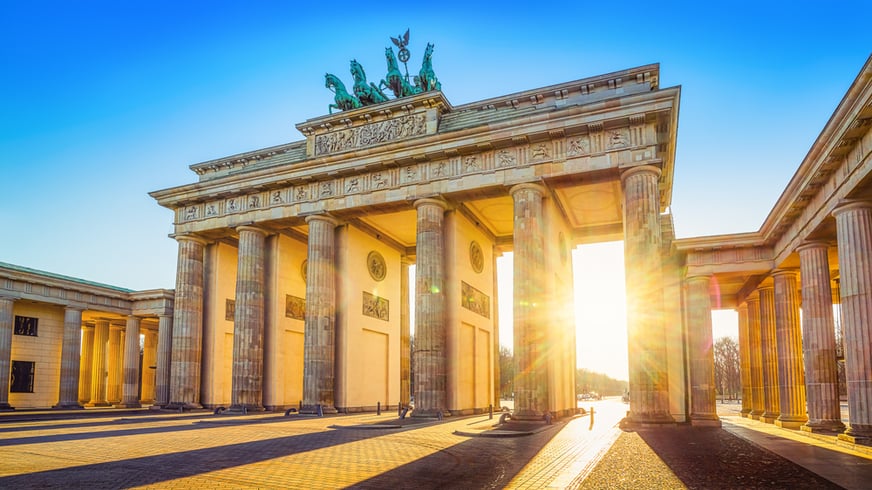
The huge Tiergarten is the city's largest park. Running through it is Strasse des 17 Juni, which leads to the famed Brandenburg Gate (just south of the Reichstag). On the southwestern fringe of the Tiergarten is the Berlin Zoo.
The Brandenburg Gate is the start of eastern Berlin's most celebrated street, Unter den Linden, the cultural heart of Berlin before World War II. It runs from west to east, leading to Museumsinsel (Museum Island), where the most outstanding museums of eastern Berlin, including the Pergamonmuseum, are situated.
Unter den Linden crosses another major artery, Friedrichstrasse. If you continue south along Friedrichstrasse, you'll reach the former location of Checkpoint Charlie, a famous border site of the Cold War days. No longer a checkpoint, it now has a little museum devoted to memories of the Berlin Wall.
Unter den Linden continues east until it reaches Alexanderplatz, the center of eastern Berlin, with its towering television tower, or Fernsehturm. A short walk away is the restored Nikolaiviertel (Nikolai Quarter), a neighborhood of bars, restaurants, and shops that evoke life in the prewar days.
Maps -- Good maps of Berlin can be purchased at bookstores or news kiosks, such as the Europa Press Center (a magazine and newspaper store in the Europa Center). One of the best maps is the Falk map, which offers full-color detail and comprehensive indexes (consequently, it's sometimes awkward to unfold and refold). Be sure to obtain an up-to-date map showing the most recent changes.
Finding an Address -- As for the numbering of streets in Berlin, keep in mind that the city sometimes assists you by posting the range of numbers that appears within any particular block, at least within major arteries such as the Kurfürstendamm. These numbers appear on the street signs themselves, which is a great help in finding a particular number on long boulevards. You won't find these numbers on street signs of smaller streets, however. Although some streets are numbered with the odds on one side and the evens on the other, many (including the Ku'Damm) are numbered consecutively up one side of the street and back down the other.
When to Go
Weather
In general, Berlin’s climate is relatively mild, but with some bitter cold spells in the winter (Dec-Feb) and some humid heat waves in the summer (June-Aug). June through September are the best months to visit in terms of weather, with temperatures generally fluctuating between 12°C and 18°C (53°F- 64°F). Spring can be slow to arrive, though sun-starved Berliners start sunbathing in the parks as early as April. September and early October often bring warm sunny days that keep the outdoor cafes open and busy. Winter tends to be gray and damp, sometimes with snow. Gray skies, with or without rain, are a possibility year-round. For current weather conditions in Berlin, visit www.berlin.de/wetter.
Berlin Calendar
Berlin remains culturally vibrant throughout the year, but note that nearly all of Berlin’s museums are closed on Monday. Many museums and attractions are closed December 25 and 26, and January 1. You may want to time your visit to coincide with one of the city’s yearly festivals. The Berlin International Film Festival (www.berlinale.de) showcasing the work of international directors, starts the second week in February and lasts for a week. In June, Berlin plays host to one of the largest Gay Pride festivals (www.regenbogenfonds.de) in Europe, featuring parades, performances, and street fairs. The Berliner Festwochen (Berlin Festival; www.berlinerfestspiele.de), which lasts from September through mid-October, brings an international roster of performing artists to Berlin for opera, symphony, and theatrical presentations. The annual Jazz-Fest Berlin (www.berlinerfestspiele.de), featuring some of the world’s finest jazz artists, starts the first week in November. Berlin’s Christmas Market, with outdoor stalls selling food, hot drinks and craft items, begins in early December and lasts through Christmas. To locate cultural events in Berlin and to purchase tickets online, visit www.visitberlin.com.
Getting Around
BY PUBLIC TRANSPORTATION -- Berlin is an enormous city, but it has an excellent public transportation system. Taking the S-Bahn (elevated train), U-Bahn (underground), or bus will get you anywhere you want to go. All of them use the same fare system. Berlin is divided into three tariff zones: AB (2.60€ for a single fare), BC (2.90€ for a single fare), and ABC (3.20€ for a single fare). A single AB ticket is good for most journeys in central Berlin. Buy your tickets at any U-Bahn or S-Bahn station and validate them in the station machines before you board. (The entire system runs on an honor system.) Tickets are good for 2 hours. For information on all forms of Berlin’s public transportation, call tel. 030/19-449, or visit www.bvg.de.
If you’re planning more than two trips on public transportation in Berlin, you’ll save money by buying a Tageskarte (day pass) for 6.70€–7.20€, depending on the number of zones you want. The Tageskarte is good for unlimited transportation within the zones you purchase it for. You can save euros on transportation and sightseeing with a Berlin WelcomeCard, which covers unlimited public transport in zones AB and gives reductions on 160 sights and attractions. A 48-hour, 72-hour, 5-day pass costs 19€/25€/32€. A 72-hour pass including admission to Museum Island’s galleries and museums costs 34€. The Tageskarte and Berlin WelcomeCard can be purchased at any Berlin Infostore. For more information visit www.berlin-welcomecard.com.
BY S-BAHN -- Speedy and efficient, S-Bahn trains (www.s-bahn-berlin.de) provide an enjoyable way to explore Berlin. The service comprises 15 routes, which feed into three main lines going east–west, north–south, and circling around central Berlin. Purchase and validate your ticket at one of the red or yellow ticket-validation machines on the platform before boarding. The S-Bahn operates from 4am to 12:30am, later at weekends. S-Bahn entrances are marked with an S in a green background. Some S-Bahn lines intersect with U-Bahn lines, so you can transfer from one to the other. The S-Bahn is particularly handy if you are traveling from Bahnhof Zoo in western Berlin to Mitte in eastern Berlin or southwest to Grunewald and the lakes.
BY U-BAHN -- U-Bahn underground trains (www.bvg.de) provide another fast and efficient way to get around Berlin. Ten lines run to more than 170 stations from 4am until midnight, later at the weekend. At peak times, trains depart every 3 to 5 minutes. U-Bahn entrances are marked with a U in a blue background. Validate your ticket in one of the validation machines before boarding.
BY BUS -- If you’re not in a hurry, Berlin’s buses are a great way to get about and enjoy the views, especially from the upper deck. Routes 100 and 200 are particularly scenic and travel from Bahnhof Zoo east to Mitte, passing many Berlin landmarks along the way. Buy your ticket before boarding, not on the bus. You can download routes from www.bvg.de.
BY TAXI -- Taxis wait outside major hotels, stations, and airports round the clock. Most drivers speak some English. There’s a minimum charge of 3.20€, plus 1.65€ per kilometer. If you’re going less than 2km (1 1/4 miles) and flag down the cab, ask for the Kurzstreckentarif (short-route fare); the driver should switch off the meter and charge no more than 4€. Reputable companies include TaxiFunk Berlin GmbH (tel. 030-44-33-22) and Funk Taxi Berlin (tel. 030-26-10-26).
BY CAR -- Once in central Berlin, there’s no need for a car; it’s cheaper, quicker, and more carbon friendly to use the excellent public transport network, even for day trips. Pay-and-display parking costs around 2.50€ per hour from 9am to 6pm or 8pm. Clearly display your ticket on the dash.
BY BICYCLE -- Berlin’s network of cycling trails makes biking a popular way to get around. Bikes are a fun, eco-friendly way of exploring the sights. Most S-Bahn and U-Bahn trains have a dedicated car for bikes, but you need to buy an additional reduced fare ticket to take the bike on public transportation.
ON FOOT -- With its grand avenues, pedestrian-only streets, leafy parks, squares, and riverside and canalside promenades, Berlin is a city best enjoyed and discovered on foot. For information on guided walking tours.
Fast Facts
ATMs -- There are plenty of ATMs for withdrawing cash 24/7. Maestro, Cirrus, and Visa cards are widely accepted, but be aware that your bank usually charge a hefty fee for withdrawals from a foreign bank.
Business Hours -- Most banks are open Monday through Friday 9am to 3pm. Most other businesses and stores are open Monday through Friday 9 or 10am to 6 or 6:30pm and Saturday 9am to 4pm. Some stores are open late on Thursday (usually 8:30pm).
Dentists -- If you need a dentist, ask your hotel concierge. For a dental emergency, call tel. 030/89004333.
Doctors & Hospitals -- You’ll find a list of Berlin hospitals and English-speaking doctors at www.doctorberlin.de. You can also locate an English-speaking doctor by calling tel. 01804/22552362. In case of a medical emergency, call tel. 030/310031. To summon an ambulance, dial tel. 112.
Emergencies -- To call the police, dial tel. 110. To summon an ambulance, dial tel. 112.
Internet Access -- Nearly all hotels and hostels offer Wi-Fi, often (but not always) free. Many bars and cafes also offer Wi-Fi (sometimes, as at Starbucks, free to customers). The Sony Center at Potsdamer Platz is a free Wi-Fi hotspot. For a list of other free hotspots, visit www.hotspot-locations.de.
Police -- The national police emergency number is tel. 110. For local police, dial tel. 030/46644664.
Newspapers & Magazines -- Newsstands carry “Zitty” and “Berlin-Programm,” both of which list current events taking place around the city. You can also check online at www.visitberlin.de.
Pharmacy -- Pharmacies (Apotheken) operate during normal business hours and post details of the nearest 24-hour pharmacy on their front door. At least one per district stays open all night. Central pharmacies include Pluspunkt Apotheke, Friedrichstrasse 60 (tel. 030/20-16-61-73), and Apotheke Berlin Hauptbahnhof (tel. 030/20-61-41-90). The website www.berlin.de lists pharmacies by district.
Post Office -- You’ll find post offices scattered throughout Berlin, with large branches at Bahnhof Zoo and Hauptbahnhof (main train station). Most post offices are open Monday through Friday 8am to 6pm and Saturday 8am to 1pm.
Safety -- Berlin is generally a safe city, but use common sense when you’re out and about. Keep an eye on your valuables in crowded places and public transportation and don’t walk alone at night, in parks and on dimly lit streets. If you’re driving, park your car in a secure lot or garage.
Telephones -- To make a local call, dial 030 (the three-digit city prefix in Berlin) followed by the number.
Toilets -- Clean public toilets are found throughout Berlin and at all train stations. In most of them you need a .50€ or 1€ coin to get through the turnstile or to unlock the stall door. It’s customary to tip attendants .50€.
Neighborhoods in Brief
Covering some 60 square miles, Berlin is one of the world’s largest cities. For first-time visitors, getting a handle on this sprawling metropolis can be difficult. Even though the Wall has been down since 1989, the first and simplest way to understand Berlin is still to think in terms of the old political boundaries of West and East.
Western Berlin Neighborhoods
Western Berlin’s glitziest artery was—and remains—the 4km-long (2 1/2-mile) boulevard known as Kurfürstendamm, or Ku’Damm for short. The train station Bahnhof Zoologischer Garten (Bahnhof Zoo for short), near the Ku’Damm, is the major transportation hub on the western side of the city and a good landmark for orienting yourself.
Tiergarten The area known as Tiergarten includes Berlin’s massive Tiergarten park and a business-residential district of the same name that is located near Bahnhof Zoo. Tiergarten park, originally intended as a backdrop to the grand avenues laid out by the German kaisers, stretches east and ends at the cultural center known as the Kulturforum, home of the Philharmonie (Philharmonic Hall), the famed Gemäldegalerie (Painting Gallery), the Neue Nationalgalerie (New National Gallery), and other museums. The park contains the Berlin Zoo in its southwest corner, and the landmark Siegessäule (Victory Column). Tiergarten’s eastern border ends at the Brandenburg Gate and the Reichstag (Parliament) building. This is one of the best areas in western Berlin for hotels and restaurants.
Charlottenburg The Charlottenburg district is the wealthiest and most commercialized in western Berlin. Along the famous Ku’Damm, which runs through it, you find the best concentration of hotels, restaurants, theaters, cafes, nightclubs, shops, and department stores. The 22-story Europa Center, a shopping center and entertainment complex (Berlin’s first, dating from the 1960s), rises just across the plaza from the Kaiser-Wilhelm-Gedächtnis Kirche (Memorial Church). Charlottenburg’s regal centerpiece is Schloss Charlottenburg (Charlottenburg Palace), with its lovely gardens and nearby museums: the Bröham Museum and the Berggruen Sammlung (Collection). Charlottenburg also is the home of the Deutsche Oper Berlin (German Opera House), one of Berlin’s three opera houses. Upscale shops, restaurants, and cafes fill the neighborhood around Savignyplatz, a tree-lined square a short walk north of Kurfürstendamm. Charlottenburg, which has plenty of hotels and pensions (B&Bs), makes a convenient base for visitors.
Kreuzberg For a long time the Kreuzberg neighborhood was the poorest and most crowded of western Berlin’s districts. Today, about 35 percent of its population is composed of Gastarbeiter (guest workers) from Turkey, Greece, and the former Yugoslavia, many of whom have now lived in Kreuzberg for 40 years or more. Starting in the 1960s and 1970s, the district became home to the city’s artistic countercultural scene. Although gentrification has changed Kreuzberg’s character, the neighborhood remains funky around the edges, with lots of bars and clubs. Kreuzberg is where you find the new Jüdisches (Jewish) Museum and the Mauermuseum Haus am Checkpoint Charlie, dedicated to the history of divided Berlin.
Schöneberg Like Kreuzberg, Schöneberg developed in the 19th century as an independent suburb for workers. After World War II, the area was rebuilt as a middle-class neighborhood. The borough is centrally located, close to the Ku’Damm, with good U-Bahn connections and many hotels and pensions. Berlin’s densest concentration of gay bars and clubs is in Schöneberg between Nollendorfplatz and Victoria-Luise-Platz.
Wilmersdorf The huge park called the Grünewald takes up the western portion of the borough of Wilmersdorf. This 38-sq.-km (15-sq.-mile) lake-filled forest begins just beyond the western edge of the Kurfürstendamm and is Berlin’s largest uninterrupted wooded area. Wannsee is the most popular lake for swimming and boating. Closer in, toward the Ku’Damm, Wilmersdorf is a quiet residential neighborhood filled with an assortment of hotels and pensions and plenty of low-key restaurants and cafes.
Dahlem Now the university district, Dahlem originally was established as an independent village to the southwest of Berlin’s center. You may want to come here to visit the Brücke Museum or the Ethnologisches (Ethnology) Museum.
Mitte & Eastern Berlin Neighborhoods
Mitte Called Berlin-Mitte, Stadtmitte (City Center), or just plain Mitte (Center), this is the central section of former East Berlin. Before the war and the division of the city, this area was, in fact, the center of Berlin and it has regained its former pre-eminence to such an extent that many visitors never visit the western side of the city. The oldest and most historic part of Berlin, Mitte has numerous cultural attractions and ever-expanding restaurant, club and arts scenes. If you really want to be where the action is, stay in Mitte.
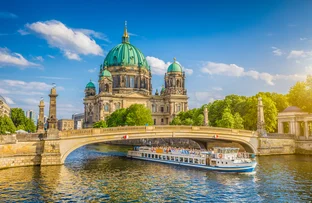
Mitte symbolically begins at Potsdamer Platz and the Brandenburg Gate, on the east side of Tiergarten park (the Reichstag is here, too). The grand boulevard called Unter den Linden, which starts at the Brandenburg Gate and extends east, is lined with 18th- and 19th-century palaces and monuments. (A new U-Bahn/subway line is being built on Unter den Linden, so expect construction for the next few years.) The Staatsoper Unter den Linden is the main opera house in eastern Berlin, and the Komische Oper, Berlin’s third opera house, is also located here. The elegantly proportioned, neoclassical square called Gendarmenmarkt, just off Unter den Linden, is home to the restored early-19th-century Konzerthaus am Gendarmenmarkt. Magnificent Museumsinsel (Museum Island), site of five major museums, anchors the eastern end of Unter den Linden and has been designated a UNESCO World Heritage Site. At the eastern terminus of Unter den Linden stands the grandiose Berliner Dom (Berlin Cathedral); across from it, on the site of the demolished GDR Palast der Republik, the city is now rebuilding the Prussian City Palace.
Friedrichstrasse, which intersects Unter den Linden, has regained its prewar status as eastern Berlin’s preeminent shopping street. U-Bahn and S-Bahn lines converge at Friedrichstrasse train station, the transportation hub of eastern Berlin (equivalent to Bahnhof Zoo in western Berlin). Hauptbahnhof, Berlin’s new main train station, is just north of Mitte in the Government Quarter.
Alexanderplatz, a square named for Russian Czar Alexander I, was the center of activity in the Soviet era. It’s now in the process of being completely redone and completely commercialized. One of Berlin’s Soviet-era landmarks, the Fernsehturm (TV tower), rises from Alexanderplatz; at 368m (1,207 ft.), it is still the highest structures in Europe. The Nikolaiviertel (Nicholas Quarter), just south of Alexanderplatz along the Spree River, is a charming area restored to look as it did (with some contemporary touches) in Berlin’s medieval and baroque eras. Taverns and riverside restaurants make this quarter ideal for a leisurely and picturesque stroll.
Prenzlauer Berg and Friedrichshain Prenzlauer Berg, northeast of Mitte, is now the hippest neighborhood in eastern Berlin, and a favored spot for young Berliners to live, with a burgeoning cafe and club scene. Friedrichshain, to the southwest of Prenzlauer Berg, is another old and formerly decrepit eastern Berlin neighborhood that is rapidly gentrifying and attracting young Berliners.