EvaL Miko / Shutterstock
Things To Do in D-Day Beaches
Bookstore

Available as paperback
and as e-book.
D-Day Beaches Attractions
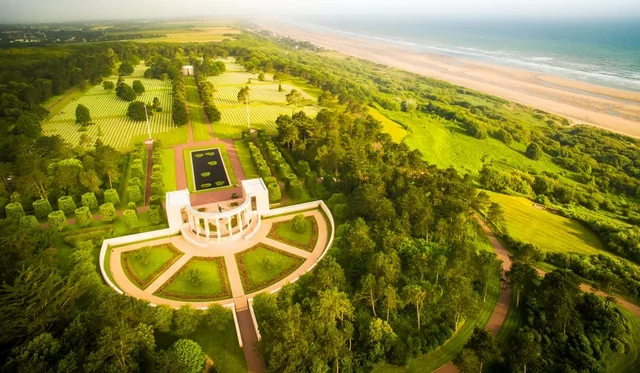
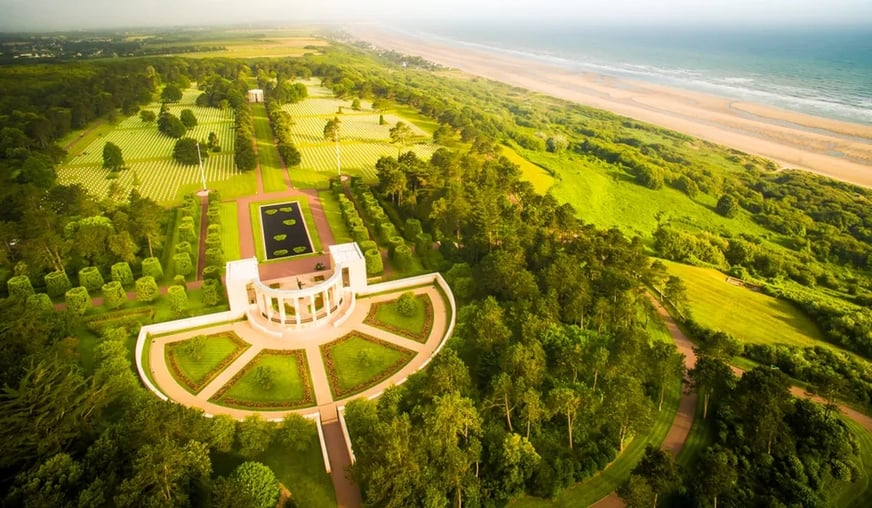
Few places in the world have a more concentrated—or more moving—selection of sights than Normandy’s D-Day Beaches. More than 30 memorials, cemeteries, and museums, which range from coastal batteries to museums dedicated to underwater military finds, are spread out along this 50km (31-mile) stretch of coast. The most spellbinding site for all nationalities is the Normandy American Cemetery and its visitor’s center, behind Omaha beach at Colleville-sur-Mer (www.abmc.gov; tel. 02-31-51-62-00). The graves of 10,000 Allies who liberated mainland France lie within 70 hectares (173 acres) of manicured grounds above the cliffs. The visitor center retells the dramatic story of the American landings—and those of British, Canadian, Polish, Free French, and other allies—on the morning of June 6, 1944. Most dramatic are the personal tales, often told via video and interactive displays. Make certain you leave enough time for a good look at the exhibitions—they really are captivating. Admission is free. The cemetery is open daily 9am to 6pm from April 14 to September 15, and until 5pm the rest of the year. Public access to Omaha Beach itself is no longer available from the memorial, but other public paths are nearby.
At the Overlord Museum, Colleville-sur-Mer (www.overlordmuseum.com; tel. 02-31-22-00-55), half a mile uphill from the Normandy American Cemetery, more than 10,000 pieces of matériel and 35 military vehicles are showcased in D-Day dioramas around a great hall. Admission is 9.50€ adults and 7€ students and children age 7 to 15; free for children 6 and under. Open daily 10am to 5:30pm February to March, November and December; 10am to 6:30pm April, May, and Sept; 9:30am to 7pm June to Aug; closed January.
Farther west along the coast, you’ll see the jagged lime cliffs of the Pointe du Hoc. A cross honors a group of American Rangers who scaled the cliffs using hooks to get at the gun emplacements. The pockmarked landscape has a lunar look, with giant craters showing where the bombs fell. Farther along the Cotentin Peninsula is the first beach to be stormed, Utah Beach, where the 4th U.S. Infantry Division landed at 6:30am. A U.S. monument commemorates their heroism and the Utah Beach Musée du Débarquement (utah-beach.com; tel. 02-33-71-53-35) offers moving, chronological displays of the D-Day landings. Open daily 10am to 5pm February to March; 10am to 6pm April and October to January; May to Sept 9:30am to 7pm; closed first two weeks December.
Eastward along the coast in the British invasion sector is the seaside resort of Arromanches-les-Bains. A deep-water port was deemed essential to Allied success, so in June 1944, two mammoth prefabricated ports known as Mulberry Harbours were towed across the Channel. The one that landed in Arromanches was nicknamed Port Winston. “Victory could not have been achieved without it,” Eisenhower later said. Indeed, in 10 months this “temporary” artificial harbor delivered 2.5 million men and countless vehicles into northern France. The wreckage is still visible just off the beach. The Musée d’Arromanches, pl. du 6-Juin (www.musee-arromanches.fr; tel. 02-31-22-34-31) opened in 2023 to replace the former D-Day landing musem. Within its fittingly austere glass and concrete frame are collections that illuminate the scale of the D-Day landings through maps, models, films, photos, and information about the technology used in the battle. Admission is 12.50€ adults and 8.20€ students and children age 6 to 18; free for children age 5 and under. Open May to August daily 9am to 7pm (until 6pm in Sept); February and November, and December 10am to 5pm; March and October 9:30am to 5:30pm; April 9am 6pm (closed Jan).
Eastward again through the British and Canadian invasion sectors is Musée Gold Beach, 2 pl. Amiral Byrd, Ver-sur-Mer (www.goldbeachmusee.fr; tel. 02-31-22-58-58). The museum focuses on the heroism of Britain’s RAF and Royal Navy and the meticulous Allied coordination that went into the D-Day landings. Admission is 4.50€ adults, 2.50€ students, 2€ children age 5 to 15; free for children age 4 and under. From April to October, hours are daily 10am-1pm and 2 to 6pm.
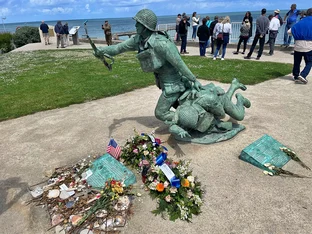
Just eastward along the coast in Courseulles-sur-Mer is the Centre Juno Beach, voie des Français Libres (www.junobeach.org; tel. 02-31-37-32-17). This gem of a museum details Canada’s entire war effort, with particular focus on the Battle of the Atlantic and the march through Germany. Outside the museum is a stark memorial to the Canadian dead of D-Day, their names inscribed simply on blue towers. Walk towards the beach and pause in front of the sculpture with the words to Paul Verlaine’s poem “Chanson d’Automne”: this was the code the BBC used to alert the French Resistance on June 5. Admission is 7.50€ adults and 6€ students and children, with reduced rates for visits only to the park or temporary exhibits. Hours are daily February to March and November to December 10am-5pm; April and May 10am-6:30pm; June to August 9:30am to 7pm; September to October 10am-6pm. Closed January.
At the Overlord Museum, Colleville-sur-Mer (www.overlordmuseum.com; tel. 02-31-22-00-55), half a mile uphill from the Normandy American Cemetery, more than 10,000 pieces of matériel and 35 military vehicles are showcased in D-Day dioramas around a great hall. Admission is 9.50€ adults and 7€ students and children age 7 to 15; free for children 6 and under. Open daily 10am to 5:30pm February to March, November and December; 10am to 6:30pm April, May, and Sept; 9:30am to 7pm June to Aug; closed January.
Farther west along the coast, you’ll see the jagged lime cliffs of the Pointe du Hoc. A cross honors a group of American Rangers who scaled the cliffs using hooks to get at the gun emplacements. The pockmarked landscape has a lunar look, with giant craters showing where the bombs fell. Farther along the Cotentin Peninsula is the first beach to be stormed, Utah Beach, where the 4th U.S. Infantry Division landed at 6:30am. A U.S. monument commemorates their heroism and the Utah Beach Musée du Débarquement (utah-beach.com; tel. 02-33-71-53-35) offers moving, chronological displays of the D-Day landings. Open daily 10am to 5pm February to March; 10am to 6pm April and October to January; May to Sept 9:30am to 7pm; closed first two weeks December.
Eastward along the coast in the British invasion sector is the seaside resort of Arromanches-les-Bains. A deep-water port was deemed essential to Allied success, so in June 1944, two mammoth prefabricated ports known as Mulberry Harbours were towed across the Channel. The one that landed in Arromanches was nicknamed Port Winston. “Victory could not have been achieved without it,” Eisenhower later said. Indeed, in 10 months this “temporary” artificial harbor delivered 2.5 million men and countless vehicles into northern France. The wreckage is still visible just off the beach. The Musée d’Arromanches, pl. du 6-Juin (www.musee-arromanches.fr; tel. 02-31-22-34-31) opened in 2023 to replace the former D-Day landing musem. Within its fittingly austere glass and concrete frame are collections that illuminate the scale of the D-Day landings through maps, models, films, photos, and information about the technology used in the battle. Admission is 12.50€ adults and 8.20€ students and children age 6 to 18; free for children age 5 and under. Open May to August daily 9am to 7pm (until 6pm in Sept); February and November, and December 10am to 5pm; March and October 9:30am to 5:30pm; April 9am 6pm (closed Jan).
Eastward again through the British and Canadian invasion sectors is Musée Gold Beach, 2 pl. Amiral Byrd, Ver-sur-Mer (www.goldbeachmusee.fr; tel. 02-31-22-58-58). The museum focuses on the heroism of Britain’s RAF and Royal Navy and the meticulous Allied coordination that went into the D-Day landings. Admission is 4.50€ adults, 2.50€ students, 2€ children age 5 to 15; free for children age 4 and under. From April to October, hours are daily 10am-1pm and 2 to 6pm.
Just eastward along the coast in Courseulles-sur-Mer is the Centre Juno Beach, voie des Français Libres (www.junobeach.org; tel. 02-31-37-32-17). This gem of a museum details Canada’s entire war effort, with particular focus on the Battle of the Atlantic and the march through Germany. Outside the museum is a stark memorial to the Canadian dead of D-Day, their names inscribed simply on blue towers. Walk towards the beach and pause in front of the sculpture with the words to Paul Verlaine’s poem “Chanson d’Automne”: this was the code the BBC used to alert the French Resistance on June 5. Admission is 7.50€ adults and 6€ students and children, with reduced rates for visits only to the park or temporary exhibits. Hours are daily February to March and November to December 10am-5pm; April and May 10am-6:30pm; June to August 9:30am to 7pm; September to October 10am-6pm. Closed January.