Things To Do in Girona
Bookstore
Available as paperback
and as e-book.
Girona Attractions
From the parking lot or the train station, it’s an easy walk across the pedestrian bridges on the Riu Onyar into the old city (Barri Vell). You’ll soon reach Plaça de Sant Feliu, the old city’s gathering point in front of the Basilica de Sant Feliu, with its distinctive truncated spire. Note the worn, 12th-century sculpture of a lioness, la Lleona, mounted on a stone column. Tradition says that a Gironan returning from a journey must kiss the statue’s behind to prove their good citizenship. A post-Covid sign forbids it, but plenty still do.
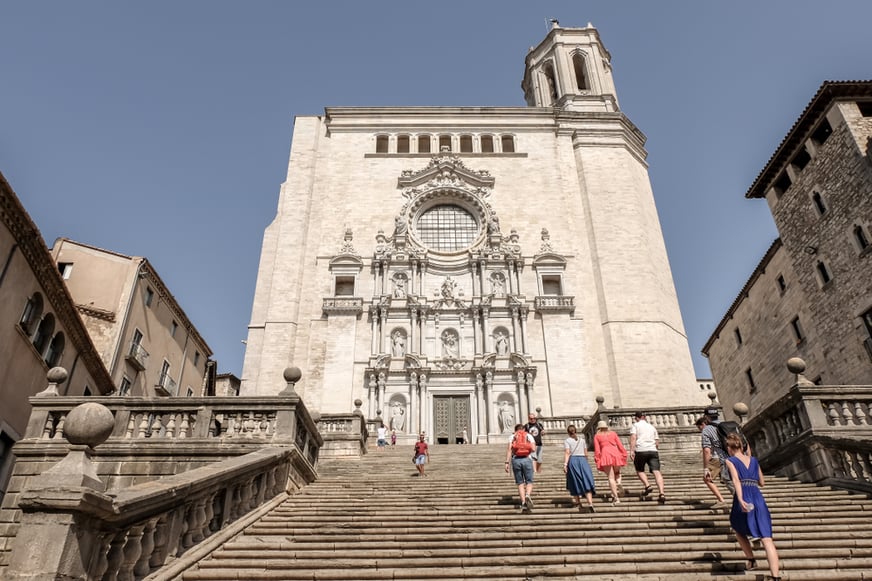
A good way to get your bearings is to climb past the church and stroll a section of the much-besieged medieval walls, les Muralles, with great views over the city towards the Pyrenees. Then drop down to the plaza in front of the Catedral de Girona (see above), the centerpiece of the old city.
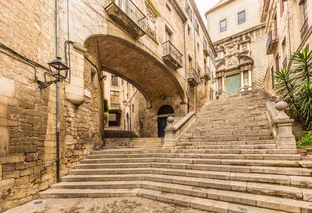
Girona’s medieval prosperity came in large part from its Jewish community, which was concentrated in El Call, the labyrinth of atmospheric alleyways between the cathedral and the river. From here, La Rambla de la Llibertat runs parallel to the river past smart shops and restaurants toward the stone arcades of Plaça de Vi.
The modern city lies on the west bank of the Onyar. Its main shopping street, Carrer de Santa Clara, leads back along the river to the lively square of Plaça de la Independència, surrounded by terraced cafés. As you complete the loop around the old city, you’ll see the much-photographed stretch of pastel-painted houses, the Cases de l’Onyar, that back onto the water.

12 Results
- Church/Art Museum
Basilica de Sant Feliu
A church has stood on this site since the early days of Christianity, and until the 10th century this was the city’s cathedral. It is dedicated to Saint Felix, martyred in Girona at the beginning of the 4th century. Eight Roman and early Christian sarcophagi are housed within, one of… - Historic Site
Casa Masó
No visitor leaves Girona without a photograph of the picturesque pastel houses along the Riú Onyar. But with a little advance planning, you can also visit one of these iconic homes. Casa Masó, which consists of four houses combined in the late 19th and early 20th centuries, was the… - Cathedral
Catedral de Girona
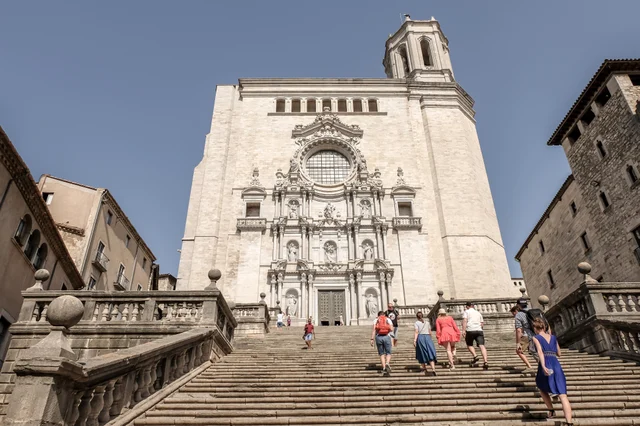
Girona’s magnificent cathedral is worth at least a couple of hours of your time, but first you’ve got to get there. The steep, 90-step staircase that leads up to the Baroque façade is not for the fainthearted (wheelchair access is via Plaça dels Apostols). (Fitness enthusiasts race… - Historic Site
Els Banys Àrabs
Despite the Arab reference in the name, these baths were built around 1194, almost two centuries after the Muslims were driven from Girona. They are a rare and remarkably well-preserved example of medieval civic architecture following Roman and Arab bathing traditions. The site is… - Religious Site
Església de Sant Feliu
Eight Roman and early Christian sepulchers are the main attractions of this Romanesque church with Gothic flourishes. In fact, the two oldest date from the 2nd century a.d. and one shows Pluto carrying Persephone to the underworld. Inside, a chapel contains the remains of city patron… - Museum
Museu del Cinema
The Catalan film technician and aficionado Tomàs Mallol assembled this collection of more than 20,000 artifacts relating to the art of moving pictures, acquired by the city in 1994. It covers the period from the mid-17th century through 1970, from Chinese shadow puppets through… - Museum
Museu dels Jueus
The Jewish population of Girona flourished in the 12th century, when scholars, including the great rabbi Nahmanides, established one of Europe’s most important philosophical centers of Kabbalistic mysticism. In keeping with European tradition, the Jewish Quarter, or “Call,” grew up… - Museum
Museu d’Arqueologia
Everyone from the Iberians, Greeks, and Carthaginians to the Romans, Visigoths, and Muslims passed through Girona and its surrounding countryside at some point, and the thorough collections of this regional branch of the Museu d’Arqueologia de Catalunya chronicle them all. The museum… - Museum
Museu d’Art de Girona
In a grand episcopal palace next door to the cathedral, this wonderful museum contains some 8,500 pieces of Catalan art, from vivid 12th century Romanesque panels through Baroque polychrome sculpture to contemporary paintings of Girona’s famous riverside houses. One fascinating… - Museum
Museu d’Història de Girona
This collection covers the sweep of local history and prehistory from the flint and iron tools of the first Neolithic peoples through the glories of medieval Girona to the dark days of the Spanish Civil War, when the city built an underground shelter to protect its children from… - Museum
Museu d’Història dels Jueus
The Jewish population of Girona flourished in the 12th century when scholars, including the great rabbi Nahmanides, made it one of Europe’s most important centers of Kabbalistic study. In keeping with European tradition, the Jewish quarter, El Call, grew up in the protective shadow… - Landmark
Pont de les Peixateries Velles
The old fishermen’s bridge, better known as the Eiffel bridge, was constructed in his trademark iron latticework by Gustave Eiffel in 1876, a decade before he built his famous tower in Paris. As you walk across the red-painted pedestrian bridge connecting Rambla de la Llibertat and…
Girona Shopping
Consistent with its role as an international seaside resort, Girona has a network of shops catering to everything from sportswear to formal wear. The most appealing shopping street is Carrer Santa Clara.
If handicrafts appeal to you, consider a 32km (20-mile) eastward trek from Girona to the hamlet of La Bispal, more or less midway between Girona and the town of Palamos. (From Girona, follow the signs pointing to Palamos.) Here, in rows of simple shops, dozens of artisans display and sell artfully rustic ceramics, some of which are too bulky to ship, others that can be packed in your carry-on luggage.
Girona Nightlife
Central Girona has a good number of tapas bars and cafes, some of which don't have easily distinguishable names. Many are scattered along La Rambla, around the edges of the keynote Plaça de Independencia, and within the antique boundaries of the Plaça Ferrán el Católic. Moving at a leisurely pace from one to another is considered something of an art form in the sultry heat of Girona's early evenings.
One of the most appealing things to do in Girona after dark, at least between June and September, is to cross the river into the verdant precincts of Parque de la Devesa, an artfully landscaped terrain of stately trees, flowering shrubs, kiosk-style refreshment stands, and open-air bars.