Jason Rothe / Shutterstock
Planning a trip to Granada
Iberia (tel. 91-333-67-01) operates multiple daily flights to Granada from Madrid, while Vueling (tel. 80-720-01-00) offers regular direct flights from Barcelona and international flights from London Gatwick and Paris Orly. Federico García Lorca Airport is 17km (10mi.) west of the city center. A bus service marked “Aeropuerto” links the airport to the center of Granada (trip time: 45 mins, fare 3€). A taxi will cost around 25€.
Granada is well connected by train to the main Spanish cities, especially others in Andalucía. There are around nine trains daily from Sevilla (trip time: 2[bf]½ hr., from 45€); nine from Córdoba (trip time: 1hr. 45min., from 26€), and four from Madrid (trip time: 3[bf]½–4 hr., from 30€). The train station is on Avenida de Andaluces, s/n (renfe.es; [tel] 91-232-03-20). It’s a 30 minute walk to Plaza Nueva, or take bus Line 4.
The main bus terminal, Estación de Autobuses de Granada, Avenida Juan Pablo II, s/n, has excellent links to most major towns and cities in Andalucía and to Madrid. There are frequent buses daily from Sevilla (trip time: 3 hr., from 27€), from Córdoba (trip time: 2hr. 45mins, from 18€), from Malaga (trip time 1hr. 45min., from 14€) and from Madrid’s Estación Sur (trip time: 4[bf]½–5hr., from 23€). For bus information, contact Alsa (alsa.es; [tel] 90-242-22-42).
By car, Granada is around 4 hours 15 minutes south of Madrid via the A-4 and A-44. From Sevilla, on the A-92 heading east, the journey takes around 2 hours and 30 minutes; from Córdoba, via the A-45 and A-92 around 2 hours and 15 minutes; from Málaga, on the A-92 around 1 hour and 30 minutes. Driving in the old center of Granada can be tricky and parking is expensive. Parking San Augustín (telpark.com) near the cathedral costs 33€ a day. Ask your hotel about possible discounts. The large car park next to the Alhambra (parkia.es) costs 22€ per day.
The municipal Oficina de Turismo, Plaza de Santa Ana (tel. 95-824-82-80) is open Monday to Friday 9am to 7:30pm, Saturday and Sunday 9:30am to 3pm. For information on both the city and surrounding area, the regional tourist office, Patronato Provincial de Turismo de Granada, Calle Cárcel Baja, 3 (tel. 95-824-71-28), is open Monday to Friday 9am to 8pm, Saturday 10am to 7pm, Sun 10 to 3pm.
Granada City Layout
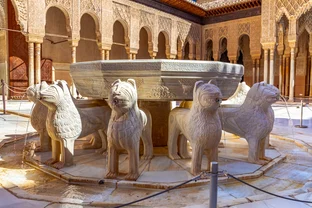
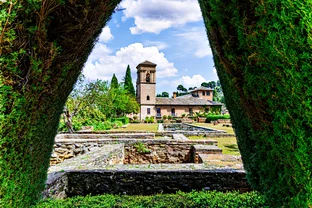
Essentially Granada is divided into upper and lower towns. Crowning the city is the Alhambra district, dominated by -- you guessed it -- the fortress palace of the Alhambra. The upper city is composed of two hills facing each other across the narrow gorge of the Río Darro. On the southern hill stands the Alhambra itself and the nearby summer palace of the Generalife, also once the gardens of the Nasrid kings.
The old Arab quarter occupies the second or northern hill, the Albaicín, a former ghetto that's now a rapidly gentrifying district with many fashionable restaurants and boutique hotels. Expect tiny alleyways, otherwise known as streets, and whitewashed houses. Ancient Arab baths and the remains of the old Moorish walls can still be seen.
Another satellite hill leads off from the Albaicín, wandering into the Sacromonte district, long a haven for Granada's famous Gypsies. A warren of little whitewashed homes trails out to a rocky mountainside riddled with caves.
Cuesta de Gomérez is one of the most important streets in the lower town, often called the Cathedral district. This is centro Granada, or "downtown," as Americans say. Congested and compact, it is relatively easy to navigate. This is Granada's business center, home to most of its restaurants, shops, and hotels. It climbs uphill from the Plaza Nueva, the center of the modern city, to the Alhambra. At the Plaza Nueva the east-west artery, Calle de los Reyes Católicos, goes to the heart of the 19th-century city and the towers of the cathedral. Granada's principal north-south artery is the Gran Vía de Colón.
Calle de los Reyes Católicos and the Gran Vía de Colón meet at the circular Plaza de Isabel la Católica, graced by a bronze statue of the queen offering Columbus the Santa Fe agreement, which granted the rights to the epochal voyage to the New World. Going west, Calle de los Reyes Católicos passes near the cathedral and other major sights in the downtown section of Granada. The street runs to Puerta Real, Granada's commercial hub, with many stores, hotels, cafes, and restaurants.
Getting Around
Walking is about the only way to get around most neighborhoods, especially the hilly Albaicín and the Alhambra. For Greater Granada, a bus or taxi will have to do. It's impossible to get around Granada by driving. A rented car is best left for exploring the surrounding Sierra Nevada.
If you must, grab a taxi. Taxis can be hailed in the streets; a green dome light indicates the vehicle is free. Taxis often line up outside first-class hotels, in the vicinity of the Alhambra, and at the landmark Plaza Nueva. Taxis are relatively inexpensive, costing about 8€ to go from Plaza Nueva to the Alhambra.
Even better: rely on Granada's small-scale red buses, which race through its narrow streets, will take you pretty much anywhere you need to go. C30 and C32 buses run continuously from Plaza Isabel la Católica to the ticket office of the Alhambra, while C31 and C34 buses leave Plaza Nueva for Albaicín and Sacromonte. The standard fare is 1.60€, but it’s even lower if you buy a multi-trip travel card (Tarjeta Credibus), available at tobacconists and newspaper kiosks.
Fast Facts
Bookstore -- The best English-language outlet is Metro, Calle Gracia 31 (tel. 95-826-15-65), which has a large section, including travel guides and maps, in its English-language department. Open Monday to Friday from 10am to 2pm and 5 to 8:30pm, Saturday 11am to 2pm.
Consulates -- The nearest are in Seville.
Currency Exchange -- The best and most central office is the Banco Santander Central Hispano, Gran Vía 3 (tel. 95-821-73-00; www.santander.com), open May to September Monday to Friday 9am to 2pm; October to April Monday to Saturday 9am to 2pm. You'll find 24-hour ATMs at Puerta Real and Plaza de Isabel la Católica.
Emergencies -- For emergencies that necessitate the police, the fire department, or an ambulance, dial tel. 112.
Hospital -- The town's biggest is the Hospital Clínico, Av. de Madrid s/n (tel. 95-802-30-00).
Internet Cafe -- One of Granada's largest and best maintained is NavegaWeb Café, Calle de los Reyes Católicos 55 (tel. 95-821-05-28).
Newspapers -- Daily newspapers edited and published in Granada include the right-of-center Ideal and La Opinión, and the slightly left-of-center Granada Hoy. For listings of the cultural events presented in and around Granada, pick up a copy of Guía de Granada del Ocio.
Pharmacy -- A large 24-hour pharmacy in the town center is Farmacia Tallon, Recogides 48 (tel. 95-825-12-90). A slightly smaller option is Farmacia Oeste, Doctor Olorez 1 (tel. 95-828-75-75).
Post Office -- Called Correos Granada, the main post office is at Puerta Real 2 (tel. 95-822-11-38). It's open Monday to Friday 8:30am to 8:30pm and Saturday 9:30am to 2pm.
Telephones -- Pay phones are scattered throughout Granada. A local call requires .20€ (30¢) for the first 3 minutes. Many pay phones also accept phone cards, available at local tobacco stands and news kiosks in increments of 6€ ($9.60), 12€ ($19), and 21€ ($34). For directory assistance for phone numbers within Spain, call tel. 11818 or 11888.
Toilets -- Granada has just a handful of public toilets. Most are along the Paseo Violon, near Congress Hall. Insert a .20€ (30¢) coin to open the door. Otherwise, duck into the nearest bar or cafe to buy a coffee or bottle of water as part of the process.