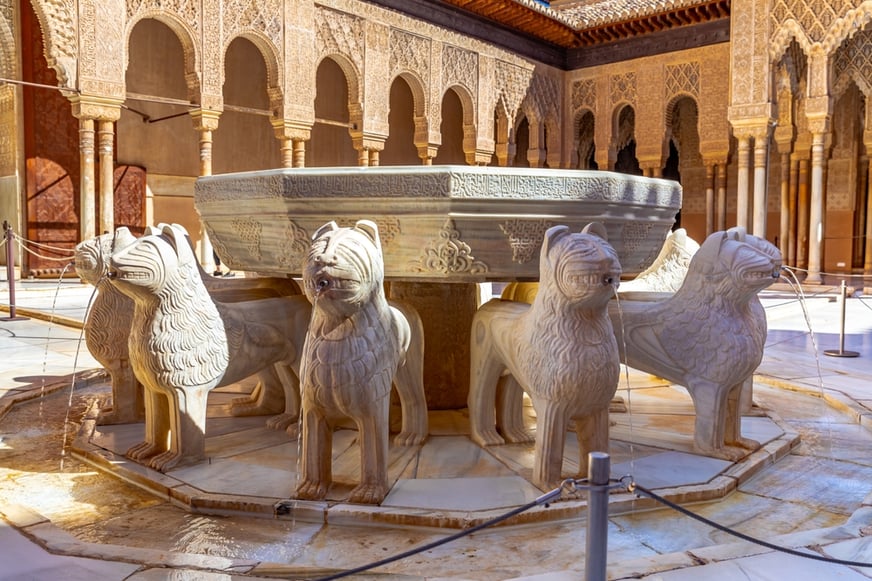
Bookstore

Available as paperback
and as e-book.
Granada Attractions
Having ticked off the Alhambra and Generalife, many visitors get straight back onto the tour bus and leave town. But Granada is one of Spain’s most vibrant and interesting cities, and it would be a pity to overlook it. After visiting the Alhambra, aim to spend at least a full day and evening exploring the city. As you’ll see, some visitors have been so captivated they’ve decided to spend the rest of their lives here.
As with any place where tourism is the mainstay, parts of Granada are overrun with tourist shops and dispiriting restaurants, but this smallish city has a strong identity of its own, and an earthy enthusiasm for food and drink. Downtown, away from the Alhambra and the hillside barrios, it is an easy and enjoyable place to stroll around, especially if you are hopping from bar to bar, enjoying the city’s famously free tapas.
Where to Stroll in Granada
Despite its name, the oldest square in Granada is Plaza Nueva, which was the site of the woodcutters’ bridge in the Muslim era. Today, the river Darro runs beneath the square. On its east side is the 16th-century Iglesia de Santa Ana built by Diego Siloé. Many visitors begin here—the tourist office is on the corner and English-speaking guides tout for business. If you don’t have time for a tour, walk a couple of minutes northeast along the banks of the Darro to Paseo de los Tristes for your first proper view of the Alhambra. Its name, meaning Promenade of the Sad, was coined in the 19th century when funeral processions passed along it on their way to the cemetery up the hill.
The most-walked street in Granada is Carrera del Darro, running north along the Darro River. It was discovered by the Romantic artists of the 19th century; many of their etchings (subsequently engraved) of scenes along this street were widely circulated, doing much to spread the fame of Granada throughout Europe. You can still find some of these engravings in musty antiques shops. Carrera del Darro ends at Paseo de los Tristes (see above).
Puerta de Elvira is the gate through which Ferdinand and Isabella made their triumphant entry into Granada in 1492. It was once a grisly place, with the rotting heads of executed criminals hanging from its portals. The quarter surrounding the gate was the Arab section (morería) until all the Arabs were driven out of the city after the Reconquista.
One of the most fascinating streets is Calle de Elvira; west of it the Albaicín (old Arab quarter) rises on a hill. In the 17th and 18th centuries, many artisans occupied the shops and ateliers along this street and those radiating from it. On Calle de Elvira is the Iglesia de San Andrés, begun in 1528, with a Mudéjar bell tower. Much of the church was destroyed in the early 19th century, but several interesting paintings and sculptures remain. Another old church in this area is the Iglesia de Santiago, constructed in 1501 and dedicated to St. James, patron saint of Spain. Built on the site of an Arab mosque, it was damaged in an 1884 earthquake. The church contains the tomb of architect Diego de Siloé (1495-1563), who did much to change the face of the city.
Bargain Sightseeing Passes
If you plan to spend a few days in the city, the Granada Card tourist pass (tel. 85-888-09-90) offers big savings, giving you access to more than a dozen key sites—including the Alhambra—plus nine free bus trips. The 72-hour pass at 56.57€ includes the most sites. The 24-hour pass at 46.92€ offers a night visit of the Alhambra, but you may struggle to get around all the sites in one day and make it pay. Buy online or at bus ticket vending machines.
For Granada’s Christian monuments, including the Catedral, Capilla Real, and Monasterio de la Cartuja , you’ll save a few euros if by buying a combined ticket online (tel. 95-821-59-09). The deal covers six churches, including Albaicín’s Iglesia de San Nicolas and its tower, from where you can get spectacular sunset views (check website for evening schedule, which varies). A combined ticket for four monuments costs 21€; all six costs 30€. For all sites, you’ll need to select timed slots, so make sure you allow enough time to get from one to another—and note that the Monasterio de la Cartuja is out of town.
Andalusia's Greatest View
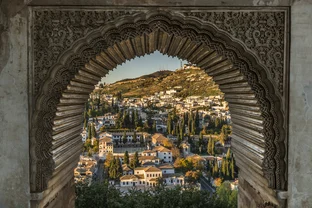
It's a tradition at sunset to flock to the Mirador de San Nicolás for what is arguably the greatest view in Andalusia. Tiled rooftops drop to the Darro River. On the far side is the Alhambra, which, if the night is right, seems so red in the dying glow it almost appears in flames. In the distance loom the snowcapped peaks of the Sierra Nevada. To reach this spot from Peso la Harina, head northwest along Calle Salvador until you reach Calle Abad. At this point turn left (west), which will lead into San Nicolás.

12 Results
- Religious Site
Abadía del Sacromonte
Crowning the Sacromonte (Sacred Hill) is this dilapidated abbey. Originally, this was a Benedictine monastery, and the ashes of San Cecilio, the patron saint of Granada, are stored inside. - Neighborhood
Albaicín
Also known by its Arabic name Albayzín, this ancient hillside barrio atop one of the Granada's two hills stands apart from the city. It is a relic of the Nasrid empire, predating the Renaissance city that sprang up around the cathedral. After the Christian reconquest it became home… - Historic Site
Alhambra and Generalife
Qalat al-Hamra (the Red Castle) is perhaps the most beautiful fortress ever built. Originally constructed for defensive purposes on a rocky hilltop above the Darro River, it was converted into a palace by the first Nasrid emir Ibn al-Ahmar in 1238 and extended by succeeding rulers… - Landmark
Baños Arabes El Bañuelo
One the oldest buildings in Granada, the 11th century “baths of the walnut tree” are among the best-preserved Arab baths on the Iberian peninsula. It is remarkable that they escaped destruction during the reign of the Catholic Monarchs, who considered public bathing decadent. Many of… - Historic Site
Casa Museo Manuel de Falla
The composer Manuel de Falla (1876-1946) lived in this charming whitewashed house on the Alhambra hill. His villa -- called a carmen -- is pretty much as he left it and is filled with memorabilia. You can see his piano and his original furniture, along with photographs, manuscripts,… - Historic Site
Casa de los Tiros
The "House of Shots" is a fortresslike palace that is Renaissance in its architecture, dating from the 1500s. Its name comes from the musket barrels protruding from its facade. Once it was owned by a noble family who was given the Generalife after the Reconquest of Granada. Their… - Historic Site
Casa-Museo Federico García Lorca (Huerta de San Vicente)
Poet/dramatist Federico García Lorca, author of Blood Wedding, The House of Bernarda Alba, and A Poet in New York, spent many happy summers with his family here at their vacation home. He moved to Granada in 1909, a dreamy-eyed schoolboy, and was endlessly fascinated with its life,… - Cathedral
Catedral and Capilla Real
Granada’s Renaissance cathedral feels too big for its setting, boxed in and partially hidden by later buildings. It was begun in 1523 on top of the city’s main mosque and not completed until 1704. It was largely designed by Diego de Siloé and later by Granada’s Alonso Cano, known as… - Religious Site
Monasterio de San Jerónimo
Following the Reconquest of Granada by Ferdinand and Isabella, this was the first monastery to be founded. Dating from the 16th century, the restored monastery-church is one of the grandest buildings designed by Diego de Siloé. Its public cloister represents a magnificent use of… - Religious Site
Monasterio de la Cartuja
This 16th-century monastery, off the Albaicín on the outskirts of Granada, is sometimes called the “Christian answer to the Alhambra” because of its ornate stucco and marble and the baroque Churrigueresque fantasy in the sacristy. You can’t help but thinking its architects and… - Museum
Museo Arqueológico de Granada
One of Spain’s oldest archaeological museums, this well-presented gallery on the banks of the Darro inhabits the 16th century Casa de Castril, a Renaissance palace with a fine façade (pictured) and patio. Its collection of artifacts ranges from a prehistoric skull fragment belonging… - Neighborhood
Sacromonte
Hundreds of Romani once lived on the “Holy Mountain” on the outskirts of Granada above the Albaicín. The mountain was named for the Christians martyred here and for its long-ago role as a pilgrimage site. Many of the caves were heavily damaged by rain in 1962, forcing most occupants…
Granada Shopping
Near the cathedral in the lower city, the narrow alleys of the Alcaicería, once the Moorish silk market, are filled with souvenir shops selling identical mass-produced trinkets. It’s a similar story on Calderería Vieja, which has the feel of a Moroccan souk.
To find something more authentic, head to Artesano Manuel Morillo, Calle Ánimas, 1 (tel. 95-822-57-15) where you can watch traditional marquetry (taracea) boxes and chess boards being made. The process consists of tiny pieces of bone and colored hardwoods being arranged into geometric patterns and glued into wooden frames. Small boxes start at around 25€, but you'll also find elaborately patterned, and very beautiful, trays, chess sets, picture frames, and more, as well as large, heirloom-quality chests of drawers, each emulating a different 17th-century Iberian design and each selling for several thousand euros.
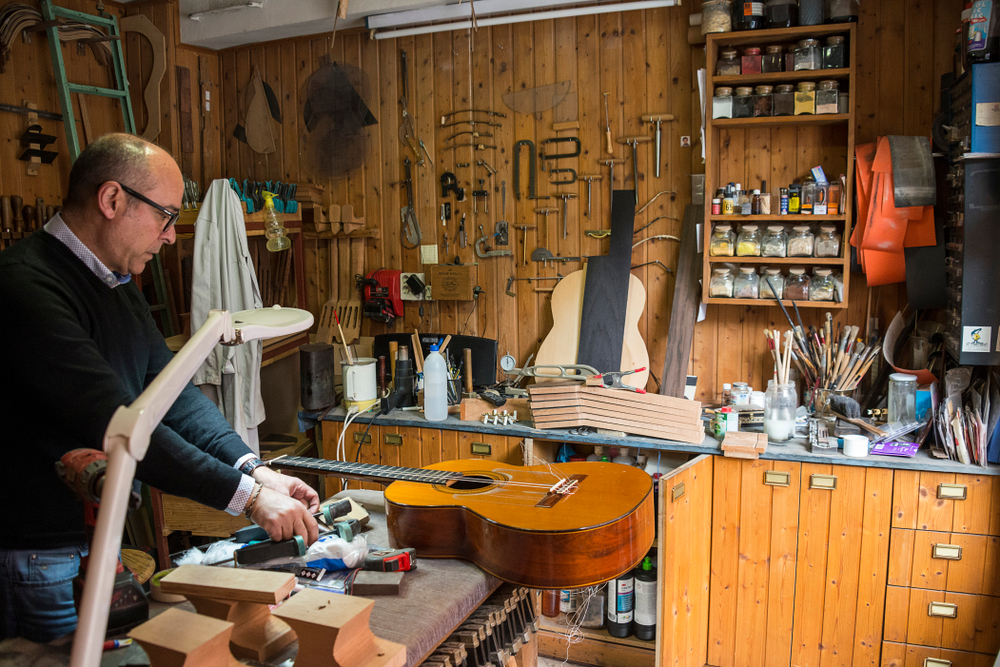
Granada and the art of guitar making have always been intricately intertwined. Even if you don't want to haul a guitar back from Andalusia, you might want to check out the neighborhood where they're manufactured. Guitarrería Gérman Pérez, Cuesta de Gomérez, 10 (tel. 95-822-70-33), or Guitarras Bellido, Paseo de las Palmas, 5 (tel. 69-371-24-23) are the two shops serious musicians patronize today. Prices for their fine instruments are high, but you could settle for a pair of wooden castanets.
El Rocío, Calle Capuchinos, 8 (tel. 95-826-58-23), is where granadinos get their flamenco gear for festivals, and they also sell accessories like fans and combs. At Patio de los Perfumes, Carrera del Darro, 5 (tel. 95-807-02-31) you can concoct your own perfume and take a tour of the historic workshop.
Salvador Aznar / Shutterstock
For edible gifts, López Mezquita, Calle de los Reyes Católicos, 39 (tel. 95-822-12-05), is a grand old pastelería selling beautifully packaged cakes and sweets. Browse the picturesque sShops and stalls near the cathedral for loose teas and traditional Arab spices.
Granada Nightlife
Watching the sun set from the Mirador San Nicolás is one of the special experiences in this city. But once you have seen the Alhambra glow from the reflected light, the night will still be young.
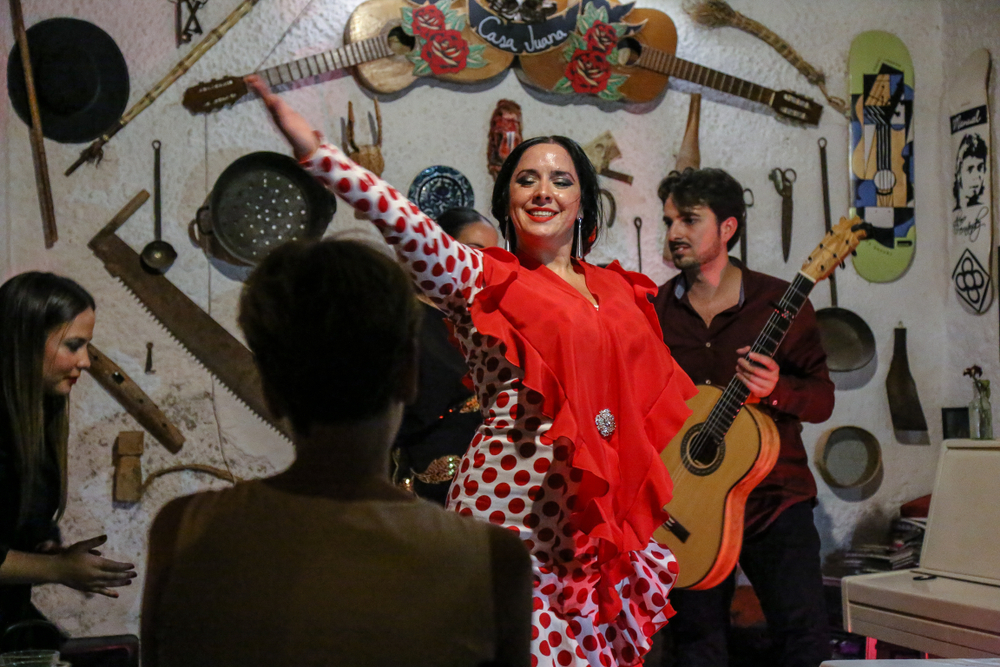
When it comes to flamenco, Granada will spoil you for choice—you’ll be handed flyers wherever you wander. For a unique experience, head to Sacromonte, where you can see the haunting zambra style performed inside a Romani cave. Among several options, Cuevas Los Tarantos, Camino del Sacromonte, 9 (tel. 95-822-45-25), stands out for passion and professionalism, with nightly shows at 7pm, 9:15pm and 10:30pm. Tickets, including a drink, cost 28€ adults, 22€ children aged 6–12, 10€ children aged 3–5. If you prefer to see a show in town, the current consensus is that Casa Ana, Calle Cárcel Alta, 7 (tel. 85-871-47-53) has the best quality tablao. The name refers to the wooden board on which the dancers stamp their rhythms, denoting an intimate show. Shows are at 5:30pm, 7:15pm, and 9pm and cost 25€ adults, 15€ children aged 5–12. A good option for flamenco with dinner in Albaicín is Los Jardines de Zoraya, Calle Panaderos, 32 (tel. 95-820-62-66), where the performance takes place in a lovely flower-filled patio. Shows are daily at 6pm, 8pm, and 10pm and cost 25€ adults, 15€ children 7–12, free for children under 7. You can choose tapas, or a set menu from 32€.
Sylvia Biskupek / Shutterstock
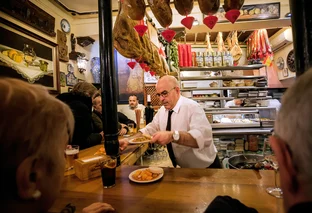
If you enjoy barhopping, Granada is for you. Wander loosely south from Calle Elvira towards the Genil River and you’ll discover dozens of atmospheric bars serving good regional wine, home-made vermouth, and in most cases, free tapas. Here are six of the best: Bodegas Castañeda, Calle Almireceros, 1; Casa Julio 1947, Calle Hermosa, 5; Casa de Vinos La Brujidera, Calle de Monjas de Carmen, 2; Cisco y Tierra, Calle Lepanto, 3; Enoteca Pacurri, Calle Gracia, 21; and Taberna Granados. For a guided visit to seek out some hidden gems, contact Granada Tapas Tours (tel. 61-944-49-84; from 60€ ).
If you’d prefer a mint tea, there are Moroccan-style teashops (teterías) dotted around the Albaicín, especially on Calle Calderería Nueva. For atmosphere, Arab pastries, and hookah pipe-smoking (cachimba), try Tetería Nazarí, Calle Calderería Nueva, 14, or Tetería del Bañuelo, Calle Bañuelo, which has a pleasant patio with views of the Alhambra.
For jazz and blues music, head to Bohemia Jazz Café, Plaza de los Lobos, 11 (nightly 3pm–1am, weekends until 2am or later) or Café Pub Liberia, Calle Duquesa, 8 (tel. 95-827-04-11; nightly 6pm–3am). Loop, Calle San Matias, 8 (tel. 65-788-99-94; Tues–Sun until 2am or later), is a cool and friendly vinyl bar that also does good tapas. Sala El Tren, a taxi ride across town at Carretera de Málaga, 136 (tel. 95-811-31-43) hosts a variety of rock concerts and is a hub for Granada’s curious devotion to dub reggae. For cocktails and dancing, Nocta, Calle Martínez de la Rosa, 27 ( tel. 65-968-36-65; Thurs–Mon 10pm–3am) attracts a young party crowd. Six Colors, Tendillas de Santa Paula, 6 (tel. 95-820-39-95; Wed–Sat 9:30pm–3am) is Granada’s liveliest gay bar.