Things To Do in Jerez de la Frontera
Bookstore
Available as paperback
and as e-book.
Jerez de la Frontera Attractions
The Plaza de Arenal isn’t one of Spain’s more captivating squares, but it is the heart of the town where the city’s winding, cobbled streets eventually lead. Tour groups and friends tend to meet under the equestrian statue of the 1920s dictator and son of Jerez, Miguel Primo de Rivera (1870–1930), for whom some locals still have a sneaking regard. The plaza’s cafés are okay for a cooling drink, but you can do better nearby (see Touring the tabancos, below).
If you’ve come this far, chances are you’ll want to get straight to the sherry houses. There are scores of bodegas all over town and almost all of them offer tours and tastings. Some are a little sniffy about the gigantic Gonzalez Byass winery in the center of town where the ubiquitous Tío Pepe is made, but a visit to Jerez without calling on this famous bodega would be a bit like going to Venice and ignoring the canals. It’s a short walk, signposted from the Plaza del Arenal. The cathedral and Alcázar stand soberly nearby.
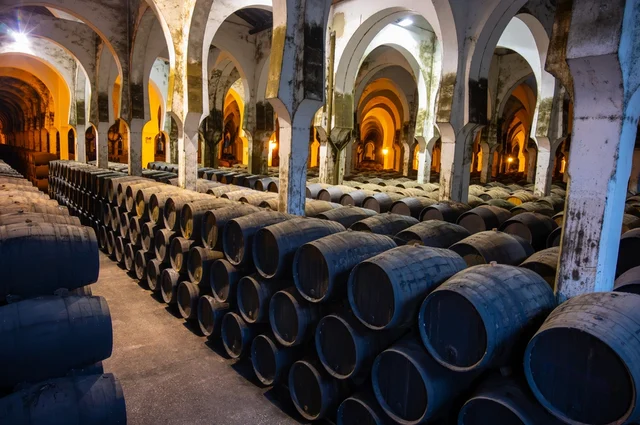
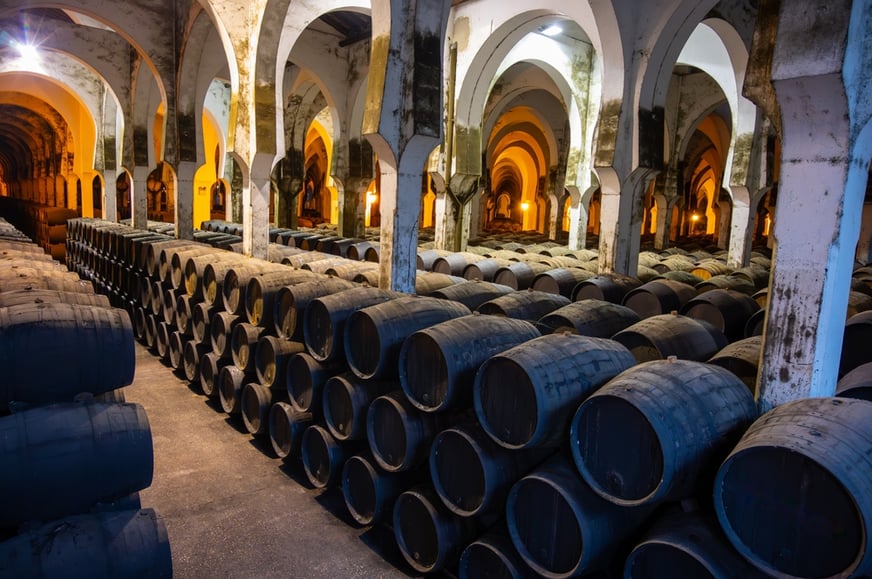
On a typical visit, you'll be shown through several buildings in which sherry and brandy are manufactured. In one building you'll see grapes being pressed and sorted; in another, the bottling process; in a third, thousands of large oak casks. Then it's on to an attractive bar where sherries -- amber, dark gold, cream, red, sweet, and velvety -- can be sampled. If offered, try the very dry La Ina sherry or the Fundador brandy, one of the most popular in the world. Warning: These drinks are more potent than you might expect.
The Story of Sherry
They’ve been making wine in and around Jerez for some 3,000 years, since the Phoenicians first brought vines to the region. The city’s Moorish name was Sherish, from which the names of both Jerez and sherry derive.
The fortified wine is made from two white grape varieties—Palomino Fino and Pedro Ximénez—and to be called sherry it must be produced within the wine region loosely bordered by Jerez, Sanlúcar de Barrameda, and El Puerto de Santa Maria. The dry, chalky soil known as albariza and the way the wine is made, combine to make sherry distinctive.
Central to the aging process is the solera system, which ensures quality and consistency. The wine is aged in three rows of stacked barrels. The top row contains the youngest wine, which is blended with that in the barrels below to produce the finished article, drawn from the bottom row. Most sherry has no vintage—each bottle contains wine from several different years.
A bodega tasting tour lets you appreciate the different styles. Fino is pale and fresh, protected by a yeasty froth called flor that forms on top of the wine in the barrel. Amontillado is a fino that has been exposed to oxygen, giving it a toffee color and nutty character. Palo Cortado is a rarity that starts as fino, then mysteriously loses its flor. Its name means “broken stick”—the symbol chalked on the barrel when that process occurs. Oloroso is a darker and richer style upon which flor doesn’t develop because more alcohol has been added. These wines are naturally very dry. Sweeter styles are made by adding sweet wine or must. Cream is the medium sweet blend traditionally favored by the British, while Pedro Ximénez is the sweetest of all, a dark, raisiny syrup.
Sherry’s international appeal owes much to Sir Francis Drake. When he destroyed the Spanish fleet at Cádiz in 1587, he made off with 2,900 barrels of sherry, sparking a British love affair with the drink. Once associated with elderly aunts, sherry is enjoying a renaissance, but take care when tasting. All sherry is significantly stronger than table wine, ranging from 15% to 22% alcohol.
Jerez is not surrounded by vineyards as you might expect. Instead, the vineyards are to the north and west in the "Sherry Triangle" marked by Jerez, Sanlúcar de Barrameda, and El Puerto de Santa María (the latter two towns are on the coast). This is where top-quality albariza soil is found; the highest quality contains an average of 60% chalk, which is ideal for the cultivation of grapes used in sherry production, principally the white Palomino de Jerez.

10 Results
- Historic Site
Alcazár
Jerez was a frontier town that went back and forth between Moors and Christians, and this fortress was built in the 11th century as a rural outpost to hold the line against Christian encroachment. The bent entrance of the horseshoe-arched Puerto de la Ciudad demonstrates the emphasis… - Winery
Bodegas Gonzalez Byass
The world’s best-known sherry maker’s bodega is so large that part of the tour is made aboard a motorized tourist train. Manuel Maria González founded the company in 1835 with help from his uncle José Angel, better known as Tío Pepe. During a 90-minute tour, you’ll visit the bodega… Bodegas Lustau
If time is tight and you’re looking for a sherry education on a budget, this tour of another of Jerez’s big names offers great value. The guided visit of Lustau’s classical 19th century cellars lasts just an hour but delivers plenty of detail about the solera process and how it…- Winery
Bodegas Tradición
More refined than the big-name operations above, this boutique house specializes in sherries classified as V.O.S. (aged 20 years or more) and V.O.R.S. (aged more than 30 years). A tour is expensive, but there is a bonus. The Rivero family that owns the bodega has amassed an… - Cathedral
Catedral de Jerez
Built over a period of 80 years from 1695, the cathedral of San Salvador has a one-piece-at-a-time feel, incorporating several architects and styles: Gothic, Baroque, and Neoclassical. Its concatenation of flying buttresses, ornate façades, and sculpted pinnacles is formidable rather… - Cultural complex
Centro Andaluz de Flamenco
One of the many cradles of flamenco is Jerez, where Moorish, Gypsy, Jewish, and Andalucían traditions met. This academic center possesses the largest public archive of books, musical scores, and performance videos of flamenco in Spain. Flamenco engravings and paintings line the walls… - Cultural center
Centro Andaluz del Flamenco
If you want to learn more about the culture of flamenco, or pick up information on upcoming shows, drop in to the beautiful old Palacio Pemartín in the Santiago district, the cradle of Jerez flamenco. Primarily an academic center—the atmosphere is rarefied and reverent—it holds the…Mon–Fri 9am–2pm
- Museum/performance space
Fundación Real Escuela Andaluza del Arte Ecuestre
Horses have fascinated Spaniards since Neolithic artists painted images of steeds in the caves outside Ronda 20,000 years ago. The museum traces the evolving bond between man and beast, emphasizing horsemanship skills and the breeding of the Pura Raza Española, or “pure Spanish… - Historic home/museum
Palacio del Virrey Laserna
Jerez has aristocratic airs, and there’s no better place to glimpse that rarified world than at the palatial home of the Count of Los Andes. It was built on the foundations of an Arab palace and passed down the generations of the same family following the reconquest of Jerez by… - Plaza
Plaza de la Asunción
This beautiful square is a lovely place to relax in golden hour light surrounded by architecture spanning six centuries. The oldest building is the Iglesia de San Dionisio, a plain-fronted Gothic-Mudéjar church from the 15th century with a single round window and arched entrance. On…
Jerez de la Frontera Shopping
The best shopping in Jerez revolves around the city’s three big preoccupations. Designer shops along Calle Larga draw their inspiration from tailored equestrian outfits and flouncy flamenco dresses. Visit Amparo Macía, Calle Larga, 55 (tel. 68-545-53-29), for exquisite modern designs. For colorful flamenco shoes, shawls, and fans, head to Senovilla, Calle Francos, 8 (tel. 69-642-84-97). Antonio García, Calle Larga, 33 (tel. 95-633-91-96) has everything the horseman or woman needs, including classic wide-brimmed sombreros and leather boots and gloves at excellent prices. Abrines, Calle Lancería, 10 (tel. 95-634-29-99), has been supplying the city’s flamenco artists with guitars and strings since 1948. They sell instruments for beginners as young as 2 years old. Visit Mala Música, Calle Medina, 10 (tel. 95-632-55-43), for second-hand CDs and vinyl.
And then, of course, there is sherry. There are wine shops all over town, and on the bodega tours, but few as charming as Casa del Jerez, Calle Divina Pastora, 1 (tel. 95-633-51-84). Most of the bodegas can ship wines to your home, and if you’re worried about taking liquids in your hand luggage, the marketing folks at Gonzalez Byass have already thought of that. How about a box of six tasting miniatures, and a couple of glasses, branded wíth Tio Pepe’s bottle, sombrero, and guitar?
Jerez de la Frontera Nightlife
A great way to combine the joys of sherry and flamenco is to go on the tabanco trail. Tabancos originated in Jerez as kiosks with sherry barrels where workers could pick up supplies on their way home. The name is probably a fusing of estanco (government-run shop), and tabaco (tobacco). Over time they developed into tiny meeting places with simple food and impromptu music. Not so long ago they were in danger of extinction, but today they’re back in fashion and dozens have popped up around the old town. There’s even an official Ruta de los Tabancos.
Which is best? For passionate flamenco, excellent tapas (try chicharrones, thinly sliced pork belly served on waxed paper), and great-value sherry from the barrel, it’s hard to beat Tabanco El Pasaje. Calle Santa Maria, 8 (tel. 95-633-33-59), where the Modernista tiled entrance is another treat. But why stop there? Continue your tour with bullfight-themed Tabanco Las Banderillas, Calle Caballeros, 12 (tel. 61-900-69-88), Tabanco San Pablo, Calle San Pablo, 12, (tel. 65-416-93-25) run by the same family since 1934, and for raucous flamenco in a stripped-back setting, Tabanco a la Feria, Calle Armas, 5 (tel. 66-347-65-42).
A great way to start your evening is with local sherry and the best tapas in town at Las Botas, Santo Domingo 13 (tel. 95-633-89-77). In business since the mid-1970s, it offers a delectable display of food, including Spanish tortillas (thick omelets with layers of potato), cured hams, regional cheese, mushrooms, and shrimp or bull meat marinated in sherry. Plates cost from 5€ to 8€ ($8-$13). It's open Monday to Saturday noon to 5pm and 8pm to 1am.
Only 3 blocks from Plaza del Arenal, Bar Alegría, Calle Corredera 30 (tel. 95-633-80-70), is patronized by savvy locals. We would come just for the croquetas de pollo (chicken croquettes), the best in the city. A friendly crowd, often young, congregates here at night. Tapas sell for 1.50€ ($2.40) and up, raciones (servings) for 6€ ($9.60). Open Monday to Saturday 8am to 11pm.
Jerez is known for its flamenco. The best shows -- very untouristy -- are at El Lagá de Tío Parrilla, Plaza del Mercado (tel. 95-633-83-34). Monday-to-Saturday shows begin at 10:30pm and 12:30am. The cover of 12€ ($19) includes the first drink, and reservations are suggested.