Armando Oliveira / Shutterstock
Planning a trip to Lisbon
In its golden age, Lisbon gained a reputation as the eighth wonder of the world. Travelers returning from the city boasted that its riches rivaled those of Venice. As one of the greatest maritime centers in history, the Portuguese capital imported exotic wares from the far-flung corners of its empire.
Treasures from Asia -- including porcelain, luxurious silks, rubies, pearls, and other rare gems -- arrived at Indian seaports on Chinese junks and eventually found their way to Lisbon. The abundance and variety of spices from the East, such as turmeric, ginger, pepper, cumin, and betel, rivaled even Keats's vision of "silken Samarkand."
From the Americas came red dyewood (brazilwood), coffee, gold, diamonds, and other gemstones. The extensive contact signaled a new era in world trade, and Lisbon sat at the center of a great maritime empire, a hub of commerce for Europe, Africa, and Asia.
In the first decade of the new millennium, and after a slumber that lasted for most of the 20th century, there is a new Lisbon awaiting you today. Some of that is good news and some of it isn't -- at least for traditionalists. Although some medieval facades and old palaces have been restored, others have given way to modern office blocks and more impersonal structures, which have replaced many of the 19th-century Art Nouveau buildings that were so much a part of the cityscape. Some of the famous old trams from years ago are still seen on the streets, but they are gradually being replaced by newer, more streamlined, and much faster trams. If you're visiting Lisbon for the first time, you'll find that the Vasco da Gama Bridge of the Tagus, dating from 1998, has sped up access to other areas of Portugal, including Alentejo province, and also made it easier to reach Spain.
Neighborhoods in Brief
Baixa The business district of Lisbon, Baixa contains much Pombaline-style architecture. (The term refers to the prime minister who rebuilt Lisbon following the earthquake.) Many major Portuguese banks are headquartered here. Running south, the main street of Baixa separates Praça do Comércio from the Rossio. A triumphal arch leads from the square to Rua Augusta, lined with many clothing stores. The two most important streets of Baixa are Rua da Prata (Street of Silver) and Rua Áurea, formerly called Rua do Oro (Street of Gold). Silversmiths and goldsmiths are located on these streets.
Chiado If you head west from Baixa, you'll enter this shopping district. From its perch on a hill, it's traversed by Rua Garrett, named for the noted romantic writer João Batista de Almeida Garrett (1799-1854). Many of the finest shops in the city, such as the Vista Alegre, a china and porcelain house, are here. One coffeehouse in particular, A Brasileira, has been a traditional gathering spot for the Portuguese literati.
Bairro Alto Continuing your ascent, you'll arrive at the Bairro Alto (Upper City). This sector, reached by trolley car, occupies one of the legendary seven hills of Lisbon. Many of its buildings were left fairly intact by the 1755 earthquake. Containing much of the charm and color of the Alfama, it's the location of some of the finest fado (meaning "fate" and describing a type of music) clubs in Lisbon, as well as excellent restaurants and bars. There are also antiques shops. Regrettably, many of the side streets at night are peopled with drug dealers and addicts, so be duly warned.
The Alfama East of Praça do Comércio lies the oldest district, the Alfama. Saved only in part from the devastation of the 1755 earthquake, the Alfama was the Moorish section of the capital. Nowadays it's home in some parts to stevedores, fishermen, and varinas (fishwives). Overlooking the Alfama is Castelo São Jorge, or St. George's Castle, a Visigothic fortification that was later used by the Romans. On the way to the Alfama, on Rua dos Bacalhoeiros, stands another landmark, the Casa dos Bicos (House of the Pointed Stones), an early-16th-century town house whose facade is studded with diamond-shape stones. Be careful of muggers in parts of the Alfama at night.
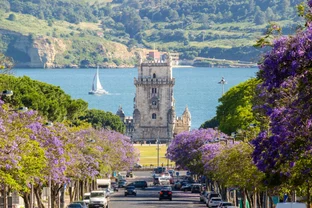
Belém In the west, on the coastal road to Estoril, is the suburb of Belém. It contains some of the finest monuments in Portugal, several built during the Age of Discovery, near the point where the caravels set out to conquer new worlds. (At Belém, the Tagus reaches the sea.) At one time, before the earthquake, Belém was an aristocratic sector filled with elegant town houses.
Two of the country's principal attractions stand here: the Mosteiro dos Jerónimos, a Manueline structure erected in the 16th century, and the Museu Nacional dos Coches, the National Coach Museum, the finest of its kind in the world. Belém is Lisbon's land of museums -- it also contains the Museu de Arte Popular and the Museu de Marinha.
Cacilhas On the south side of the Tagus, where puce-colored smoke billows from factory stacks, is the left-bank settlement of Cacilhas. Inhabited mainly by the working class, it's often visited by right-bank residents who come here for the seafood restaurants. You can reach the settlement by way of a bridge or a ferryboat from Praça do Comércio.
The most dramatic way to cross the Tagus is on the Ponte do 25 de Abril. Completed in 1966, the bridge helped open Portugal south of the Tagus. The bridge is 2.2km (1 1/2 miles) long, and its towers are 190m (623 ft.) high. The longest suspension bridge in Europe (it stretches for 16km/10 miles), Ponte Vasco da Gama, also spans the Tagus here. It's made areas from the north of the country and the southern Algarve, to the east across the Alentejo plain to southern Spain, more accessible. Standing guard on the left bank is a monumental statue of Jesus with arms outstretched.
Fast Facts
Your hotel's concierge usually is a reliable source of information.
Babysitters -- Most first-class hotels can provide babysitters from lists the concierge keeps. At small establishments, the sitter is likely to be a relative of the proprietor. Rates are low. Remember to request a babysitter early -- no later than the morning if you're planning on going out that evening. Also request a sitter with at least a minimum knowledge of English. If your sitter is fluent in English, count yourself lucky.
Currency Exchange -- Currency-exchange booths at Santa Apolónia station and at the airport are both open 24 hours a day. ATMs offer the best exchange rates. They pepper the streets of the central Baixa district and are also found less frequently in other parts of the city. The post office will exchange money as well.
Dentists -- The reception staff at most hotels maintains lists of local, usually English-speaking dentists who are available for dental emergencies. Some of them will contact a well-recommended dental clinic, Clinica Medica e Dentaria da Praça d'Espanha, Rua Dom Luís de Noronha 32 (tel. 21/796-74-57). Some of the staff members speak English.
Drugstores -- Farmácia Valmor, Av. Visconde Valmor 60B (tel. 21/781-97-43), is centrally located and well stocked.
Emergencies -- To call the police or an ambulance, telephone tel. 112.
Hospitals -- In case of a medical emergency, ask at your hotel or call your embassy and ask the staff there to recommend an English-speaking physician. Or try the British Hospital, Rua Saraiva de Carvalho 49 (tel. 21/394-31-00), where the telephone operator, staff, and doctors speak English.
Hot Lines -- The drug abuse hot line is tel. 21/726-77-66. The number for the Lisbon office of Alcoholics Anonymous is tel. 21/716-29-69.
Internet Access -- You can check your e-mail at Cyber.bica, Duques de Bragança 7 (tel. 21/322-50-04; www.cyberbica.com), in the Chiado district (Metro: Baixa-Chiado). It's open Monday to Friday 11am to midnight.
Laundry -- Keeping your clothes clean can be a problem if you're not staying long in Lisbon. For dry cleaning, try Lavatax, Rua Francisco Sanches 65A (tel. 21/812-33-92).
Lost Property -- For items lost on public transportation, inquire at Secção de Achados da PSP, Olivais Sul, Praça Cidade de Salazar Lote 180 (tel. 21/853-54-03), which is open Monday to Friday 9am to 12:30pm and from 1:30 to 5pm.
Luggage Storage & Lockers -- These can be found at the Estação da Santa Apolónia (tel. 80/820-82-08), by the river near the Alfama. Lockers cost 4€ for up to 48 hours.
Mail -- While in Portugal, you can have your mail directed to your hotel (or hotels), to the American Express representative, or to Poste Restante (General Delivery) in Lisbon. You must present your passport to pick up mail. The main post office, Correio Geral, in Lisbon is at Praça do Restauradores, 1100 Lisboa (tel. 21/323-89-71). It's open Monday to Friday 8am to 10pm, and Saturday and Sunday 9am to 6pm.
Police -- Call tel. 112.
Safety -- Lisbon used to be one of the safest capitals of Europe, but that hasn't been true for a long time. It's now quite dangerous to walk around at night. Many travelers report being held up at knifepoint. Some bandits operate in pairs or in trios. Not only do they take your money but they demand your ATM code. One of the robbers holds a victim captive while another withdraws money. (If the number proves to be fake, the robber might return and harm the victim.) During the day, pickpockets galore prey on tourists, aiming for wallets, purses, and cameras. Congested areas are particularly hazardous. Avoid walking at night, especially if you're alone.
Taxes -- Lisbon imposes no city taxes. However, the national value-added tax (VAT) applies to purchases and services.
Telegrams, Telex & Fax -- At most hotels, the receptionist will help you send a telegram. If not, there's a cable dispatch service open 24 hours a day at Marconi (the Portuguese Radio Communications Office), Rua de São Julião 131. To send telegrams from any telephone to points outside Portugal, dial tel. 1582 to reach Marconi. To send telegrams within Portugal (your Portuguese-language skills had better be good), dial tel. 1583 from any telephone. Most foreign visitors leave the logistics to the hotel concierge. Telexes and faxes can be sent from most hotels, or you can go to the general post office.
Telephone -- You can make a local call in Lisbon in one of the many telephone booths. For most long-distance telephone calls, particularly transatlantic calls, go to the central post office. Give an assistant the number, and he or she will make the call for you, billing you at the end. Some phones are equipped for using calling cards, including American Express and Visa. You can also purchase phone cards. Lisbon's city code is tel. 01.
Time -- For the local time in Lisbon, phone tel. 12151, the "Speaking Clock."
Transit Information -- For airport information, call tel. 21/841-35-00. For train information, dial tel. 80/820-82-08. TAP Air Portugal is at Avenida Do Berlin 1998 (tel. 21/841-50-00).
Weather -- To find out about the weather, call tel. 12150 (available only in Portuguese). If you don't speak Portuguese, ask someone at your hotel desk to translate one of the weather reports that appear daily in the leading newspapers.
Getting There
By Plane
Foreign and domestic flights land at Lisbon's Aeroporto de Lisboa (tel. 21/841-35-00; www.ana-aeroportos.pt), about 6.5km (4 miles) from the heart of the city. An AERO-BUS runs between the airport and the Cais do Sodré train station every 20 minutes from 7:45am to 8:15pm. The fare is 3.50€. It makes 10 intermediate stops, including Praça dos Restauradores and Praça do Comércio. There's no charge for luggage. Taxi passengers line up in a usually well-organized queue at the sidewalk in front of the airport, or you can call Rádio Táxi at tel. 21/811-90-00. The average taxi fare from the airport to central Lisbon is 12€. Each piece of luggage is 1.60€ extra.
For ticket sales, flight reservations, and information about the city and the country, you can get in touch with the Lisboa personnel of TAP Air Portugal, Loja Gare do Oriente, Edifìcio Estação do Oriente, Avenida de Berlim, 1998 Lisboa (tel. 70/720-57-00 for reservations; www.tap-airportugal.pt).
By Train
Most international rail passengers from Madrid and Paris arrive at the Estação da Santa Apolónia, Avenida Infante Dom Henrique, the major terminal. It's by the Tagus near the Alfama district. Two daily trains make the 10-hour run from Madrid to Lisbon. Rail lines from northern and eastern Portugal also arrive at this station. EXPO '98 brought a new, modern terminal to Lisbon. Connected to the Metro system and opened in 1998, Gare de Oriente at Expo Urbe is the hub for some long-distance and suburban trains, including service to such destinations as Porto, Sintra, the Beiras, Minho, and the Douro. At the Estação do Rossio, between Praça dos Restauradores and Praça de Dom Pedro IV, you can get trains to Sintra. The Estação do Cais do Sodré, just beyond the south end of Rua Alecrim, east of Praça do Comércio, handles trains to Cascais and Estoril on the Costa do Sol. Finally, you can catch a ferry at Sul e Sueste, next to the Praça do Comércio. It runs across the Tagus to the suburb of Barreiro; at the station there, Estação do Barreiro, you can catch a train for the Algarve and Alentejo. For all rail information, at any of the terminals above, call tel. 80/820-82-08 (www.cp.pt) between 7am and 11pm daily.
By Bus
Buses from all over Portugal, including the Algarve, arrive at the Rodoviária da Sete Rios (tel. 21/358-14-81; www.rede-expressos.pt). If your hotel is in Estoril or Cascais, you can take bus no. 1, which goes on to the Cais do Sodré. At least six buses a day leave for Lagos, a gateway to the Algarve, and nine buses head north every day to Porto. There are 14 daily buses to Coimbra, the university city to the north. One-way fare from Lagos to Lisbon is 18€.
By Car
International motorists must arrive through Spain, the only nation connected to Portugal by road. You'll have to cross Spanish border points, which usually pose no great difficulty. The roads are moderately well maintained. From Madrid, if you head west, the main road (N620) from Tordesillas goes southwest by way of Salamanca and Ciudad Rodrigo and reaches the Portuguese frontier at Fuentes de Onoro. Most of the country's 15 border crossings are open daily from 7am to midnight.
Orientation
Visitor Information
The main tourist office in Lisbon is at the Palácio da Foz, Praça dos Restauradores (tel. 21/12-05-050; www.visitportugal.com), at the Baixa end of Avenida da Liberdade. Open daily from 9am to 8pm (Metro: Restauradores), it sells the Lisbon Card, which provides free city transportation and entrance fees to museums and other attractions, plus discounts on admission to events. For adults, a 1-day pass costs 16€, a 2-day pass costs 27€, and a 3-day pass costs 34€. Children 5 to 11 pay 9.50€ for a 1-day pass, 14€ for a 2-day pass, and 17€ for a 3-day pass. Another tourist office is located across from the general post office in Lisbon on Rua do Arsenal 15, 1100-038 Lisbon (tel. 21/031-27-00; www.visitlisboa.com). This tourist office is open daily from 9am to 7pm.
City Layout
Main Streets & Squares -- Lisbon is the westernmost capital of continental Europe. According to legend, it spreads across seven hills, like Rome. That statement has long been outdated -- Lisbon now sprawls across more hills than that. Most of the city lies on the north bank of the Tagus.
No one ever claimed that getting around Lisbon was a breeze. Streets rise and fall across the hills, at times dwindling into mere alleyways. Exploring the city, however, is well worth the effort.
Lisbon is best approached through its gateway, Praça do Comércio (Commerce Square), bordering the Tagus. It's one of the most perfectly planned squares in Europe, rivaled only by the Piazza dell'Unità d'Italia in Trieste, Italy. Before the 1755 earthquake, Praça do Comércio was known as Terreiro do Paço, the Palace Grounds, because the king and his court lived in now-destroyed buildings on that site. To confuse matters further, English-speaking residents often refer to it as Black Horse Square because of its statue (actually a bronze-green color) of José I.
Today the square is the site of the Stock Exchange and various government ministries. Its center is used as a parking lot, which destroys some of its harmony. In 1908, Carlos I and his elder son, Luís Filipe, were fatally shot here by an assassin. The monarchy held on for another 2 years, but the House of Bragança effectively came to an end that day.
Directly west of the square stands the City Hall, fronting Praça do Município. The building, erected in the late 19th century, was designed by the architect Domingos Parente.
Heading north from Black Horse or Commerce Square, you enter the hustle and bustle of Praça de Dom Pedro IV, popularly known as the Rossio. The "drunken" undulation of the sidewalks, with their arabesques of black and white, have led to the appellation "the dizzy praça." Here you can sit sipping strong unblended coffee from the former Portuguese provinces in Africa. The statue on the square is that of the Portuguese-born emperor of Brazil.
Opening onto the Rossio is the Teatro Nacional de Dona Maria II, a free-standing building whose facade has been preserved. From 1967 to 1970, workers gutted the interior to rebuild it completely. If you arrive by train, you'll enter the Estação do Rossio, whose exuberant Manueline architecture is worth seeing.
Separating the Rossio from Avenida da Liberdade is Praça dos Restauradores, named in honor of the Restoration, when the Portuguese chose their own king and freed themselves from 60 years of Spanish rule. An obelisk commemorates the event.
Lisbon's main avenue is Avenida da Liberdade (Avenue of Liberty). The handsomely laid-out street dates from 1880. Avenida da Liberdade is like a 1.5km-long (1 mile) park, with shade trees, gardens, and center walks for the promenading crowds. Flanking it are fine shops, the headquarters of many major airlines, travel agents, coffeehouses with sidewalk tables, and hotels. The comparable street in Paris is the Champs-Elysées; in Rome, it's via Vittorio Veneto.
At the top of the avenue is Praça do Marquês de Pombal, with a statue erected in honor of the 18th-century prime minister credited with Lisbon's reconstruction in the aftermath of the earthquake.
Proceeding north, you'll enter Parque Eduardo VII, named in honor of the son of Queen Victoria, who paid a state visit to Lisbon. In the park is the Estufa Fria, a greenhouse well worth a visit.
Finding an Address -- Finding an address in the old quarters of Lisbon is difficult because street numbering at times follows no predictable pattern. When trying to locate an address, always ask for the nearest cross street before setting out. Addresses consist of a street name followed by a number. Sometimes the floor of the building is given as well. For example, Avenida Casal Ribeiro 18 3 means that the building is at number 18 and the address is on the third floor.
Street Maps -- Arm yourself with a good city map before setting out. Maps with complete indexes of streets are available at most newsstands and kiosks. Those given away by tourist offices and hotels aren't adequate because they don't show the maze of little streets.
Getting Around
Central Lisbon is relatively compact and, because of heavy traffic, it's best explored by foot. That's virtually the only way to see such districts as the Alfama. However, when you venture farther afield, such as to Belém, you'll need to depend on public transportation like trams, which are inexpensive but often slow. Considering the hilly terrain and the fact that many of the streets were designed for donkey carts, though, the tram system works well.
As one Frommer's reader (Evamarie Doering, of Belmont, California) wrote, "In the 15 years since my last visit there, Lisbon has become one of the noisiest cities I've ever visited. Traffic is outrageous; driving is difficult because of the speed and the tendency of the natives to ride 6 inches from your rear bumper. The buses, of which there are a great many, are very noisy, and produce volumes of smoke. Honking of car horns seems to be a national pastime." Her description is, unfortunately, apt. Even the most skilled chauffeurs have been known to scrape the fenders of their clients' rented limousines while maneuvering through the city's narrow alleyways.
By Public Transportation
CARRIS (tel. 21/361-30-00; www.carris.pt) operates the network of funiculars, trains, subways, and buses in Lisbon. The company sells a bilhete de assinatura turístico (tourist ticket). A 1-day pass goes for 3.70€. Passes are sold in CARRIS booths, open from 8am to 8pm daily, in most Metro stations and network train stations. You must show a passport to buy a pass.
Metro -- Lisbon's Metro stations are designated by large M signs. A single ticket costs .80€, a day pass 3.70€. One of the most popular trips -- and likely to be jampacked on corrida (bullfight) days -- is from Avenida da República to Campo Pequeno, the brick building away from the center of the city. Service runs daily from 6:30am to 1am. For more information, call tel. 21/350-01-15 (www.metrolisboa.pt).
Surprisingly, riding the Lisbon Metro is like visiting an impressive art collection. Paintings, glazed tiles, and sculptures make for an underground museum. You'll see interesting collections of contemporary art, including some works by famous Portuguese artists such as Maria Keil and Maria Helena Vieira da Silva. Stations that display some of the finest art include Cais do Sodré, Baixa/Chiado, Campo Grande, and Marquês de Pombal.
Bus & Tram -- Lisbon's buses and trams are among the cheapest in Europe. The eléctricos (trolley cars, or trams) make the steep run up to the Bairro Alto. The double-decker buses come from London and look as if they need Big Ben in the background to complete the picture. If you're trying to stand on the platform at the back of a jammed bus, you'll need both hands free to hold on.
The basic fare on a bus or eléctrico is 1.40€ if you buy the ticket from the driver (tel. 21/361-30-00; www.carris.pt). The transportation system within the city limits is divided into zones ranging from one to five. The fare depends on how many zones you traverse. Buses and eléctricos run daily from 6am to 1am.
At the foot of the Santa Justa Elevator, on Rua Áurea, there's a stand with schedules pinpointing the zigzagging tram and bus routes. Your hotel concierge should have information.
The antediluvian eléctricos, much like San Francisco's cable cars, have become a major tourist attraction. Beginning in 1903, the eléctricos replaced horse-drawn trams. The most interesting ride for sightseers is on eléctrico no. 28, which takes you on a fascinating trip through the most history-rich part of Lisbon.
Electric Train -- A smooth-running, modern electric train system connects Lisbon to all the towns and villages along the Portuguese Riviera. There's only one class of seat, and the rides are cheap and generally comfortable. You can board the train at the waterfront Cais do Sodré Station in Lisbon and head up the coast all the way to Cascais.
The electric train does not run to Sintra. For Sintra, you must go to the Estação do Rossio station, opening onto Praça de Dom Pedro IV, or the Rossio, where frequent connections can be made. The one-way fare from Lisbon to Cascais, Estoril, or Sintra is 1.80€ to 4€ per person (tel. 21/261-30-00; www.carris.pt).
Funiculars -- Lisbon has a trio of funiculars: the Glória, which goes from Praça dos Restauradores to Rua São Pedro de Alcântara; the Bica, from the Calçada do Combro to Rua da Boavista; and the Lavra, from the eastern side of Avenida da Liberdade to Campo Mártires da Pátria. A one-way ticket on any of these costs 1.40€ (tel. 21/261-30-00; www.carris.pt).
Ferry -- Long before the bridges across the Tagus were built, reliable ferryboats chugged across the river, connecting the left bank with the right. They still do, and have been rebuilt and remotorized so they're no longer noisy. Many Portuguese who live on the bank opposite Lisbon take the ferry to avoid the heavy bridge traffic during rush hour.
Most boats leave from Cais de Alfândega (Praça do Comércio) and Cais do Sodré, heading for Cacilhas. The trip is worth it for the scenic views alone. Arrivals are at the Estação do Barreiro, where trains leave about every 30 minutes for the Costa Azul and the Algarve. Ferries depart Lisbon throughout the day about every 15 to 20 minutes; trip time across the Tagus is 15 minutes. The cost of the continuing train ticket includes the ferry. The separate ferry fare from the center of Lisbon to Cacilhas is .81€ (tel. 808/20-30-50; www.transtejo.pt).
By Taxi
Taxis in Lisbon tend to be inexpensive and are a popular means of transport for all but the most economy-minded tourists. They usually are diesel-engine Mercedes. The basic fare is 2.50€ for the first 153m (502 ft.), .10€ for each extra 162m (531 ft.), plus 20% from 10pm to 6am. The law allows drivers to tack on another 50% to your bill if your luggage weighs more than 66 pounds. Portuguese tip about 20% of the modest fare. For a Rádio Táxi, call tel. 21/811-90-00 (www.retalis.pt).
Many visitors stay at a Costa do Sol resort hotel, such as the Palácio in Estoril or the Cidadela in Cascais. If you stay there, you'll probably find taxi connections from Lisbon prohibitively expensive. Far preferable for Costa do Sol visitors is the electric train system.
By Car
In congested Lisbon, driving is extremely difficult and potentially dangerous -- the city has an alarmingly high accident rate. It always feels like rush hour in Lisbon. (Theoretically, rush hours are Mon-Fri 8-10am, 1-2pm, and 4-6pm.) Parking is seemingly impossible. Wait to rent a car until you're making excursions from the capital. If you drive into Lisbon from another town or city, call ahead and ask at your hotel for the nearest garage or other place to park. Leave your vehicle there until you're ready to depart.
Car Rentals -- The major international car-rental companies are represented in Lisbon. There are kiosks at the airport and offices in the center. They include Avis, Av. Praia da Vitória 12C (tel. 21/351-45-60; www.avis.com), open daily from 8am to 7pm; and Hertz, Rua Castilho 72 (tel. 21/381-24-30 or 21/381-24-35; www.hertz.com), open Monday to Friday 8am to 7pm, Saturday 9am to 1pm and 2 to 7pm, and Sunday 9am to 1pm and 3 to 7pm; Budget, Rua Castillo 167B (tel. 21/386-05-16; www.budget.com), is open daily 9am to 7pm.
When to Go
Climate
Lisbon’s location in south-east Europe means it has a hot summers cooled by an Atlantic breeze and mild winters. Temperatures in July and August average around 26.3°C (79.3°F), while its temperate winters can be a pleasant 16.1°C (60°F). Although there can be pleasant winter days with bright blue skies, the most likely time rain falls is between November and March. Summer generally sees only a few showers.
Lisbon Calendar
The year begins gently with festivals such as Lisbon Fish & Flavours, a gastronomic delight with demonstrations and classes in Commerce Square. In April, rows of colourful stalls open their shutters in Edward VII Park for the Lisbon Book Fair, a must for bookworms. The city’s biggest celebrations, the Festas de Lisboa, turn June into a whirl of music, dance, parades and parties, especially in the city center and the Alfama. In hot August it’s time to cool off to the strains of live jazz music in the Calouste Gulbenkian Foundation’s shaded gardens for Jazz em Agosto (www.musica.gulbenkian.pt/jazz/), while Arte de Lisbon (www.artelisboa.fil.pt/) in November brings art lovers to Nation’s Park. The year ends back in Commerce Square with a New Year’s Eve concerts and fireworks.