Things To Do in Montserrat, Spain
Bookstore
Available as paperback
and as e-book.
Montserrat, Spain Attractions
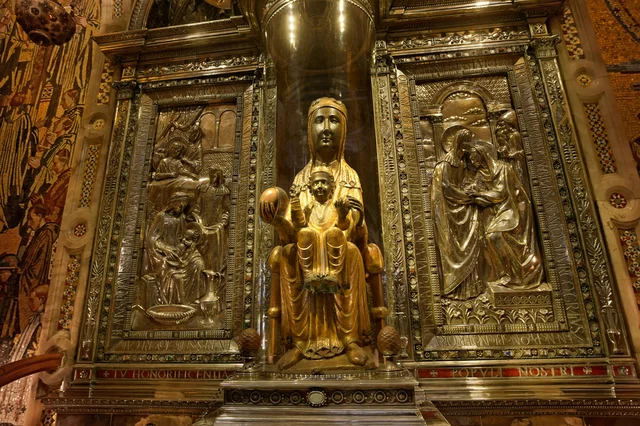
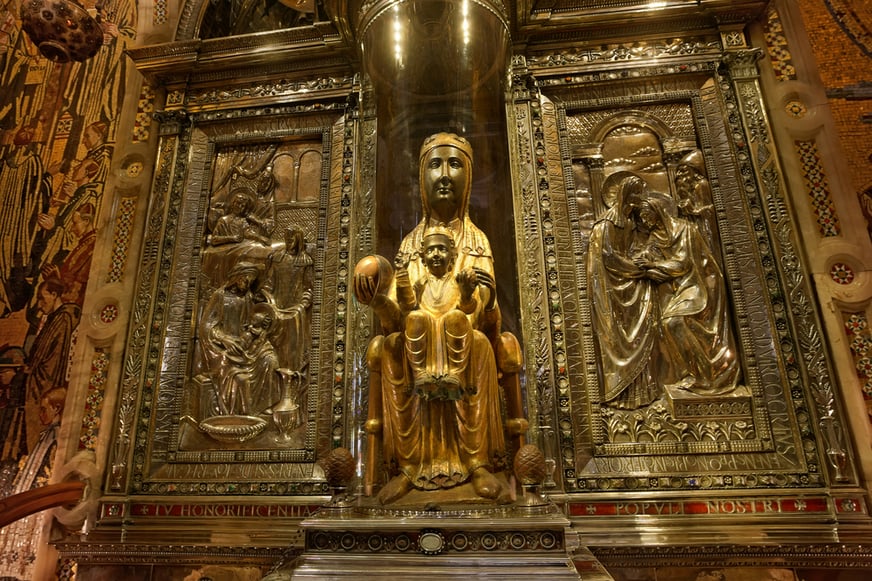
You can see Montserrat’s jagged peaks from all over eastern Catalunya—its serrated ridgeline is a symbol of Catalan identity. According to legend, the statue of the Virgin of Montserrat was brought here for safekeeping in the 8th century as Muslim armies invaded, to be rediscovered in a mountain grotto in the 12th century, since when many miracles have been attributed to her. In fact, the small polychrome carving of the Virgin with Child, whose wooden features have darkened with age, probably dates from the 12th century. As a buffer state between Christian France and often Islamic Spain, medieval Catalunya espoused a fierce and intense Christian faith that reached its apogee in the cult of the Virgin of Montserrat, one of the legendary “dark” virgins of Iberian Catholicism.
Most visitors head straight to the Basilica de Montserrat to see La Moreneta. The meter-tall carving is mounted on a silver throne high above the main altar. You’ll be in a long line of people shuffling past the statue, which is encased in bulletproof acrylic. The faithful can touch the orb in her right hand through a cutout in the casing (kissing is discouraged post-Covid).
Try to be there at 1pm to hear the Escolanía, a renowned boys’ choir established in the 13th century, singing the Virolai, a hymn to the Virgin. The basilica is open daily 7am‒8pm; the La Moreneta throne is open Monday to Friday 8–10:30am and noon‒6:25pm. Admission is free.
In nearby Plaça de Santa María, the Museu de Montserrat (tel. 93-877-77-45) houses art donated by the faithful over the years, including religious works by Caravaggio and El Greco, an early Picasso (El Viejo Pescador from 1895), and some lovely Impressionist paintings by Monet, Sisley, and Degas. The museum is open daily 10am to 5:45pm; admission is 8€ adults, 6.50€ seniors and students, 4€ ages 8 to 16.
You can also make an excursion to the Santa Cova (Holy Grotto), where La Moreneta is said to have been discovered. The funicular will take you halfway, but you must complete the trip on foot. The natural grotto was reworked in the 17th century when a small church in the shape of a cross was built. It houses a permanent exhibition of religious art. The grotto is open daily 10:30am‒3:30pm (until 4pm weekends and holidays). The round-trip fare is 6€.
If waiting in line to see holy relics isn’t your thing, you might simply enjoy a day of hiking in the spectacular scenery that surrounds this special site.