Exploring Monfragüe
Bookstore
Available as paperback
and as e-book.
Parque Nacional de Monfragüe Attractions
Although the park is vast, navigating it is straightforward. Stop first at the Torrejón el Rubio tourist office on the corner of Calle Paso (tel. 92-745-52-92; Tues–Sun 10am–2pm and 4–6pm), where you can pick up well-produced maps with color-coded routes by car and foot. The Ruta Roja (Red Route) is the best known and a good place to start. The nearby BirdCenter, Calle Carretera (tel. 92-719-95-79; Wed–Sun 10am–2pm and 4–8pm), offers advice on everything from birdwatching to local cave paintings and stargazing at the adjoining observatory. The building itself is interesting—a steel-and-stone representation of a pair of spreading wings. If you’re planning to birdwatch, download the useful Birding in Extremadura app.
The Centro de Arte Rupestre de Monfragüe, part of the Torrejón el Rubio visitor center on Calle Carretera (tel. 68-557-20-15) can help you discover more than 100 examples of prehistoric rock art (arte rupestre) in the national park. These paintings, depicting human figures, animals, and abstract symbols, date from the Mesolithic period to the Iron Age. Admission to the introductory exhibition is 1.50€ adults, 1€ ages 13–18, free for children under 13. Guided tours (4€) cover some of the key sites, including simple but striking paintings near Castillo de Monfragüe. The ancient artworks remain open to the elements and viewing them is an adventure. You’ll use a torch and laminated guide to identify the stick figures, while dangling from a platform at the cave entrance.
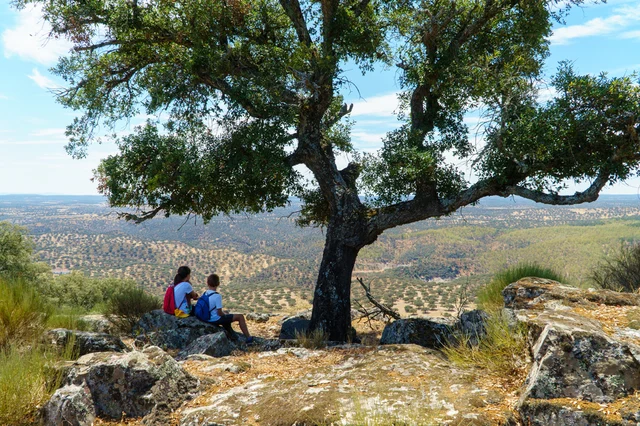
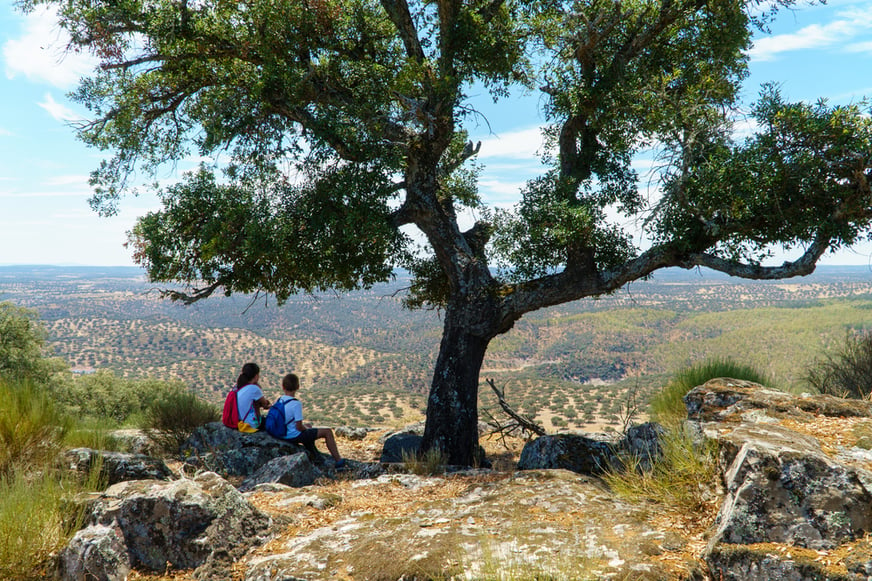
To enter the park, take the EX-208 north toward Villarreal de San Carlos. A natural first stop is Castillo de Monfragüe, a heavily restored 9th-century ruin with Moorish origins. It’s not much to look at, but the thrill comes from the panoramic views across the Tagus River and its tributaries, flanked by untouched woodland. Look up, and down, to see raptors soaring on the thermals. To reach the castle, park in the designated lot at the bottom of the hill and catch the free shuttle that runs every 30 minutes Tuesday to Saturday. If it’s not operating, the walk takes about 20 minutes.
Continue on EX-208 northwest to the mirador at Salto de Gitano—Gypsy’s Leap. This iconic spot has Monfragüe’s most photographed view, looking across the craggy gorge to Peña Falcón, a dramatic outcrop colonized by scores of griffon vultures circling low and slow. You might also see a rare black stork skimming the water. It’s easy to park at the mirador and there are wooden shelters where you can gaze up with binoculars or a telephoto lens to get the perfect image.
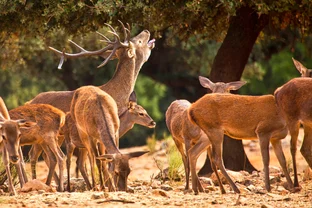
As the road winds on, look out for several well-managed miradors and stopping points where might see roe deer grazing—unbothered by humans. Puente del Cardenal is a stone bridge commissioned by the Bishop of Plasencia in 1450 to connect that city with Trujillo. It is said to have cost the same number of pieces of gold as the stones it contains—30,000. Its elegant granite arches are sometimes visible, sometimes submerged by the river.
Five minutes’ drive north of the bridge, the tiny, slate-built hamlet of Villarreal de San Carlos is the only settlement for miles around. It was established at the end of the 18th century by Carlos III as a garrison to protect the area against banditry, all too common at the time. Today, it provides a base for birdwatchers and backpackers with a couple of bars, a handful of basic places to stay, and an informative visitor center (tel. 92-719-91-34). In February, it hosts the International Ornithology Fair, whose photography competition produces mind-blowing results.