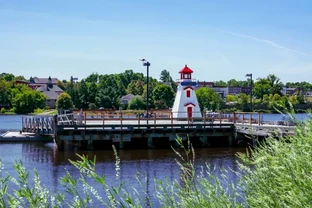
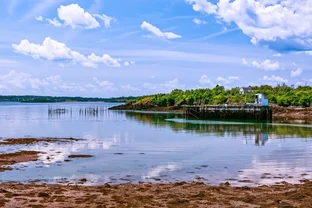
The Passamaquoddy Bay region is often the first point of entry for those arriving overland from the United States. The deeply indented bay is wracked by massive tides that produce currents powerful enough to stymie even the sturdiest fishing boats. It's a place of deep fogs,…
New Brunswick Tourism
Things To Do in Passamaquoddy Bay
Jump to:
Bookstore

Available as paperback
and as e-book.
Passamaquoddy Bay Attractions
The lovely village of St. Andrews—or St. Andrews By-the-Sea, as the chamber of commerce persists in calling it—traces its roots back to the days of the Loyalists. After the American Revolution, New Englanders who had supported the British were made to feel unwelcome. They decamped first to Castine, Maine, which they presumed was safely on British soil. But it wasn’t; the St. Croix River was later determined to be the border between Canada and the United States. Forced to uproot again, the Loyalists dismantled their new homes, loaded the pieces aboard ships, and rebuilt them on the welcoming peninsula of St. Andrews, a short sail away. Some of these remarkably resilient saltbox houses still stand in town today.
EXPLORING ST. ANDREWS
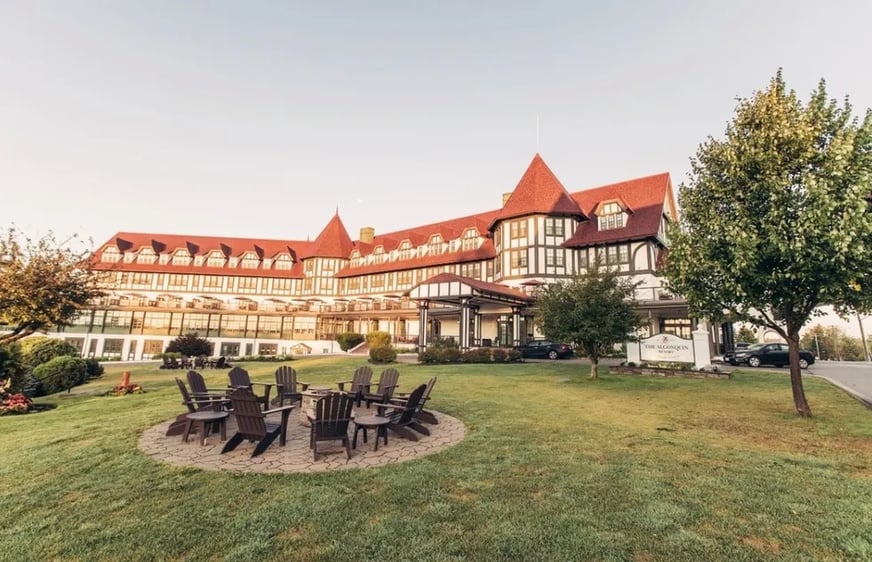
In the late 19th century, this community emerged as a fashionable summer resort, as many of Canada’s affluent and well-connected built homes and gathered annually here for social activities. The Tudor-style Algonquin Hotel (pictured above, now known as The Algonquin Resort) was built on a low rise overlooking the town in 1889, and quickly became the town’s social hub and defining landmark.
St. Andrews is beautifully sited at the tip of a long, wedge-shaped peninsula. Thanks to its off-the-beaten-track location, the village hasn’t been spoiled much by modern development, and walking the wide, shady streets—especially those around the Algonquin—invokes a more genteel era. Some 250 homes around the village are more than a century old. A number of appealing boutiques and shops are spread along Water Street, which stretches for some distance along the town’s shoreline. It’s easy to grab a boat tour from the waterfront, and on Thursday mornings in summer, don’t miss the weekly farmer’s market on the waterfront. I definitely recommend this town if you’re seeking a tame, easy tourism dip into New Brunswick.
EXPLORING ST. ANDREWS
Many of the private dwellings in St. Andrews feature plaques with information on their origins—look for them especially on the sides of the town’s saltbox-style homes. The village’s easily walkable and charming downtown flanks Water Street, the long commercial street paralleling the bay. You’ll find understated commercial architecture here, much of it from the turn of the 20th century, in a variety of styles. Allow an hour or so for browsing through the boutiques and art galleries. There’s also a mix of restaurants and inns.
A new hop-on/hop-off bus service provides free transportation in July and August between the town centre and six other popular stops including the Huntsman Marine Science Centre, Kingsbrae Garden, Algonquin Resort, and Kiwanis Oceanfront during a 45-minute loop on Thursday, Friday and Saturday afternoons.
Toward the western end of Water Street is Joe’s Point Road (it’s at the foot of Harriet Street). The stout wooden blockhouse that sits just off the water behind low, grass-covered earthworks was built by townspeople during the War of 1812, when the colonials anticipated a U.S. attack (which never came). This structure is almost all that remains of the scattered fortifications created around town during that war—there are cannons here from a different era—but it’s in excellent shape, with artifacts placed so it appears the soldiers might have just ducked out for a pint. It has lovely views of the bay and, at low tide clam diggers sometimes drive their trucks far out on the ocean floor of these expansive flats. The fortification is administered to visitors as the Blockhouse National Historic Site (tel. 506/529-4270 or 506/636-4011). It’s open June through August; admission is free. A new hop-on/hop-off bus service provides free transportation in July and August between the town centre and six other popular stops including the Huntsman Marine Science Centre, Kingsbrae Garden, Algonquin Resort, and Kiwanis Oceanfront during a 45-minute loop on Thursday, Friday and Saturday afternoons.
Across the street from the blockhouse are peaceful lawns and gardens, established in 1967 to mark the centenary of Canadian Confederation. Centennial Park also has views of the bay and is a pleasant spot for a picnic.
At the other end of Water Street, headed east from downtown, is the open space of Indian Point and a local campground. Now the views of the bay become even more panoramic, and they’re especially dramatic at sunrise. The water is swimmable, but frigid. Better to beachcomb: Look for worn, rounded pieces of flint and coral on the shoreline. Both were imported: Early traders loaded up their holds with flint from England and coral from the Caribbean to serve as ballast during the long crossings. When they arrived, they simply dumped the rocks overboard, and today they still churn up from the deep.
For a more protected swimming spot, wander down Acadia Drive, which runs downhill behind the Algonquin Hotel. Popular Katy’s Cove has floating docks, forming a sort of natural saltwater swimming pool along a fetching inlet. Certified lifeguards patrol, and often there’s beach volleyball, barbecue, and sand sculpting contests here. There’s a small fee to swim and to use the on-site playground here.

7 Results
- Aquarium/Museum
Fundy Discovery Aquarium
The aquarium on the grounds of the Huntsman Marine Science Centre is a welcome distraction for visitors, especially beloved by kids (who can watch colorful seahorses at feeding time, get splashed by rambunctious salmon, and say hello to Loki and Snorkel, a couple of very active… - Park/Garden
Kingsbrae Garden
This 11-hectare (27-acre) public garden opened in 1998, using the former grounds of a long-gone estate. The designers incorporated the existing high hedges and trees, and have ambitiously planted open space around the mature plants. The project has become a noted stop for garden…$$St. Andrews
- Historic home
Ministers Island Historic Site/Covenhoven
This rugged, 200-plus-hectare (500-acre) island is linked to the mainland by a sandbar at low tide, and the 2-hour tours are scheduled around the tides. (Call for upcoming times.) You’ll meet your tour guide on the mainland side, then drive your car out convoy-style across the ocean…Chamcook - Historic House/Park/View
Roosevelt Campobello International Park
As the name suggests, Roosevelt Campobello International Park is as much about Franklin Delano Roosevelt as it is the scenery. FDR’s experiences here shaped him into the impressive world leader he ultimately became. From the age of one, this is where the U.S. President and his… - Historic home
Ross Memorial Museum
For a dose of local history, stop by this historic home, which was built in 1824; in 1945 the home was left to the town by Rev. Henry Phipps Ross and Sarah Juliette Ross. Though the two of them never lived here, choosing instead to spend their time over a 40-year period at what is…$St. Andrews - Museum
The Chocolate Museum
Chocolate is so integral to this town’s history, of course there’s a museum to the cacao bean. Here you can view an 11-minute video about the history of local chocolates. Displays and exhibits explain 19th-century chocolate boxes, and there are interactive multimedia displays about…$$Around Town - Nature
Wild Salmon Nature Centre
The splashy visitor center of the Atlantic Salmon Federation is dedicated to educating the public about the increasingly rare and surprisingly intriguing Atlantic salmon. Located in a bright and airy post-and-beam facility, the center allows visitors to get oriented through exhibits,…St. Andrews