Things To Do in Salamanca
Bookstore
Available as paperback
and as e-book.
Salamanca Attractions
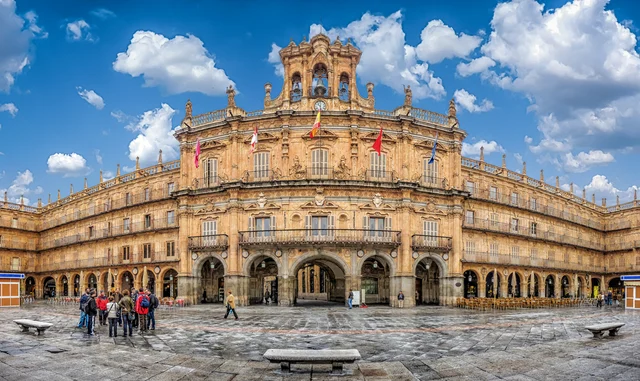
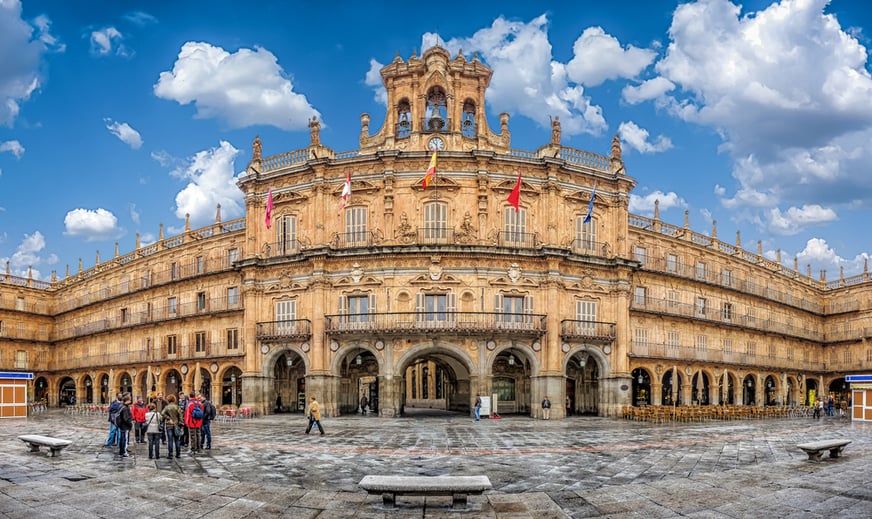
You probably won’t want to visit Salamanca in August, when the scorching midday makes even the lizards dash across the plazas in search of a sliver of shade. But at any other time, this is a stroller’s city, where new delights catch the eye at every turn. The Plaza Mayor ★★★ (see above) is the heart of the community, and in true academic fashion, it embodies the conflicting spirits of Spanish intellect. José Benito Churriguera’s design of the square is rational, cool, and neoclassical—but the decoration is utterly Baroque. Salamantinos gather here at all hours of the day and night to connect with each other, to talk, and (most of all) to eat and drink. When the sun sets and the stone plaza begins to cool, cafe tables spill out from beneath the arcades and “tunas” (student singers in old-fashioned academic cloaks) wander from table to table singing for tips.
About a quarter of the old city is devoted to buildings of the University of Salamanca, which reached its apex of influence in the 15th and 16th centuries but remains one of Spain’s most prestigious centers of scholarship. Courtyards around university buildings are generally open to the public, and the Patio de Escuelas Menores is a popular gathering point for tour groups as well as Salamantinos. Standing proudly in the center is a statue of 16th-century poet and scholar Fray Luis de León, the city’s poster boy for intellectual freedom and defiance of tyranny. Imprisoned for 4 years by the Inquisition for translating the Biblical “Song of Solomon” into Castilian, the scholar began his first lecture after returning to the classroom, “Decíamos ayer . . . ,” or “as we were saying yesterday. . .".
The architecture of Salamanca
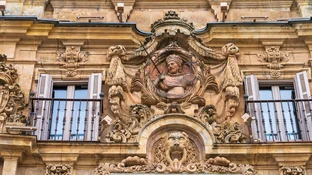
Spanish baroque architecture takes the impulse for distortion to an extreme. The Churriguera family carved out a name for themselves with a style that owes a great deal to the forms assumed by twisted rope. José Benito Churriguera (1665–1725) and his brothers Joaquin (1674–1724) and Alberto (1676–1750) were stone sculptors who became architects. Their work in Salamanca, especially with altarpieces and the stucco work on building facades, spawned many imitators in Spain as well as in Mexico—hence the term Churrigueresque.

11 Results
- Historic Site
Casa de las Conchas (House of Shells)
It’s hard to miss this restored 1483 house on the street between the University and Plaza Mayor because the facade consists of 400 simulated scallop shells, the symbol of Santiago (St. James), the patron saint of the Reconquista. It was created by a medical professor at the… - Historic Site
Casa-Museo Unamuno
To understand the intellectual, humanistic side of Salamanca, visit this 18th-century house where early 20th-century poet/philosopher/novelist Miguel de Unamuno lived during his first term as university rector. Never have we seen a home where the life of the mind was so manifest,… - Religious Site
Catedral Salamanca
Salamanca actually has two impressive cathedrals connected to each other, located in the south end of the old town. If you’re just entering for worship or to say a prayer, you’ll go into the “new” cathedral. If you want to tour the spaces, though, you’ll be added to a group and… - Museum
Cielo de Salamanca
Sometimes the best attempts at understanding the universe turn out to be bad science but deserve to survive because they are simply beautiful. This fresco of the night sky painted by Francisco Gallego in 1474 is just such an example. It covers part of the ceiling of the old… - Religious Site
Convento de San Estéban
Dominicans from this monastery accompanied Columbus on his voyages. Not only did they proselytize to the natives of the New World, they argued that indigenous people around the world had souls and human rights. While the dignity of all persons seems common sense in the 21st century,… - Religious Site
Convento de las Duenas
Unlike the brothers at adjacent San Estéban, the Dominican nuns are cloistered, but the cloister and intensely fragrant rose garden of their convent are open to visitors. Originally a noble palace, it was donated to the order in 1419 and has been subsequently altered and enlarged.… - Religious Site
Ieronimus
Salamanca’s cathedrals were built to provide a commanding view of the countryside to the south, and their restored towers offer spectacular vistas of both the city and the sprawling Castilian plain. Guided visits to the towers are separate from other tours of the cathedral. - Souvenirs
Mercatus
The official university store has the usual branded merchandise, but it also sells some terrific souvenirs that won’t embarrass you once you get home. If you became enamored of the student singing groups, or “tunas,” one night on Plaza Mayor, you can purchase CDs here. Silk scarves… - Museum
Museo de Art Nouveau-Art Déco
Masterful Art Nouveau glass by Emile Gallé and René Lalique are the artistic highlights, but the 1,500-plus piece collection of the Manuel Ramos Andrade Foundation also embraces jewelry, paintings, furniture, and marble and bronze figurines. All the works date from the late 1880s… - Museum
Museo de Salamanca
Only steps from the grandly carved main entrance of the University, this attractive little museum is packed with religious art confiscated from convents and monasteries in the mid–19th century. Most of the churches from which the 15th- to 17th-century carvings and paintings were… - Historic Site
Universidad de Salamanca
Established in 1213 and granted its full charter in 1254, Salamanca was organized on the model of the University of Bologna—that is, it gave precedence to humanistic scholarship over the study of theology favored by the University of Paris. Its intellectual heyday was in the 15th and…
Salamanca Shopping
The town's two main shopping neighborhoods extend around Calle Meléndez and the historic borders of Plaza Mayor. Both areas are good bets for fashion and housewares. A rastro, or flea market, is held every Sunday along Avenida de Aldehuela. It's best to go before noon. Buses go here from Plaza de España in the center of town. The best place for handicrafts is Aertesania Duenda, Calle San Pablo 29 (tel. 92-321-36-22), with one-of-a-kind items, often in wood, including music boxes and picture frames.
Mercatus (Calle Benedicto XVI, 22; tel. 677-579-827), the official university store, has the usual branded merchandise, but it also sells some terrific souvenirs that won’t embarrass you once you get home. Silk scarves reproduce the Cielo de Salamanca in all its mysterious beauty; you can also purchase T-shirts, tote bags, puzzles, and drink coasters emblazoned with the same image. Or go tacky and buy your budding scholar a bright stuffed frog, the good-luck talisman of Salamanca students. It’s open Mon–Sat 10am–8pm, Sun 10am–2pm.
Salamanca Nightlife
Don't expect a large variety of nightlife options; this is a small-scale university town with an emphasis on undergraduate shenanigans. Your best bet is a stroll around the Plaza Mayor, where you'll pass cafes and bars ideal for lingering or loitering, depending on your point of view. Usually a group of singing "tuna" dressed in medieval costumes perform for free nightly at 10pm, although these students appreciate tips. You might also wander onto such neighboring medieval streets as Calle de Bordadores, Calle San Vicente, Calle Rúa Mayor, and Calle Varillas, any of which offer tucked-away spots for a quick caffeine or alcohol fix.