Barrio de Triana

Located across the river from the city center, Triana is fiercely independent. You’ll see souvenir shops here that never mention the name Sevilla.
Traditionally home to Romani people (gitanos), it has produced many famous bullfighters and flamenco artists.
Triana is also known for ceramics, with a long history of making brightly decorative bowls and tiles (azulejos). Legend says that Triana’s patron saints, the 3rd-century martyrs Santa Justa and Santa Rufina, were potters. There are still several workshops concentrated around Calle San Jorge, and the excellent museum Centro Cerámica Triana, Calle Callao, 16 (tel. 95-434-15-82), is well worth a visit. It’s open Tuesday to Sunday 10am to 7pm and costs 2.10€.
Iglesia de Santa Ana, on Párocco don Eugenio (tel. 95-427-08-85) is Sevilla’s oldest church, dating from 1280. It is nicknamed the cathedral of Triana, and a ceramic plaque reveals the origin of the neighborhood’s name: It depicts the Virgin Mary’s mother, Santa Ana, with the Virgin and Christ—the Trinity of Ana.
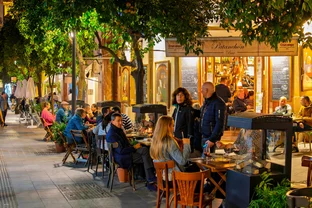
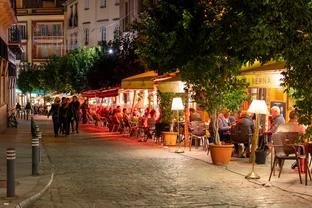
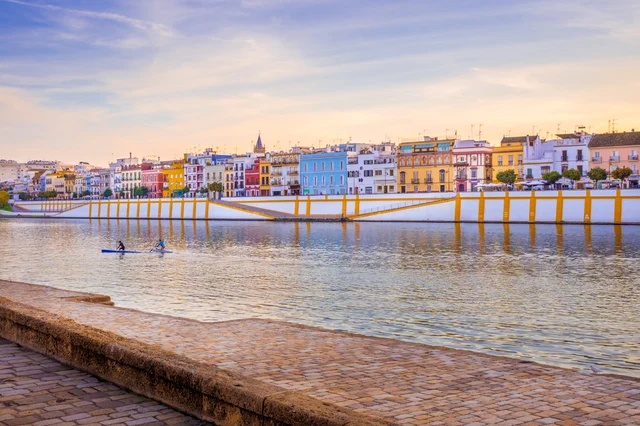
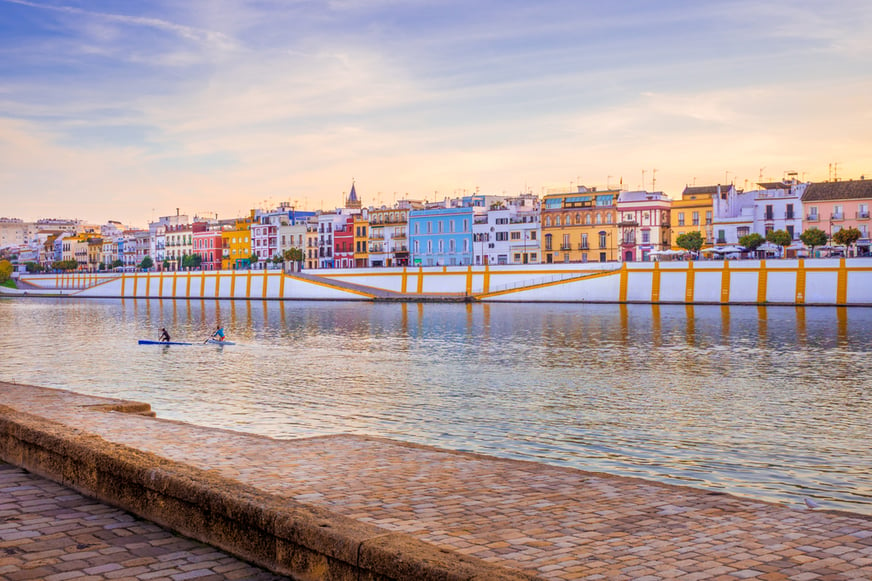
The riverfront along Calle Betis is lined with marisquerías (seafood restaurants) that set up outdoor tables during the warm weather. It’s a good place for evening tapas and late-night flamenco.
At the end of the Puente Isabel II bridge (always called Puente de Triana here), the Mercado de Triana (tel. 67-407-40-99) has been redeveloped as a gourmet market, with excellent tapas bars that carry on long after the food stalls have closed. Next to the market, the former Almohad fortress of Castillo de San Jorge (tel. 95-547-02-55) has recently reopened as a museum dedicated to sacred art, with a focus on Semana Santa. It is open Wednesday to Sunday from 10am to 5pm; admission is free.
Located across the river from the city center, Triana is fiercely independent. You’ll see souvenir shops here that never mention the name Sevilla.
Traditionally home to Romani people (gitanos), it has produced many famous bullfighters and flamenco artists.
Triana is also known for ceramics, with a long history of making brightly decorative bowls and tiles (azulejos). Legend says that Triana’s patron saints, the 3rd-century martyrs Santa Justa and Santa Rufina, were potters. There are still several workshops concentrated around Calle San Jorge, and the excellent museum Centro Cerámica Triana, Calle Callao, 16 (tel. 95-434-15-82), is well worth a visit. It’s open Tuesday to Sunday 10am to 7pm and costs 2.10€.
Iglesia de Santa Ana, on Párocco don Eugenio (tel. 95-427-08-85) is Sevilla’s oldest church, dating from 1280. It is nicknamed the cathedral of Triana, and a ceramic plaque reveals the origin of the neighborhood’s name: It depicts the Virgin Mary’s mother, Santa Ana, with the Virgin and Christ—the Trinity of Ana.
The riverfront along Calle Betis is lined with marisquerías (seafood restaurants) that set up outdoor tables during the warm weather. It’s a good place for evening tapas and late-night flamenco.
At the end of the Puente Isabel II bridge (always called Puente de Triana here), the Mercado de Triana (tel. 67-407-40-99) has been redeveloped as a gourmet market, with excellent tapas bars that carry on long after the food stalls have closed. Next to the market, the former Almohad fortress of Castillo de San Jorge (tel. 95-547-02-55) has recently reopened as a museum dedicated to sacred art, with a focus on Semana Santa. It is open Wednesday to Sunday from 10am to 5pm; admission is free.
Details
Bookstore
Available as paperback
and as e-book.