Things To Do in Sitges
Bookstore

Available as paperback
and as e-book.
Sitges Attractions
Sitges was once a fortified medieval town on the hillside above the beach, and bits and pieces of that fortress persist. The modest former castle, for example, is now the seat of the town government.
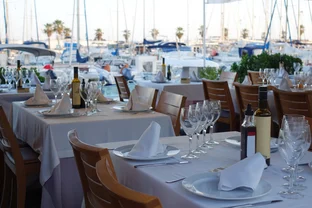
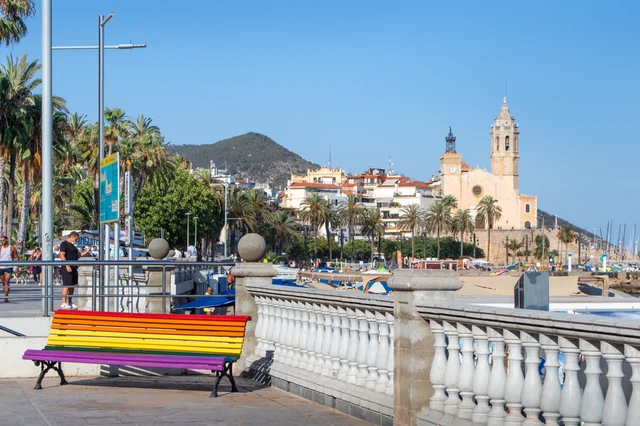
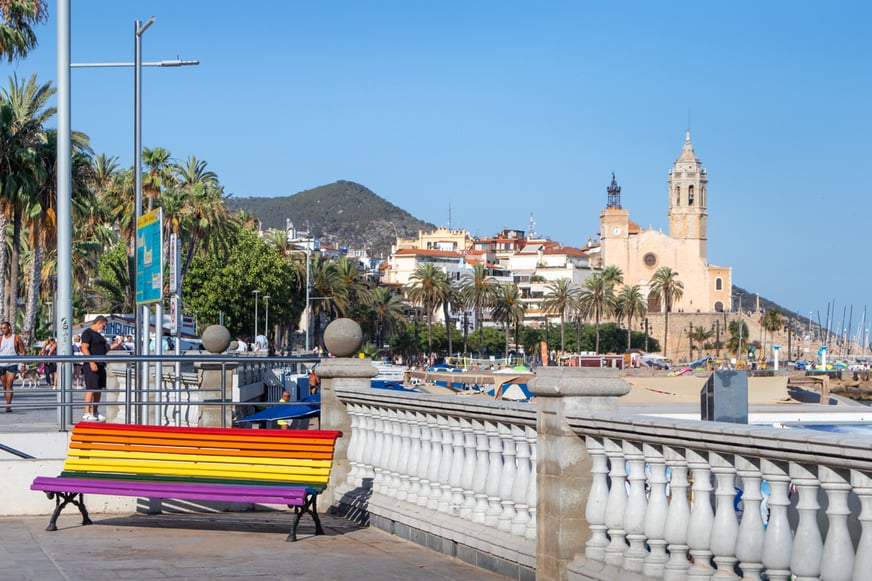
The oceanfront Passeig de la Ribera is much more emblematic of modern Sitges. A favorite spot to promenade in the early evening, it is defined by two landmarks of different eras and sensibilities. A sign on Chiringuito (Paseo de la Ribera, 31; tel. 98-894-75-96), a beachside restaurant/bar founded in 1913, identifies it as the first establishment to use that name. (Chiringuito has since become a generic term for similar casual spots along the Spanish coast that have improved on the original.)
At the east end of the promenade, booming surf soaks the stone steps leading to Plaça del Baluart, where the 17th-century baroque Església de Sant Bartomeu i Santa Tecla overlooks the harbor. So does a single cannon, the last of six that drove off English warships in 1797. Behind the landmark church are the Museu Cau Ferrat and the Museu Maricel.
Many people come here to hit the beaches—there are almost 20 of them—and the beaches nearest the town center come equipped with outdoor showers, public toilets, and umbrella and sun lounger rentals; some have kiosks renting watersports equipment.
A mixed crowd of young folks and families congregate at Playa de la Ribera, one of the largest and busiest beaches due to its proximity to town. Playa San Sebastián, Fragata Beach, and the “Beach of the Boats” (below the church and next to the yacht club) are the area’s family beaches. Beaches on the eastern end, such as Aiguadolç and Els Balomins, are the most peaceful, and the latter is also clothing-optional.
All along the coast, women can and certainly do go topless. Farther west at the most solitary beaches, the attire grows even skimpier, especially along the Playas del Muerto, where two tiny nude beaches lie between Sitges and Vilanova i la Geltrú. The first beach draws nudists of all sexual orientations, while the second is principally if not exclusively gay. Be advised that lots of action takes place in the woods in back of these beaches.
Centre de Interpretación del la Malvasia de Sitges
Lovers of wine and rich cuisine should not miss this interpretation center for a grape variety unique to Sitges. Brought back in the early 14 century from the eastern Mediterranean by a mercenary fleet in service of the kings of Aragón, the grape produces intense, heavily aromatic,…- Museum
Fundació Stämpfli-Art Contemporani
This organization brings the artistic reputation of Sitges up to date—the oldest works are from the 1960s—and injects an international perspective to the seaside art colony. Small but growing, the permanent collection includes around 90 works by 60 artists from 22 different… - Museum
Museu Cau Ferrat
This museum brilliantly captures the life, lifestyle, and art of the early years of Sitges as an art colony. In the late 19th century, modern artist Santiago Rusiñol (1861–1931) joined two 16th-century fishermen’s cottages to create a combined studio, home, and art gallery. His… - Museum
Museu Maricel
One of the people attracted to the Sitges art scene was American industrialist Charles Deering (heir to the company that would become International Harvester), who had this charming palace built right after World War I. Today it displays the collection of Dr. Jésus Pérez Rosales,… - Museum
Museu Romàntic (Can Llopis)
Using furniture and household objects to recreate family rooms in the downstairs section of the building, this museum conjures the daily life of a land-owning Sitges family in the 18th and 19th centuries. The wine cellars are a reminder that the Llopis family, while nominally…
Sitges Nightlife
One of the best ways to pass an evening in Sitges is to walk the waterfront esplanade, have a leisurely dinner, and then retire at about 11pm to one of the open-air cafes for a nightcap and some serious people-watching.
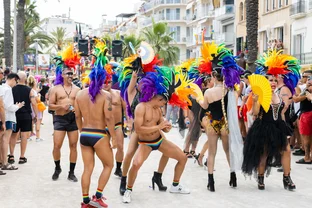
In true Spanish fashion, nightclubs and bars rarely open before 11pm, and in Sitges, most cater to a gay clientele. Keep in mind that the hottest club action doesn’t begin until after the bars close at 2:30am.
Most clubs close around sunrise. The greatest concentration is on Carrer Sant Bonaventura and Carrer Primer de Maig, both in the center of town, a short walk from the beach. A listing detailing gay bars and their style—from leather to black rubber to disco-ball dancing—is available online at gaysitgesguide.com.