Things To Do in Tarragona
Bookstore

Available as paperback
and as e-book.
Tarragona Attractions
Central Tarragona consists of a new city organized around the broad avenues of Les Rambles on fairly flat terrain, and a partially walled old city that huddles around the cathedral on high rocky ground. Traces of Roman Tarraco are found in both the old and new cities, as are a few gems of Modernisme architecture and design (see below).
In the new city, a seaside belvedere called the Balcó del Mediterráni (Balcony of the Mediterranean) connects the old and new Rambles. Be sure to stroll the main artery, Rambla Nova, a wide tree-lined boulevard. Running parallel with Rambla Nova to the east, the Rambla Vella marks the beginning of the old town; it was once part of the Roman Via Augusta.
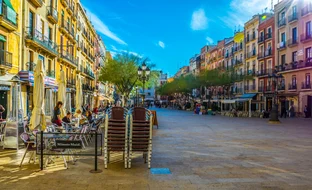
Just off Rambla Vella, the Plaça de La Font functions as the go-between from old to new cities. It has a lively cafe scene as well as city government offices.
Exploring Roman Tarragona Without Overpaying
Apart from the sections of the Roman aqueduct still standing on the northern fringe of the city proper, most of the major Roman ruins are grouped together under the umbrella of the Museu d’História de Tarragona (Calle Cavallers, 14; tel. 97-724-22-20). The museum itself is distributed among a few historic houses owned by the city (included in the combined admission pass), but visitors will find the Roman sites themselves of greater interest. To see the best Roman artifacts, visit the Museu Nacional Arqueològic de Tarragona.
Single site admissions to the Roman monuments are 5€ adults, 2.50€ seniors and students, free ages 12 and younger. Combined admission to five sites (four Roman monuments and a noble house) is 15€ adults, 7.50€ seniors and students. You can buy the combined pass at any of the sites. Visiting times vary depending on the site and the time of year; check the website for details.
Roman ruins are distributed throughout the city.
Modernista Architecture in Tarragona
Just as Tarraco was a provincial reflection of the glories of Rome, modern Tarragona can boast some glimmers of Barcelona’s Modernista masterpieces. When you’re making your promenade on Rambla Nova in the new city, stop in to see the Modernista interior of the Teatre Metropol (Rambla Nova, 46; tel. 97-722-99-30), built in 1908 and still used for live theater, dance, and concerts.
At the edge of the old city, L’Església de Sant Francesc (Rambla Vella, 28) has a striking Modernista chapel well worth visiting (Mon–Sat 11am–1pm and 5–8pm, Sun 10:30am–noon and 5:30–8:30pm; free admission).
If you’re continuing uphill to the old city through Plaça de la Font, pop into the Ajuntament (City Hall) to see the ship-shaped Modernista tomb of Jaume I of Aragón (1208–76), the conqueror who intertwined the political fates of Aragón and Catalunya and stands today as a rallying symbol for Catalan autonomy, if not outright independence from Spain. The Ajuntament is open Monday through Friday 10am to 8pm and Saturday and Sunday 10am to 2pm; admission is free.

6 Results
- Historic Site
Amfiteatre Romà
This 2nd-century-c.e. theater was carved from the cliff that rises above the crashing ocean. Contrasted against the vast spread of seaside sky and the abrupt and rugged cliff, the amphitheater must have been one of the most dramatic in the ancient world. Even in ruins, it’s a sight… - Cathedral
Catedral
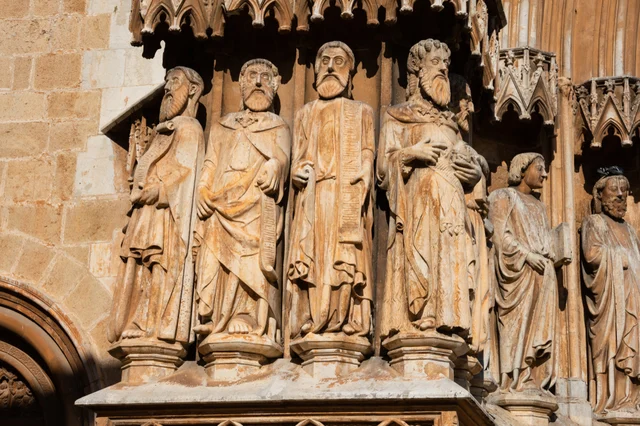
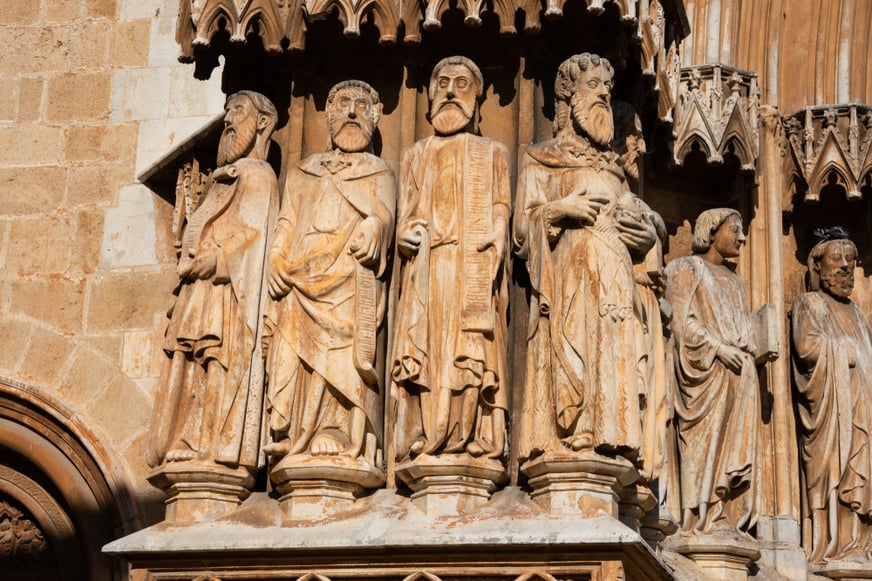
Begun in the mid–12th century and finally consecrated in 1331, the cathedral spans the transition from Romanesque to Gothic architecture. It has a fortress-like quality, if for no other reason than it stands at the highest point of the city. The immense rose window of the main facade… - Museum
Museu Nacional Arqueològic de Tarragona
Catalunya’s oldest archaeology museum was established in the first half of the 19th century and continued to add to its collection as urban expansion and building projects unearthed more relics of the city’s early history. The museum has been under renovation for close to a decade,… - Museum
Museu d’Art Modern de Tarragona
“Modern” at this museum is more a statement of era than style, as the paintings ignore all the avant-garde movements of the 20th century. It was founded by the donation of several sculptures by Julio Antonio that had been in the possession of his family. Additional bequests have… - Historic Site
Passeig Arqueològic
When the Romans decided to enclose their city of Tarraco in the 2nd century a.d., they built their walls on top of huge boulders. Only about a third of the original 3,500m construction still stands, and you can follow a garden-like path for about 0.8km (1/2 mile) of that length.… - Historic Site
Pretorì i Circ Romà
In the 1st century a.d., the Romans selected a hillside location to build this three-level complex that dedicated a floor each to worship (the top level), government (the middle level), and the circus (the lower level). The well-preserved circus, with a capacity of 30,000 spectators,…
Tarragona Shopping
You'll find a scattering of handicrafts shops throughout Tarragona's historic core, with a particularly dense concentration along the Ramble Nova. Any of them might provide a handcrafted souvenir of your visit.
For the densest concentration of shops and boutiques, head for the Centro Comercial Parc Central, on Avinguda Roma. The center has at least 40 other stores selling clothing, sundries, and household goods from some of the biggest chains in Spain, and some international chains.
Tarragona Nightlife
Rambla Nova contains a handful of sleepy-looking bars, any of which will serve a cup of coffee or bottle of beer throughout the day and evening.
Concerts and theatrical productions are staged in the city's cultural centerpiece, Teatre Metropol, Rambla Nova 46 (tel. 97-724-47-95). Because of the language barrier, you might skip theatrical events presented in Catalan in favor of musical and dance presentations.