Things To Do in Tiberias
Bookstore

Available as paperback
and as e-book.
Tiberias Attractions
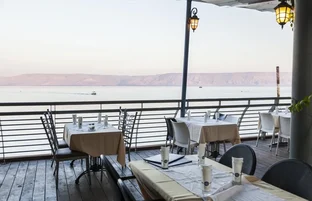
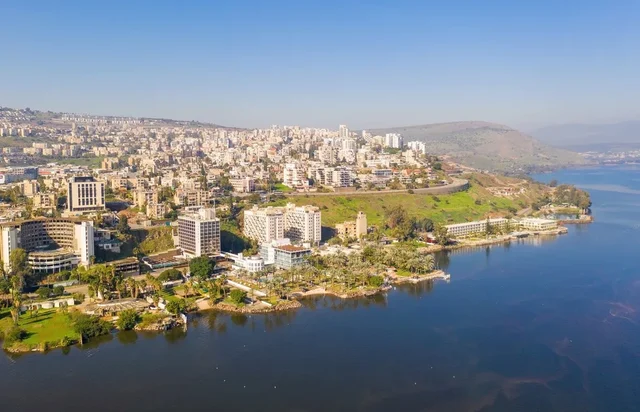
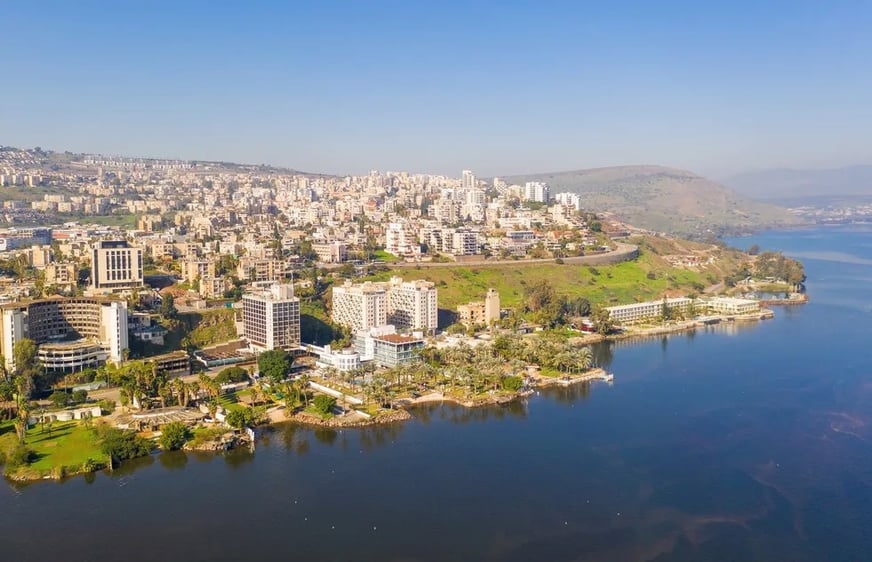
The main city on the Sea of Galilee, Tiberias has a split personality. Ha Galil Street is reminiscent of a tree-shaded main street in any small American town—it’s lined with small shops serving the population from the surrounding countryside. If the old basalt-rock buildings, with their second-story balconies, were renovated, the street could be charming. A block to the east is the other main street, Ha-Banim Street, passing high-rises, megahotels, and the Midrehov, or Pedestrian Mall, leading to the Waterfront Promenade, packed with tourists during the summer and Jewish holidays, throbbing at night with wall-to-wall discos, pubs, cafes, and restaurants. The Waterfront Promenade has a magnificent view across the lake. Ninety meters (295 ft.) to the left are the remains of a Crusader fort, jutting up in black basalt stone from the water.
Important places of veneration for religious pilgrims over the centuries, the Jewish tombs of the city of Tiberius are varied and many.
Arguably the most important is the famed Rambam’s (Maimonides’s) Tomb (its located off Yochanan Ben-Zakkai Street). Rabbi Moses Ben-Maimon, known both as Maimonides and the Rambam, was the greatest Jewish theologian of the Middle Ages. A Sephardic Jew, he was born in Cordova, Spain, but lived most of his life in Morocco and Egypt, where he was an Aristotelian philosopher, a physician (he served as personal physician to Saladin, at his royal court in Egypt), and a leading scientist and astronomer. His principal work was “The Guide for the Perplexed.” Although he didn’t live in Tiberias, according to legend, as he was dying, the great Maimonides had himself strapped to a donkey and was carried northward from Egypt, toward the Holy Land, where he hoped to be buried. The inhabitants of Tiberias found his body and buried him in their city. The philosopher, who died in 1204, is now honored by a newly restored mausoleum and gardens.
Nearby is the tomb of Rabbi Yochanan Ben-Zakkai, founder of the Yavne Academy in the years following the destruction of Jerusalem in a.d. 70 (the Yavneh Academy was central to keeping Judaism alive in the decades after Jerusalem’s destruction). And on a hillside just west of town is the memorial to Rabbi Akiva, a cave in which, according to tradition, he was buried. This great sage compiled the commentaries of the Mishnah before the Romans tortured him to death at Caesarea around a.d. 135 for his role in supporting the Bar Kochba revolt.
The tomb of Rabbi Meir Baal Haness (Meir, Master of Miracles; he also lived in the time of the Mishnas), on the hill above the hot springs, is considered one of Israel’s holiest sites; pilgrims visit in search of medical cures and help with personal problems. Rabbi Meir is remembered in a white building that has two tombs. The Sephardic tomb, with the shallow dome, was built around 1873 and is believed to contain the actual grave, close to the interior western wall of the synagogue; the building with the steeper dome is the Ashkenazi synagogue, erected about 1900. Tradition has it that Rabbi Meir was brought here after his death but had willed that he be buried standing up, so that when the Messiah came he could simply walk out to greet him.
Tiberias is home to other tombs in varying states of neglect, and strong pilgrimage traditions have developed over the centuries. A marble structure beside a modern apartment building, the Tomb of the Matriarchs is believed, according to some traditions, to be the final resting place of a number of biblical women, including Jacob’s third and fourth wives, Bilhah and Zilpah; Yocheved (the mother of Moses); Zipporah (Moses’ wife); Elisheva (wife of Aaron); and Avigail (one of the wives of King David).
All the tombs are open Sunday through Thursday between 8am and 4pm and Friday from 8am to 2pm. There is direct service to Tiberias by bus from all major cities. The Central Bus Station is on Ha-Yardem Street, 2 blocks inland from Ha-Atzma’ut Square.
- Natural Attraction
Hammat Tiberias National Park
Hammat Tiberias (or Hammat) contains the ruins of one of Israel’s most magnificent ancient synagogues, as befits a town that would have hosted wealthy visitors from distant Jewish communities (it was a famous spa resort for centuries and was founded well before Tiberius in the a.d.… - Gym/Spa
Hot Springs of Tiberias
Located 1.6km (1 mile) south of Tiberias, these thermal baths have been famous for their curative powers for more than 3,000 years. They are probably among the earliest-known thermal baths in the world, noted by Josephus, Pliny, church historians, and many Arabic writers. Some…
Tiberias Nightlife
Tiberias bustles after dark, as prodigiously as it does in the daytime. That’s particularly true in summer when performers of all types (both local and foreign) make appearances at the Bet Gabriel Amphitheater and the majestic Sherover Promenade, both on the southern tip of the Sea of Galilee (across from the Tzemach Junction). With parklike grounds, a snack bar/restaurant, and stunning vistas of the lake, it’s a memorable venue for concerts. Check with the Tiberias Tourist Information Office for a schedule of performances.
Folklore events are often scheduled at hotels, and everyone is welcome to attend. For details, contact the tourist office at the end of the Ha-Banim Street Pedestrian Mall.
There are also many late-night pubs, cafes, bars, and restaurants. Good places for a quiet drink with live music include the Leonardo Plaza and the Jordan River hotels at the southern end of the Old City. Big Ben, on the Pedestrian Mall, has a more traditional indoor pub as well as a terrace; the crowd is a bit older and less rowdy.
Many of the hotels (and even the hostels) around town have nice bars and pubs where you can relax and enjoy a drink and conversation with fellow travelers.
There are plenty of opportunities to go dancing, as well. The most unusual is the summer disco dancing on the boat operated by the Kinneret Sailing Company on the Sea of Galilee; call tel. 04/665-8007, or stop by its office at the Waterfront Promenade, for information. An evening disco cruise also leaves from the Lido Kinneret Beach (Lido Kinneret Cruises; tel. 04/672-0330) at varying times.