
Things To Do in Torremolinos
Bookstore

Available as paperback
and as e-book.
Torremolinos Attractions
The things you won't find here are the towers (torres) and windmills (molinos) that originally gave the little fishing village its name. They have been bulldozed under and replaced with soulless concrete bunkers. Today Torremolinos has been rechristened "Torrie" by its hordes of package-tour devotees.
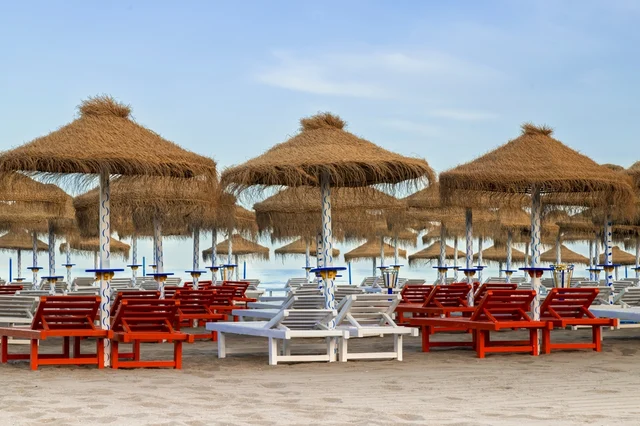
Most visitors are here for the beaches, not the Mudéjar architecture. There are two: El Bajondillo (aka Playa de Bajondill) and La Carihuela, the latter bordering the old fishing village that is now engulfed in development. The sands are gray.
These beaches are packed in July and August, when you'll find yourself lying next to a dishwasher from Hamburg, a shoe salesman from Leicester, and a janitor of an office building in Stockholm. Let the rich and famous enjoy Marbella. Torremolinos is blue collar -- and proud of it.
It can be hard to say where Torremolinos ends and Benalmádena-Costa begins, but there are a few reasons to visit that neighboring town to the west. Families will find a cluster of kid-appealing attractions in Benalmádena, while young and old both may enjoy the Teleférico Benalmádena cable car (Explanada del Tivoli, s/n; no phone), a 15-minute ride to the top of Mount Calamorro. This limestone ridge has spectacular views of the ant-like village of tourist lodgings below on the beach. Several hiking trails branch out, and the cable car company provides useful trail maps. There are sometimes falconry demonstrations at the summit. Round-trip tickets are 19.90€.
City officials try to amuse their summer visitors with free events, including music and dance festivals, even jazz concerts and sporting competitions as well.
Torrie's Heartland & La Carihuela
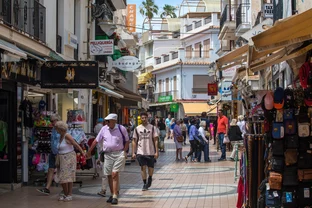
The resort is divided into two parts, the main town and the fishing village down below. Locals, especially British expats, call the main square "Central T-town." It centers on the traffic-clogged Plaza Costa del Sol, where you are likely to see an international parade of passersby. The main shopping street is Calle San Miguel, hawking some of the junkiest souvenirs in Andalusia. But, surprise, some excellent Spanish goods will often appear in a shop selling otherwise tawdry crafts not worth the suitcase space.
Brash, bold Plaza Nogalera in the heart of Torremolinos is active day and night. Expect sangria bars, gay hangouts, dance clubs, tascas (taverns) -- and inflated prices. Pick and choose carefully here.
For strolling, we prefer nearby Pueblo Blanco, off Calle Casablanca. It doesn't assault you quite as vigorously as Nogalera.
La Carihuela is west of Torrie's center and is most often approached via Avenida Carlotta Alessandri. It has far more Spanish flavor than the town itself, and there are many old fishermen's cottages remaining, but none so compelling that you have to visit for that reason.
More Fun in Benalmádena
9km (5 1/2 miles) west of Torremolinos, Benálmadena (also called Benálmadena-Costa) is a virtual suburb of Torremolinos, although in the past decade it has been making a somewhat hopeless attempt to establish its own identity.
Package-tour operators fill up most of the hotels here. It's not the kind of place you should expect to pay full price. Puerto Marina Benálmadena, its yachting haven, is its toniest part and is a popular rendezvous on a hot summer night, especially with the youth of the area. Also intriguing is the village proper, Benálmadena-Pueblo, the center of the Old Town or what's left of it. It sprawls across a sierra (mountain), 7km (4 miles) from the coast. Unlike the heart of old Torremolinos, this pueblo hasn't been completely spoiled. It'll give you a preview of what a small Andalusian town looks like, provided you decide to venture no farther inland. The area is bounded by shops, bars, and other services.
The town also has the best aquarium in the Costa del Sol, and a lovely Butterfly Park. Click here to read more about those attractions.
Torremolinos Nightlife
Torremolinos has more nightlife than any other spot along the Costa del Sol. The earliest action is always at the bars, which stay lively most of the night, serving drinks and tapas until at least 3am. Note that some bars are open during the day as well.
Purpose-built for jazz concerts and jam sessions Clarence Jazz Club, Danza Invisible, 8 (tel. 95-191-80-87). is the largest jazz club in Spain. There are usually concerts every week, up to 200 per year. Many of the biggest names in Latin jazz have performed here. Check the website for the calendar. Admission varies but is usually 20€‒30€.
Ready to dance the night away? Octan, Palma de Mallorca, 36, a well-designed nightclub in the town center, is one of the most convivial in Torremolinos. Strobes, spotlights, fog machines, and a state-of-the-art sound system set the scene. Expect to pay 8€ or more for a drink; the cover charge is from 25€, including one drink. The club is open from 11pm‒6am in summer months only.
For unabashed tourist flamenco, try Tablao Iñaki Beach, Paseo Maritimo, 51, Copacabana Building 22 (tel. 635-966-445), at Playamar. Many of the artists come from the bars of Sevilla and Granada. Performances run from May through December, usually at 8 and 10pm. It’s best to reserve in advance as many shows sell out in advance. The 30€ cover (18€ for children) includes a drink and the show.
Gay men and women from throughout northern Europe are almost always in residence in Torremolinos. Plaza de la Nogalera and Plaza de los Tientos are centers of gay nightlife.
One of the Costa del Sol’s major casinos, Casino Torrequebrada, Avenida del Sol, Benalmádena-Costa (tel. 95-257-73-00), is on the lobby level of the Hotel Torrequebrada. In addition to slot machines, it has tables devoted to blackjack, baccarat, poker, and two kinds of roulette. The gaming hall is open daily 8pm‒5am, the restaurant 9pm‒2am. There is live music on weekends. Bring your passport to be admitted; you must be over age 18 to enter.