

Studies show that young people are drinking less alcohol than previous generations did, suggesting that the hedonistic heyday of debauched spring breaks and other booze-fueled youthful vacations is behind us. (Beleaguered residents of coastal communities from Miami Beach to Phuket might beg to differ.)
Still, it's safe to assume the world's drinking laws won't be set aside due to lack of use anytime soon.
Spain, in fact, seems to get stricter with its booze regulations every year.
For a long time, the country's legal drinking age was 16. Starting in 1991, though, regional governments began raising the minimum drinking age to 18.
The last regional holdout, Asturias in the country's northwest, joined the rest of Spain in 2015.
Ever since, alcohol "may not be sold, served or supplied to persons under the age of 18" anywhere in Spain, according to Madrid's official tourism website.
Obviously, that's a younger drinking age than the 21-years-old minimum that has been the law of the land in the United States since 1984.
For 18-, 19-, and 20-year-old Americans headed to Spain and considering bucking Gen Z's sober-curious bent, we refer you to MIT's online advice for students participating in the university's study abroad program.
"Be mature," reads the guidance, written in the style of a stern vice principal trying to quiet down an unruly assembly. "Don’t be the 'ugly American.' Spanish students your age are accustomed to having beer, wine, and other alcoholic beverages at home and outside the home with family and friends. They tend to have a totally matter-of-fact relationship with alcohol. American students who act like children in a candy store when freed from our laws seem foolish and immature."
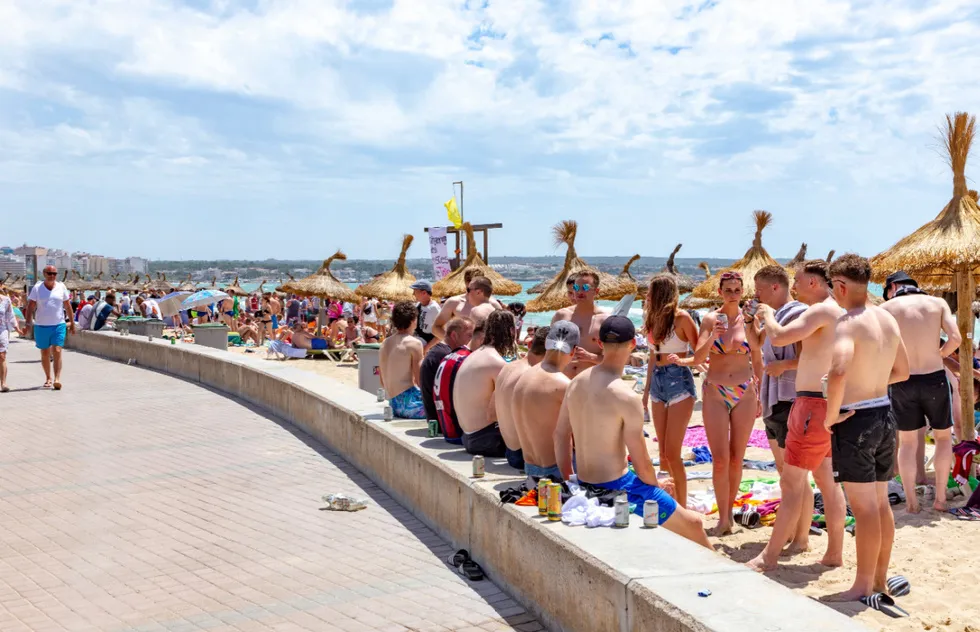 (Summer crowd in Palma de Mallorca, Spain | Credit: travelview / Shutterstock)
Other drinking laws to know
Speaking of foolish and immature behavior, many years of putting up with rowdy tourists drawn to Spain's sunny coasts, one-of-a-kind festivals, and vibrant cities have prompted the country to enact a bunch of additional alcohol-related regulations affecting visitors who have passed the legal drinking age.
Unless you're at an outdoor cafe, drinking on the street in Madrid and Barcelona is illegal, and violators can be charged a hefty fine.
In recent years, fed-up local governments in the Balearic Islands—the Mediterranean chain that includes storied summer party locales Mallorca and Ibiza—have rolled out an array of new liquor laws aimed at clamping down on alcohol consumption in beach resort areas.
Among the stuff banned with the laws: happy hours, some party boat trips, sales of alcohol in shops from 9:30pm to 8am, and the distribution of more than six free alcoholic drinks per person per day at all-inclusive hotels.
Additionally, the Balearic Islands have banned drinking in the street. Those who violate the law, which will remain in effect until at least 2027, are subject to fines from €500 to €1,500 ($541–$1,600)—or up to €3,000 (about $3,600) for serious offenses.
Maybe it's a good time to consider joining the sober travel trend?