Home > Destinations > Europe > England > London > In Depth > Architecture
Frommers.com Frommers.com
Most Recent London Forum Posts
Most Recommended Articles
Most Commented Articles
  Print This Article Print Get Frommer's RSS Feed RSS

Architecture

Originally, London was a collection of scattered villages and towns that were unified under the pressure of the Industrial Revolution in the 18th and 19th centuries. A little of the city's original flavor and feeling remains in such places as Whitechapel, Chelsea, Hammersmith, and Hampstead. During the 18th century, when the principles of "picturesque planning" were being evolved for a rapidly expanding London, planners consciously incorporated the best of the greens, riverbank terraces, and small-scale layouts of the original villages. These rural features (rigorously preserved by neighborhood residents today) are now completely enclosed by the bulk and congestion of urban London.

Norman Architecture (1066-1200)

The oldest surviving architectural style in London dates to when the 1066 Norman Conquest brought the Romanesque era to Britain, where it flourished as the Norman style.

Churches in this style were large, with a wide nave and aisles to accommodate the masses who came to hear Mass and worship at the altars of various saints. But to support the weight of all that masonry, the walls had to be thick and solid, giving Norman churches a dark, somber, mysterious, and often oppressive feeling.

The best examples of Norman architecture include London's White Tower (1078), William the Conqueror's first building in Britain at the Tower of London; Durham Cathedral (1093-1488), with a Norman floor plan, and Ely Cathedral (1083-1189), with a nave and south transept that are perfectly Norman.

Gothic Architecture (1150-1550)

The French Gothic style invaded England in the late 12th century, trading rounded arches for pointy ones -- an engineering discovery that freed church architecture from the heavy, thick walls of Norman structures and allowed ceilings to soar, walls to thin, and windows to proliferate.

The Gothic proper in Britain can be divided into three overlapping periods or styles: Early English (1150-1300), Decorated (1250-1370), and Perpendicular (1350-1550).

The best example of Early English is Salisbury Cathedral (1220-65), unique in Europe for the speed with which it was built. The first to use pointy arches was Wells Cathedral (1180-1321), which has 300 statues on its original facade.

The facade, nave, and chapter house of York Minster (1220-1480), which preserves the most medieval stained glass in Britain, is Decorated, though the chancel is Perpendicular and the transepts are Early English. Exeter Cathedral (1112-1206) has an elaborate Decorated facade and fantastic nave vaulting.

The Perpendicular, King's College Chapel at Cambridge (1446-1515) has England's most magnificent fan vaulting, along with some fine stained glass. Henry VII's Chapel (1503-19) in London's Westminster Abbey is textbook Perpendicular.

Renaissance Architecture (1550-1650)

It wasn't until the Elizabethan era that the Brits turned to the Renaissance style sweeping the Continent. England's greatest Renaissance architect, Inigo Jones (1573-1652), brought back from his Italian travels a fevered imagination full of the exactingly classical theories of Palladianism, a style derived from the buildings and publications of Andrea Palladio (1508-80). However, most English architects at this time tempered the Renaissance style with a heavy dose of Gothic-like elements.

Jones applied his theories of Palladianism to such edifices as Queen's House (1616-18 and 1629-35) in Greenwich; the Queen's Chapel (1623-25) in St. James's Palace and the Banqueting House (1619-22) in Whitehall, both in London.

Baroque Architecture (1650-1750)

England's greatest architect was Christopher Wren (1632-1723), a scientist and member of Parliament who got the job of rebuilding London after the Great Fire of 1666. He designed 53 replacement churches alone, plus the new St. Paul's Cathedral, which was the crowning achievement of English Baroque and of Wren himself. Other proponents of baroque architecture were John Vanbrugh (1664-1726) and his mentor and oft collaborator, Nicholas Hawksmoor (1661-1736), who sometimes worked in a more Palladian idiom. Vanbrugh's crowning achievement was Blenheim Palace (early 1700s), England's Versailles.

Neoclassical & Greek Architecture (1714-1837)

Many 18th-century architects cared little for the baroque period, and during the Georgian era (1714-1830) a restrained, simple neoclassicism reigned. This Greek revival style was practiced by architects such as James "Athenian" Stuart (1713-88), who wrote a book on antiquities after a trip to Greece, and the somewhat less strict John Soane (1773-1837).

Much of the city of Bath was made over in the 18th century, most famously by the father and son team of John Woods, Sr. and Jr. (1704-54 and 1728-81, respectively). They were responsible, among others, for the Royal Crescent (1767-75), where you can visit one house's interior and even lodge in another.

Victorian Gothic Revival Architecture (1750-1900)

The early Romantic Movement swept up others with rosy visions of the past. This imaginary and fairy-tale version of the Middle Ages led to such creative developments as the pre-Raphaelite painters and Gothic revival architects, who really got a head of steam under their movement during the eclectic Victorian era.

Gothic "Revival" is a bit misleading, as its practitioners usually applied their favorite Gothic features at random rather than faithfully re-creating a whole structure.

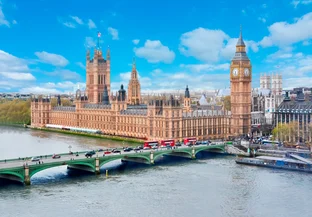
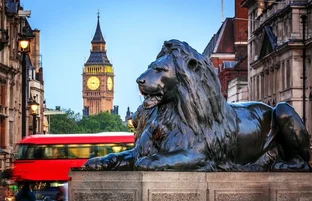
The best example is the Palace of Westminster (Houses of Parliament), London (1835-52). Charles Barry (1795-1860) designed the wonderful British seat of government in a Gothic idiom that, more than most, sticks pretty faithfully to the old Perpendicular period's style. His clock tower, usually called "Big Ben" after its biggest bell, has become an icon of London itself.

20th Century Architecture

After the World War II Blitz, much of central London had to be rebuilt. Most of the new commercial buildings in the city held to a functional school of architecture aptly named Brutalism. It wasn't until the boom of the late 1970s and 1980s that postmodern architecture gave British architects a bold, new direction with a skyscraper motif.

Stellar examples of modern architecture include Lloyd's Building in London (1978-86), the masterpiece of Richard Rogers (1933- ), and Canary Wharf Tower (1986), also in London, a complex designed by Cesar Pelli (1926-).


Back to Top


Note: This information was accurate when it was published, but can change without notice. Please be sure to confirm all rates and details directly with the companies in question before planning your trip.


  Print This Article Print Get Frommer's RSS Feed RSS
Destination Guide
Destination Guide Destination Guide Destination Guide
Destination Guide Destination Guide Frommer's London 2010 Destination Guide Frommer's London 2010

Author: Darwin Porter
Pub Date: September 28, 2009
Price: $19.99

Add to Cart
Destination Guide Destination Guide Destination Guide Related Titles:
England For Dummies, 4th Edition
Destination Guide
England With Your Family
Destination Guide
Frommer's 24 Great Walks in Dublin, 1st Edition
Destination Guide
Destination Guide Destination Guide
Destination Guide Destination Guide Destination Guide
Destination Guide
Destinations
Destinations
Home > Destinations > Europe > England > London > In Depth > Architecture