Home > Destinations > Europe > England > London > Traveler's Guide to Art & Architecture > Architecture
Bookstore Travel Talk - Our Message Boards Tips and Tools Book a Trip Deals and News Trip Ideas, Activities, Lifestyles Hotels Destinations Frommers.com Home
Frommer's - The best trips start here. Frommer's - The best trips start here.
Sign up for our FREE Newsletters! Win a FREE Trip
  Email This Article Email Print This Article Print Get Frommer's RSS Feed RSS

Architecture

While each architectural era in London has its own distinctive features, there are some elements, floor plans, and terms common to many.

From the Romanesque period on, most churches consist of either a single wide aisle or a wide central nave flanked by two narrow, shorter aisles. The aisles are separated from the nave by a row of columns, or square stacks of masonry called piers, connected by arches. Sometimes -- especially in the medieval Norman and Gothic eras -- there is a second level to the nave, above these arches (and hence above the low roof over the aisles) punctuated by windows, called a clerestory. Often between the arches and clerestory windows there is a small passageway inside the wall called the triforium, open on the nave side via a series of small arches.

This main nave/aisle assemblage is usually crossed by a perpendicular corridor called a transept near the far, east end of the church, so that the floor plan looks like a Latin Cross. The shorter, east arm of the nave is called the chancel; it often houses the stalls of the choir and the altar. Some churches use a rood screen (so called because it supports a rood, the Saxon word for crucifixion) to separate the nave from the chancel. If the far end of the chancel is rounded off, it is called an apse. An ambulatory is a corridor outside the altar and choir area, separating it from the ring of smaller chapels radiating off the chancel and apse.

Some churches, especially after the Renaissance when mathematical proportion became important, were built on a Greek Cross plan, each axis the same length, like a giant +.

It's worth pointing out that very few buildings (especially churches) were built in only one style. They often took centuries to complete, during which time tastes would change and plans would be altered.

Norman (1066-1200)

Aside from a smattering of ancient sites -- preclassical stone circles at Stonehenge and Avebury, and Roman ruins such as the Bath spa and Hadrian's Wall -- the oldest surviving architectural style in England dates to when the 1066 Norman Conquest brought the Romanesque era to Britain, where it flourished as the Norman style.

Churches were large, with a wide nave and aisles to fit the masses that came to hear Mass and worship at the altars of various saints. But to support the weight of all that masonry, the walls had to be thick and solid (pierced by only a few small windows) and resting on huge piers, which gives Norman churches a dark, somber, mysterious feeling.

Some of the features of this style include:

  • Rounded arches. These load-bearing architectural devices allowed the architects to open up wide naves and spaces, channeling the weight of the stone walls and ceiling across the curve of the arch and down into the ground via the columns or pilasters.

  • Thick walls.

  • Infrequent and small windows.

  • Huge piers. These are square stacks of masonry.

  • Chevrons. These zigzagging decorations often surround a doorway or wrap around a column.

    White Tower, London (Gundulf, 1078), William the Conqueror's first building in Britain, is the central keep of the Tower of London. The tower's fortress-thick walls and rounded archways provide a textbook example of a Norman-era castle. St. John's Chapel, located in the White Tower, is one of the few remaining Norman churches in England.

    Gothic (1150-1550)

    The French Gothic style invaded England in the late 12th century, trading rounded arches for pointy ones -- an engineering discovery that freed architects from the thick walls of Norman structures and allowed ceilings to soar, walls to thin, and windows to proliferate.

    Instead of dark, somber, relatively unadorned Norman interiors that forced the eyes of the faithful toward the altar, the Gothic interior enticed the churchgoers' gazes upward to high ceilings filled with light. While the priests conducted Mass in Latin, the peasants could "read" the Bible stories in the stained-glass windows.

    The squat exteriors of the Norman churches were replaced by graceful buttresses and soaring spires, which rose from town centers.

    The Gothic style made comebacks in the 17th century as Laudian Gothic in some Oxford and Cambridge buildings, in the 18th century as rococo or Strawberry Hill Gotick, and in the 19th century as Victorian Gothic Revival, discussed below.

    The Gothic proper in Britain can be divided into three periods or styles: Early English (1150-1300), Decorated (1250-1370), and Perpendicular (1350-1550). Although each has identifiable features, they all include:

  • Pointed arches. The most significant development of the Gothic era was the discovery that pointed arches could carry far more weight than rounded ones.

  • Ribbed vaulting. In Gothic buildings, the square patch of ceiling between four columns arches up to a point in the center, creating four sail shapes. This is called a cross-vault. The X separating these four sails is often reinforced with ridges called ribbing. As the Gothic progressed, the spaces between the structural ribbing became more decorative, often filled with tracery (delicate and lacelike carved stone). In the Perpendicular style, fan vaulting (cone-shape concave vaults springing from the same point) was often used.

  • Flying buttresses. These freestanding exterior pillars connected by graceful, thin arms of stone help channel the weight of the building and its roof out and down into the ground.

  • Plate tracery. The tip of a window, or the tips of two side-by-side windows, is often filled with a flat plate of stone pierced by a light (tiny window), which is either round or in a trefoil (three round petals, like a clover) or quatrefoil (four petals) shape.

  • Stained glass. The multitude and size of Gothic windows allowed them to be filled with Bible stories and symbolism writ in the colorful patterns of stained glass. The use of stained glass was more common in the later Gothic periods.

  • Rose windows. These huge, circular windows, often the centerpieces of facades, are filled with elegant tracery and "petals" of stained glass.

  • Spires. These pinnacles seem to defy gravity and reach toward heaven itself.

  • Gargoyles. These are drain spouts disguised as wide-mouthed creatures or human heads.

  • Choir screen. Serving as the inner wall of the ambulatory and the outer wall of the choir section, the choir screen is often decorated with carvings or tombs.

    Among England's towering Gothic achievements, Salisbury Cathedral (1220-65) is almost unique for the speed with which it was built and the uniformity of its architecture. King's College Chapel (1446-1515) at Cambridge has England's most magnificent fan vaulting, along with some fine stained glass. At Windsor are two great examples, the College Chapel at Eton College (the stained glass is modern, and the fan vaulting painstakingly redone in 1957, but the 15th-century murals are original), and the St. George's Chapel in Windsor Castle (a gorgeous nave vault with fan vaulting in the aisles and carved choir stalls).

    Renaissance (1550-1650)

    While Italy and even France were experimenting with the Renaissance ideals of proportion, classical inspiration, and mathematical precision to create unified, balanced structures, England was trundling along with the late Tudor Gothic Perpendicular style (the Tudor use of red brick became a major feature of later Gothic revivals) in places such as Hampton Court Palace.

    It wasn't until the Elizabethan era that the Brits turned to the Renaissance style sweeping the Continent. Architect Inigo Jones (1573-1652), England's greatest Renaissance architect, brought back from his travel in Italy a fevered imagination full of the exactingly classical theories of Palladianism, as developed by Andrea Palladio (1508-80). Although Jones applied what he'd learned to several English structures, most English architects at this time tempered the Renaissance style with a heavy dose of Gothic-like elements.

    Little specifically identifies Renaissance buildings, except:

  • A sense of proportion.

  • A reliance on symmetry.

  • The use of classical orders. This idea specifies three different column types: Corinthian, Ionic, and Doric.

    Noteworthy structures in this style by Inigo Jones include the Queen's House, Greenwich (1616-18 and 1629-35); the Queen's Chapel, St. James's Palace (1623-25), and the Banqueting House, Whitehall (1619-22), both in London; and the state rooms of Wiltshire's Wilton House (1603), where Shakespeare performed and D-day was planned. Recently, Shakespeare's Globe Theatre dusted off one of Jones's never-realized plans and used it to construct the new indoor theater.

    Baroque (1650-1750)

    England's greatest architect was Sir Christopher Wren (1632-1723), a scientist and member of Parliament who got the job of rebuilding London after the Great Fire of 1666. He designed 53 replacement churches alone, plus the new St. Paul's Cathedral and numerous other projects.

    The identifiable features of the baroque as practiced by Wren and others include:

  • Classical architecture rewritten with curves. The baroque is similar to the Renaissance; however, many of the right angles and ruler-straight lines are exchanged for curves of complex geometry and an interplay of concave and convex surfaces. The overall effect is to lighten the appearance of structures and to add some movement of line.

  • Complex decoration. Unlike the sometimes severe and austere designs of Renaissance and other classically inspired styles, the baroque was often playful and apt to festoon structures with decorations to liven things up.

    St. Paul's Cathedral, London (1676-1710), is the crowning achievement both of the English baroque and of Christopher Wren himself. The city's other main Wren attraction is the Royal Naval College, Greenwich (1696).

    A student of Wren, Nicholas Hawksmoor practiced a baroque more fanciful than that of his teacher. Hawksmoor left London several churches, including St. Mary Woolnoth (1716-24); St. George's, Bloomsbury (1716-30); Christ Church, Spitalfields (1714-29); and St. Anne's, Limehouse (1714-30).

    Neoclassical & Greek Revival (1714-1837)

    Many 18th-century architects cared little for the baroque, and during the Georgian era (1714-1830), a restrained, simple neoclassicism reigned, balanced between a resurgence of the precepts of Palladianism and an even more distilled vision of classical theory called Greek Revival.

    Buildings in these styles may be distinguished by:

  • Mathematical proportion, symmetry, and classical orders. These classical ideals first rediscovered during the Renaissance are the hallmark of every classically styled era.

  • Crescents and circuses. The Georgians were famous for these seamless, curving rows of identical stone town houses with tall windows, each one simple yet elegant inside.

  • Open double-arm staircases. This feature was a favorite of the neo-Palladians.

    The chapel in Greenwich Hospital (1779-88) is a fine example of the style, courtesy of the most textbook of Greek Revivalists, James "Athenian" Stuart. The greatest site by Greek Revivalist John Soane is his own idiosyncratic house at No. 13 Lincoln's Inn Fields (1812-13), now Sir John Soane's Museum (other Soane buildings include the Dulwich Picture Gallery and the facade of the Bank of England in Bartholomew Lane). Another example of this style is the British Museum (Robert and Sidney Smirke, 1823).

    Victorian Gothic Revival (1750-1900)

    While neoclassicists were reinterpreting the classical age, the Romantic movement swept up many others with rosy visions of the past. Their imaginary and fairytale version of the Middle Ages led to such creative developments as the pre-Raphaelite painters and Gothic Revival architects, who really got a head of steam under their movement during the eclectic Victorian era.

    Buildings in the Victorian Gothic Revival style can be distinguished by:

  • Mishmash of Gothic features. Look at the Gothic features described earlier, and then imagine going on a shopping spree through them at random. How to tell the copycats from the original? Victorian buildings are much younger, so they tend to be in better shape. They're also often much larger than original Gothic buildings.

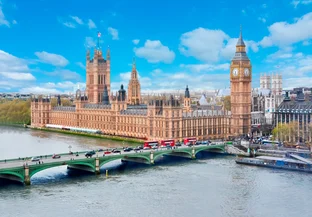
  • Eclecticism. Few Victorians bothered with getting all the formal details of a particular Gothic era right (London's Houses of Parliament comes closest). They just wanted to make sure the overall effect was pointy with pinnacled turrets, busy with decorations, and medieval.

  • Grand scale. These buildings tend to be very large. This was usually accomplished by using Gothic only on the surface, with Industrial Age engineering underneath.

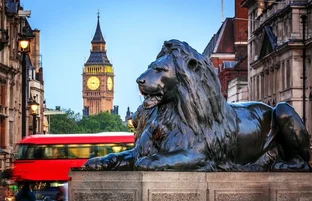
    Charles Barry designed the British seat of government, the Palace of Westminster (Houses of Parliament; 1835-52), in a Gothic idiom that sticks pretty faithfully to the old Perpendicular period's style. His clock tower, usually called Big Ben after its biggest bell, has become an icon of London.

    The massive pinnacled and redbrick Victorian St. Pancras Chambers (formerly the Midlands Hotel; George Gilbert Scott, 1867) at St. Pancras Station makes for a quirky entrance to the Industrial Age phenomenon of rail travel. (And, while purely industrial and not Gothic, the station's steel-and-glass train shed, designed by William Henry Barlow, was an engineering marvel, the widest in the world at its time.) The Albert Memorial (George Gilbert Scott, 1863-72), a massive Gothic canopy by the same architect, was commissioned by Queen Victoria in memory of her husband. Like St. Pancras, the Natural History Museum (Alfred Waterhouse, 1873-81) is a delightful marriage of imposing neo-Gothic clothing hiding an Industrial Age steel-and-iron framework.

    The 20th Century

    For the first half of the 20th century, London was too busy expanding into suburbs (in an architecturally uninteresting way) and fighting world wars to pay much attention to architecture. After the Blitz, much of central London had to be rebuilt, but most of the new buildings that went up in the City held to a functional school of architecture aptly named Brutalism. It wasn't until the late 1970s and 1980s that postmodern architecture gave British architects a bold new direction.

    Identifiable features of postmodern architecture in London include:

  • The skyscraper motif. Glass and steel as high as you can stack it.

  • A reliance on historic details. Like the Victorians, postmodernists also recycled elements from architectural history, from classical to exotic.

    The Lloyd's Building (1978-86) is the British postmodern masterpiece by architect Richard Rogers, who had a hand in the design of Paris's funky Centre Pompidou. Britain's tallest building, Canary Wharf Tower (César Pelli, 1986), is the centerpiece of the early 1990s Canary Wharf office complex and commercial development. Charing Cross (Terry Farrell, 1991) capped the famous old train station with an enormous postmodern office-and-shopping complex in glass and pale stone.


    Back to Top


    Note: This information was accurate when it was published, but can change without notice. Please be sure to confirm all rates and details directly with the companies in question before planning your trip.


      Email This Article Email Print This Article Print Get Frommer's RSS Feed RSS
    Frommer's London 2008 Frommer's London 2008

    Author: Darwin Porter
    Pub Date: September 04, 2007
    Price: $17.99

    Buy Now!
    Related Titles:
    England For Dummies, 4th Edition
    Frommer's Best Day Trips from London: 25 Great Escapes by Train, Bus or Car, 3rd Edition
    Frommer's Britain's Best-Loved Driving Tours, 8th Edition
    Sponsored Links: What's This?
    Be a Brit Different.
  • Add Frommers.com RSS Feed  Add Frommers.com RSS Feed (What's This?)
    Add Frommers.com Deals & News to Your Web Site
    Add to My Yahoo!     Add to My MSN     More RSS Readers
    Add Frommers.com Podcast Add Frommers.com Podcast (What's This?)
    Home > Destinations > Europe > England > London > Traveler's Guide to Art & Architecture > Architecture