|
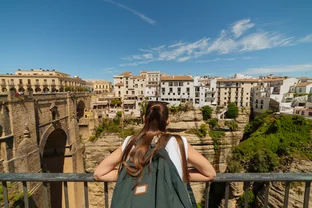
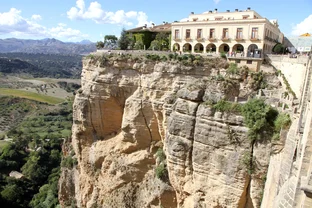
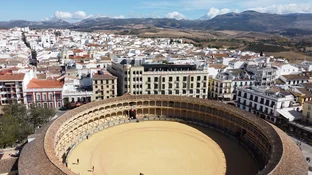
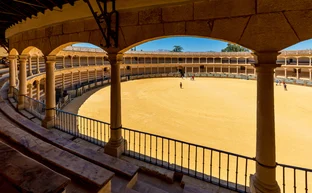
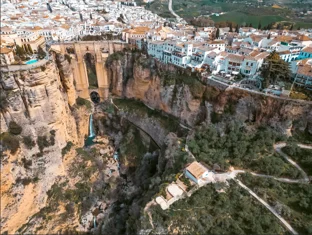
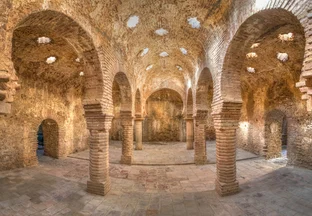
AttractionsIt takes a half-day at most to see Ronda, but if you have more time, spend a full day or even two wandering the narrow streets of the walled Old Town and exploring the Moorish ruins. The best time to visit is in the spring when the orange and almond trees are in bloom. Ronda was precariously erected at the edge of the mountain range of the Serranía de Ronda on a rocky geological platform site that was cut by the Guadalevín River in prehistoric times. El Tajo, a 100m (328-ft.) ravine, divides Ronda into two distinct parts, including La Ciudad, the Moorish Old Town with a labyrinth of streets and alleyways, flanked by whitewashed houses with wrought-iron balconies. La Ciudad is on the south side of El Tajo ("the ravine" in English). The newer town, El Mercadillo, is to the north. This town sprang up after the Christian Reconquest and is filled with a number of attractions, including the Plaza de Toros (bullring). Three bridges cross the gorge, the main one being Puente Nuevo, from which you can enjoy a panoramic view of Ronda and its countryside. This is Ronda's most famous bridge and was an architectural marvel when it was constructed between 1755 and 1793. A lantern-lit parapet graces the bridge. Over the years many people have fallen to their deaths from here -- even the original architect did so during an inspection. During the bitter Spanish Civil War, it was a place of execution for Franco's troops or the rebels, depending on which group was controlling Ronda at the time. Ernest Hemingway in For Whom the Bell Tolls recorded how prisoners were thrown alive into this deep gorge. Ronda's two other bridges are both north of Puente Nuevo. These include Puente Viejo (Old Bridge), dating from 1616, and the single-span Moorish bridge, Puente de San Miguel. Ronda is still entered by two ancient gates, the 13th-century Puerta de Almocobar and the 16th-century Puerta de Carlos V. In the center of the Moorish quarter is Iglesia de Santa María de la Encarnación la Mayor, Plaza Duquesa de Parcent s/n (tel. 95-287-22-46), a collegiate church that acts as a cathedral. The landmark square it occupies is Ronda's most central. Like many churches in Andalusia, Santa María is a reconstruction of a former mosque, in this case, the Great Mosque of Ronda. As a result, both the interior and exterior feature a medley of architectural styles. Outside you see Moorish, Gothic, and Renaissance influences, with a belfry constructed on top of the old Moorish minaret. Inside you'll find naves in the late Gothic style, a main altar heavy with baroque gold leaf, a Plateresque chancel, and an arch still covered with Arabic calligraphy. You can still see an old Muslim mihrab (prayer niche) in front of the current street door. The two-tiered balcony on the facade was a gallery where notables could watch special events staged on the square below. Admission is 4€ ($6.40) for adults, 3€ ($4.80) for students, and free for children 11 and under. The church is open daily May to October 10am to 8pm (daily 10am-6pm in the off season). East of the church if you follow Callejón de los Tramposos, you can see a Moorish tower, Minarete de San Sebastián, part of the original Great Mosque of Ronda dating to the 14th century. The still-functioning Baños Arabes, in a ravine below the Palacio del Marqués de Salvatierra (tel. 65-695-09-37), are reached from the turnoff to Puente San Miguel. Dating from the 13th century, the baths have glass roof-windows and hump-shaped cupolas. Still well preserved, they are the finest example of Moorish baths in Spain. The star-shaped vents in the roof were modeled after the ceiling of the more famous bathhouse at the Alhambra in Granada. Note the beautiful octagonal brick columns supporting horseshoe arches. A channel from the nearby river carried water into the complex, which once was surrounded by landscaped Moorish gardens. Admission is 3€ ($4.80) Monday to Saturday and free on Sunday. The baths are open Monday to Friday 10am to 7pm, Saturday 10am to 3pm, and Sunday 9am to 3pm. Palacio de Mondragón, Plaza de Mondragón (tel. 95-287-84-50), was once the 14th-century private home of the Moorish king Abomelic. But after the Reconquista, it was renovated to receive King Ferdinand and Queen Isabella, who stayed here. Inside you can see a trio of courtyards and a collection of Moorish mosaics. There is also a beautiful carved wooden ceiling. A small museum houses artifacts devoted to regional archaeology. Better than the museum is the restored Mudéjar courtyard where you can take in a panoramic view of El Tajo with the Serranía de Ronda looming in the background. Flanked by two Mudéjar towers, the building now has a baroque facade. It's open Monday to Friday 10am to 7pm, Saturday and Sunday 10am to 3pm; admission is 3€ ($4.80) for adults and free for children 13 and under. Casa del Rey Moro, Cuesta del Santo Domingo (tel. 95-218-72-00), is misnamed, as this House of the Moorish King was actually built in 1709. However, it's believed to have been constructed over Moorish foundations. The interior is closed, but from the garden, you can take an underground stairway, called La Mina, which leads you to the river, a distance of 365 steps. Christian slaves cut these steps in the 14th century to guarantee a steady water supply in case Ronda came under siege. The owners of the Casa Imperial in Seville are turning this building into a sumptuous luxury hotel. When completed, perhaps in the lifetime of this edition, it is anticipated this will become Ronda's high-end luxury address. Ronda has the oldest bullring in Spain. Built in 1785, the Plaza de Toros is the setting for the yearly Corrida Goyesca in honor of Ronda native son Pedro Romero, one of the greatest bullfighters of all time. The bullring is a work of architectural beauty, built of limestone with double arches and 136 Tuscan-like columns. The town is still talking about the music video Madonna and entourage staged here. If you want to know more about Ronda bullfighting, head for the Museo Taurino, Calle Virgen de la Paz (tel. 95-287-41-32; www.rmcr.org), reached through the ring. It's open daily March to October 10am to 8pm and November to February 10am to 7pm. Admission is 6€ ($9.60). Exhibits document the exploits of the noted Romero family. Francesco invented the killing sword and the muleta, and his grandson, Pedro (1754-1839), killed 5,600 bulls during his 30-year career. Pedro was the inspiration for Goya's famous Tauromaquia series. There are also exhibits devoted to Cayetano Ordóñez, the matador immortalized by Hemingway in The Sun Also Rises. Museo Lara, Calle Armiñan 29 (tel. 95-287-12-63; www.museolara.org) contains the private art collection of a well-known local, Juan Antonio Lara. He started collecting "things" when he was a young boy, and this extensive museum is filled with what he accumulated in his lifetime -- some 5,000 artifacts in all. These are divided into seven different compartments -- galleries devoted to bullfighting, archaeology, weapons, antique clocks, knives, musical instruments, and early cameras and cinematographic equipment. Admission is 4€ ($6.40) for adults, and 2€ ($3.20) for students, children, and seniors. Hours are daily 11am to 8pm. When Curses Become a Blessing -- On a hot day -- and summers are very hot in Ronda -- you can retreat to the town's loveliest spot, the gardens of Alameda del Tojo, beyond the Plaza de Toros in El Mercadillo, the New Town. This park dates from the heyday of the British invasion in the 19th century. The city fathers at the time raised money to create the gardens by heavily fining citizens who used obscene language in public. Apparently, there was a lot of cussing going on because the park is truly beautiful. If you walk to the end of the gardens, a panoramic balcony emerges from the face of the cliff. If you don't have vertigo, you can take in a vast sweep of the countryside beyond and the views of Serranía de Ronda in the distance. A cliff-top walk leads to the Hotel Reina Victoria. Prehistoric Cave Paintings Near Benaoján, the Cueva de la Pileta (tel. 95-216-73-43; www.cuevadelapileta.org), 25km (16 miles) southwest of Ronda, plus a 2km (1 1/4-mile) hard climb, has been compared to the Caves of Altamira in northern Spain, where prehistoric paintings were discovered toward the end of the 19th century. In a wild area known as the Serranía de Ronda, José Bullón Lobato, grandfather of the present owners, discovered this cave in 1905. More than a mile in length and filled with oddly and beautifully shaped stalagmites and stalactites, the cave also contained five fossilized human skeletons and two animal skeletons. In the mysterious darkness, prehistoric paintings depict animals in yellow, red, black, and ocher, as well as mysterious symbols. One of the highlights of the tour is a trip to the chamber of the fish, containing a wall painting of a great black seal-like creature about 1m (3 ft.) long. This chamber, the innermost heart of the cave, ends in a precipice that drops vertically nearly 75m (250 ft.). In the valley just below the cave lives a guide who'll conduct you around the chambers, carrying artificial light to illuminate the paintings. Plan to spend at least an hour here. Tours are given daily from 10am to 1pm and 4 to 6pm (Nov to mid-Apr 10am-1pm and 4-5pm). Admission, including the hour-long tour, is 8€ ($13) for adults, 5€ ($8) for children 10 to 13, and 2.50€ ($4) for ages 5 to 9. It's easiest to get here by car from Ronda, but you can also take the train to Benaoján. The cave, with an entrance at least 6.5km (4 miles) uphill, is in the rocky foothills of the Sierra de Libar midway between two tiny villages: Jimera de Libar and Benaoján. Ronda and the cave are in parallel valleys, separated by a steep range of hills. Reaching the cave requires a rather complicated detour to either the south or the north of Ronda and then doubling back.
Maps Note: This information was accurate when it was published, but can change without notice. Please be sure to confirm all rates and details directly with the companies in question before planning your trip. Related Features Partner Deals:
|
|
|||||||||||||||||||||||||||||||||||||||||||||||||||||||||||||||||||||||||||||||||||||||||||||||||||||||||||||||||||||||||||||||||||||||||||||||||||||||||||||||||||||||||||||||||||||||||||||||||||||||||||||||||||||||||||||||||||||||||||||||||||||||||