
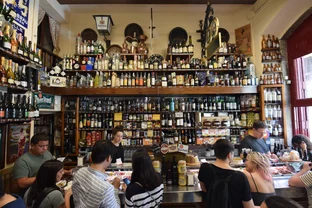
Barcelona is a city rich in museums, meaning you could spend a full week here visiting several per day and not get to them all. Since no one has unlimited time to sightsee, here's our cheat sheet of the museums that are the most satisfying for visitors.Museu Nacional d’Art de…
Anna Lurye / Shutterstock
Things To Do in Barcelona
Jump to:
Bookstore
Available as paperback
and as e-book.
Barcelona Attractions
It’s no secret that Barcelona gets a lot of visitors, and the main attractions manage that demand carefully. If you don’t already have a ticket for the most popular sites before you arrive, you risk missing out. No matter the season, buy timed-entry tickets in advance for the Basilica de la Sagrada Família, Parc Güell, and Museu Picasso. You can still buy tickets on the door at less busy spots, but in almost every case it pays to get them online. You’ll often save a euro or two, and you’ll usually be able to skip the lines.
You might also consider getting a sightseeing pass. Depending on what you want to see, a range of discount programs can help you make big savings. Barcelona Card includes free admission and skip-the-line access to more than 25 museums, unlimited public transport for 3, 4, or 5 days (including airport trains), and discounts on around 70 cultural activities, including up to 20 percent on the major Modernista buildings. Buy it at Barcelona Turisme offices, or online for a 10 percent discount. Online prices are: 51.30€ for 72 hours, 60.30€ for 96 hours, and 70.10€ for 120 hours. Prices for children aged 4–12 are 31.50€, 39.60€, and 44.10€.
The 2-day Barcelona Card Express, costs only 24.30€ online, and includes free public transport, but offers discounts rather than free admissions. For both cards, check the website for discounts of up to 50 percent.
For art lovers, Articket BCN provides skip-the-line access to six major art museums for 38€: Museu Picasso, Museu Nacional d’Art de Catalunya, Fundació Joan Miró, Fundació Antoni Tàpies, Centre de Cultura Contemporània de Barcelona (CCCB), and the Museu d’Art Contemporani de Barcelona (MACBA). You’ll save 45 percent if you make it to all six, but for most visitors the Barcelona Card is probably a better bet.
When weighing the options, bear in mind that on the first Sunday of each month, admission is free at many museums including Museu Picasso, Museu Nacional d’Art de Catalunya (MNAC), and Museu d’Història de Catalunya. MNAC is also free every Saturday after 3pm, and Museu Picasso offers free entry on Thursday evenings.
Also: beware of unofficial websites that charge higher rates than the ones listed here.
A word on Audio Guides
Barcelona’s museums and historic buildings are sophisticated, well-funded places, and technology is to the fore. Almost every attraction features an audio guide, often via an app you access on your phone, and many (including the cathedral and Sagrada Família) offer augmented reality.
But just because you can, does it mean you should? The danger is you spend half your visit fiddling with your phone. Where audio guides are especially helpful, we’ll recommend them on this website, but many of Barcelona's extraordinary sights require no enhancement. So, consider switching off your phone, removing your earbuds, and immerse yourself in simple contemplation.
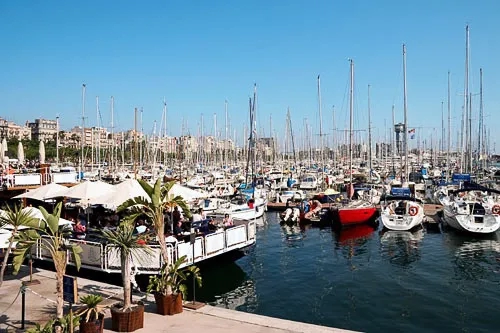
Planning your Barcelona sightseeing geographically
Most of Barcelona (with the notable exception of the Gothic Quarter and Raval, near the sea) is laid out on a grid. Locals refer to the sea (mar) or mountain (montaña) side of streets to give directions, but for the sake of explanation here, we’ll place the Mediterranean to the south (which it isn’t exactly) and to the north the mountains that you can see from almost anywhere in the city. There are essentially four parts of Barcelona that interest visitors most: the Old City of the Romans and the Middle Ages; the 19th-century planned city, called Eixample; the waterfront; and the mountain called Montjüic.
In the oldest part of town, les Rambles (pronounced “las ramblas”) is a central north-south artery from Plaça de Catalunya down to the sea. It’s actually a succession of streets, whose names—Rambla de Santa Mònica, Rambla dels Caputxins, Rambla de Sant Josep, Rambla dels Estudis, Rambla de Canaletes—recall the various religious orders that were once located here. To the west of it lies the Raval neighborhood, and to the east, the oldest part of Barcelona: the Barrio Gotico and El Born. The Picasso Museum, the Cathedral, the church of Santa Maria del Mar, and the Palace of Catalan Music are found in the warren of narrow streets holding the Gothic Quarter and the Born neighborhoods. The Raval is home to the Museum of Contemporary Art and the CCCB (Contemporary Center of Catalan Culture), along with lively eateries and shops reflecting the ethnic culture of recent immigrants.
Above the busy hub of Plaça de Catalunya stretches the Eixample, the Catalan word for “expansion,” which is exactly what took place in the second half of the 19th century after Barcelona’s medieval walls were demolished in 1860. Urban planner Ildefons Cerdá freed up the city from the narrow twisting alleys of the Gothic Quarter, shooting his wide thoroughfares and identically spaced blocks of buildings northward, which connected old Barcelona with the village of Gracia; the Rambles were extended beyond Plaça de Catalunya as the Passeig de Gracia (or “the passage to Gracia”), now a chic shopping boulevard.
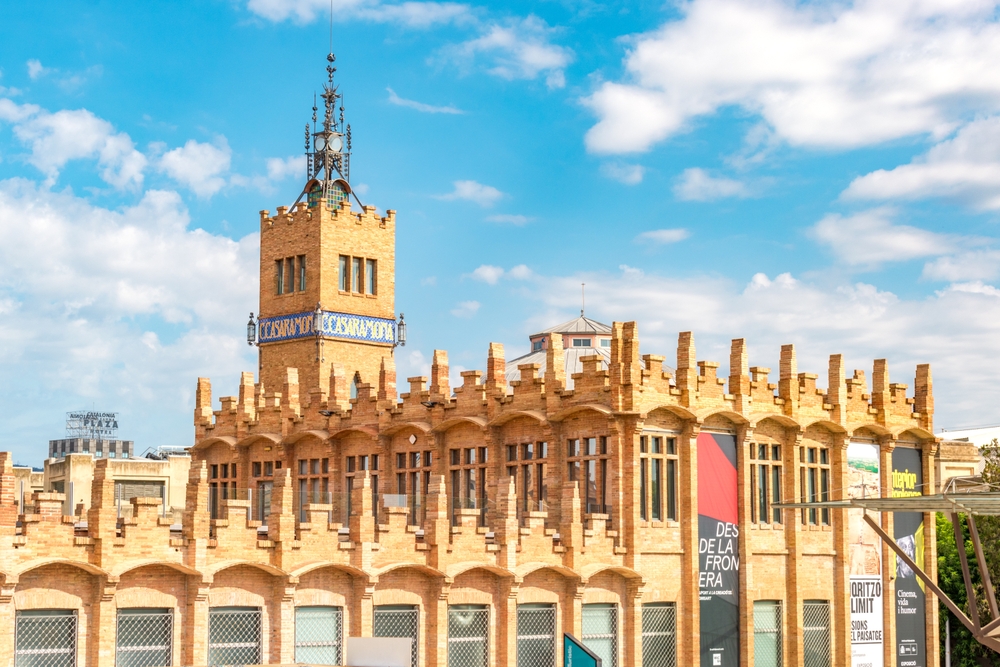
Seeing Great Works of Moderniste Architecture Beyond Gaudi
If you'd like to explore the city's hidden treasures of Modernisme, those that aren’t open specifically as historic museums, consider putting these beauts on your itinerary:
Caixa Forum—Near Plaça d’Espanya, this former factory built by the major Modernista architect Puig I Cadalfach re-opened in 2002 as a handsome venue for La Caixa bank’s traveling art exhibitions. If you don’t want to pay for the art shows, you can still roam around the brick pavilions and go up on the undulating rooftop, which you will probably have pretty much to yourself. Av. De Francesc Ferrer i Guárdia, 6-8.
Fundació Mapre—The elegant Casa Garriga Nogués, an extraordinary Modernista mansion by Enric Sagnier in l’Eixample, is now also a space of traveling art exhibitions, which rarely cost more than 3 € to enter. Carrer de Diputació 250. Complete information at www.fundacionmapfre.org/fundacion/en/exhibitions/casa-garriga-nogues.
Hotel España—This still-operating hotel in Raval was renovated by Doménech I Muntaner in 1903-04, given another facelift in 2010 and still another in 2025. Stroll in to see Modernista features like the outrageous alabaster fireplace by sculptor Eusebi Arnau, which still dominates one of the dining rooms. Carrer de Sant Pau 9-11, www.hotelespanya.com.
Palau Baró de Quadras—Open by appointment only, the former residence at Av. Diagonal 373 has been chopped up over the years, but many stunning original elements are still intact.
Want to see more in the company of a local expert? Try the architectural tours at Insight Barcelona (www.insight-barcelona.com); their tours access a number of sites that aren’t usually open to the public.
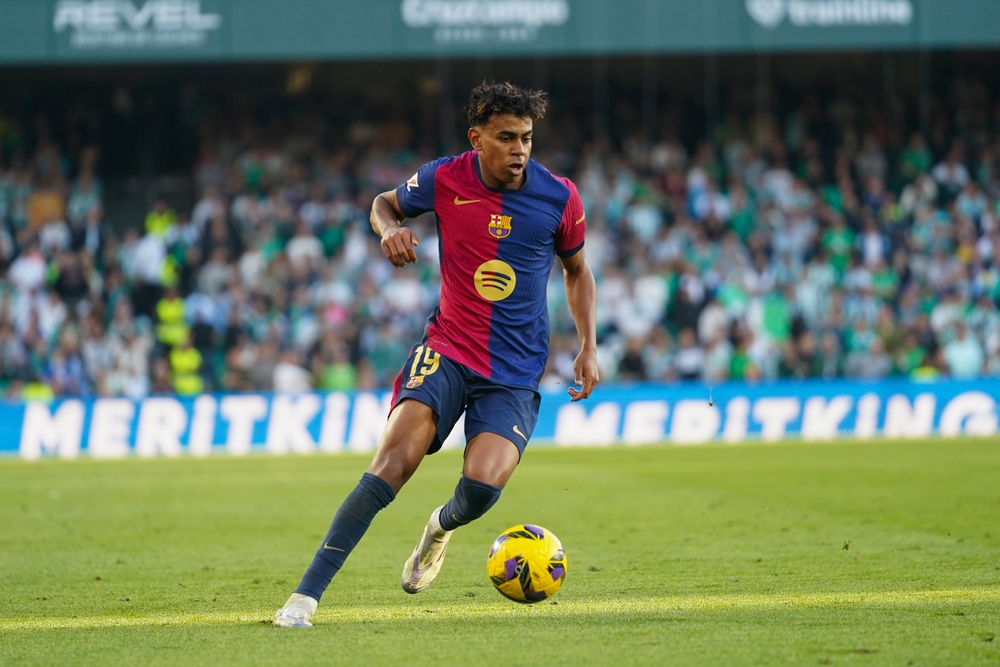
Futbol (Soccer) Experiences in Barcelona
“More than a club” is FC Barcelona’s motto, reflecting the great soccer team’s role as a powerful symbol of Catalan identity, and counterweight to Castilian archrival Real Madrid.
The club’s stadium Camp Nou, where the likes of Lionel Messi, Ronaldinho, and countless Spanish stars made their names, reopened in 2025 after a top to bottom renovation. The new ground holds 105,000 fans, making it the biggest football stadium in Europe. You can usually get tickets via the website from around 60€ for any game other than El Clásico against Real Madrid, when prices soar.
You can also visit the stadium for the Camp Nou Experience, Arístides Mallol, s/n, (tel. 90-218-99-00). A basic ticket at 28€ lets you tour the museum and its extensive collection of trophies and famous players’ shirts, while the Total Xperience at 42€ adds the chance to take shots against a goalkeeping robot, customize a soccer shirt, and take a virtual reality tour of the Barça universe.

72 Results
- Monument
Arc de Triomf
Unlike triumphal arches in other European capitals, this monumental red-brick arch has nothing to do with military conquest. It was built to showcase the city’s civil achievements as the gateway to the 1888 World’s Fair, which took place in nearby Parc de la Ciutadella. The… - Cooking Class
BCN Kitchen
A kitchen and dining room in the El Born neighborhood is the base for this organization that offers a number of hands-on classes. A tapas workshop, for example, usually includes such classics as tortilla Española, gazpacho, and fried calamari with squid ink aioli. English language… - Beach
Barcelona Beaches
You don’t have to leave the city to hit the beach. European blue flags (indicators of the highest water quality) fly on all 10 of Barcelona’s beaches. Four of the best lie along the strand from the tip of La Barceloneta east to Port Olimpic. Each has showers, bathrooms, snack bars,… - Religious Site
Basilica de la Sagrada Familia
Architect Antoni Gaudí (1852–1926) was a profoundly religious man, and from 1912 forward he made the design of this soaring basilica his life’s work. If it is not the grandest church in all of Spain, it is certainly the grandest constructed within living memory. The church was begun… CaixaForum
This is one of the city's more exciting contemporary art spaces, in terms of both its setting and what's inside. Opened in 2002 in the Casaramona, an old moderniste textile factory designed by Puig i Cadalfach that was used as police barracks in the 1930s, the vibrant edifice…Montjuïc
- Historic Neighborhood/Park
Call
Barcelona had one of the most robust Jewish communities in Iberia from the 12th century until 1391, when the community in the heart of the Barri Gòtic came under siege. Six centuries of absence have wiped away most evidence of Jewish presence, but since the 1990s, a concerted effort… - Historic home
Casa Amatller
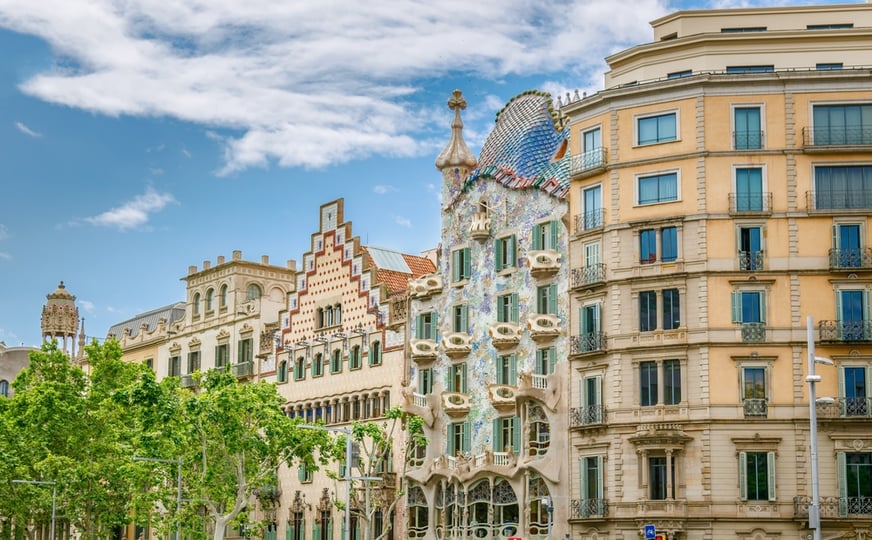
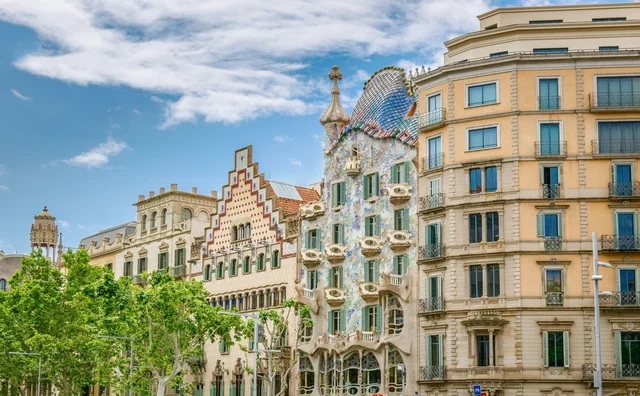
Three of the greatest residential Modernista buildings in Barcelona stand along the block of Passeig de Gràcia between Carrer del Consell de Cent and Carrer d’ Aragó. Labeled by tourism promoters as the Quadrat D’Or, or Golden Quarter, it’s also referred to with a wink as the Mançana… - Historic home
Casa Batlló
Next door to Casa Amatller is Gaudí’s extraordinary 1905 creation for the textile tycoon Josep Batlló, who gave the architect free rein to create “a paradise on earth.” The facade’s sinuous curves give the structure a lush organic appeal, and the balconies, like those at La Pedrera,… - Hotel
Casa Bonay
This independent boutique hotel, in an 1869 Neoclassical mansion, is a buzzy spot with several bars and restaurants attracting a local crowd—notably at Libertine, a lunch and coworking space by day and cocktail lounge by night. Each soundproofed room has a slightly different layout,…$$L’Eixample - Architecture/Historic Site
Casa Lleó Morera
The third celebrated house of the Block of Discord was completed in 1905 by the third member of the Modernista triumvirate, Lluís Domènech i Montaner. Sadly, it is not currently open to visitors, but it is worth examining from the outside and glimpsing the extraordinary craftsmanship… - Museum
Casa Vicens
The earliest residence designed by Gaudí, an 1883 summer home for Barcelona stockbroker Manel Vicens and his family, became available for sale to the highest bidder over a decade ago. Luckily it was purchased by a bank, which implemented an exquisite renovation of the building and… - Historic Site
Castell de Montjuïc
In contrast to its often-grim history, this mass of military stone is now surrounded by serene gardens where local families come for Sunday picnics. The fort last saw action in the Spanish Civil War, when it was used by both sides for torture and executions. Most notoriously, the… - Religious Site
Catedral de Barcelona
A celebrated example of Catalan Gothic architecture, Barcelona’s cathedral was begun at the end of the 13th century and more or less completed by the mid–15th century. One notable exception, the western facade, dates from the 19th century when churchgoers felt that the unadorned… Centre de Cultura Contemporània de Barcelona (CCCB)
Adjacent to the MACBA, the CCCB is a temporary exhibition space located in what was a 19th-century poorhouse. The building has been ingeniously adapted to its current function. The extension, built by prize-winning architects Helio Piñón and Albert Viaplana, is an impressive…El Raval- Park/Garden
Colònia Güell
For many, Gaudí's most prolific work lies not within Barcelona, but outside. He designed the church for the Colònia Güell, an ambitious plan of Eusebi Güell's that lies 20 minutes by train inland from the city. Güell was a progressive man and wished to set up a colony for the workers…Outer Barcelona - Cooking Class
Cook & Taste
Students in the half-day cooking classes in a kitchen in the old city have the option of taking a guided tour of La Boqueria before the class begins. It's a great way to get a real feel for Spanish foodstuffs and for the discerning way that Spanish cooks select their ingredients.… - Museum
CosmoCaixa (Museu de la Ciencia)
This museum is a high-tech, hands-on learning center that young children find a real blast. Set in a Modernista building with an underground extension, the vast museum has permanent exhibitions, such as “The Flooded Forest.” This living slice of Amazonian rainforest has more than 100… - Cultural center
El Born Centre de Cultura
When the old wholesale Born market, a glorious 19th-century cast-iron structure built in imitation of similar buildings in Paris, underwent demolition in the 1990s, the plan was to turn it into a high-end retail destination, or perhaps a public library. But then ruins of streets and… - Neighborhood/Historic District
El Call
Barcelona had one of Spain’s most significant Jewish communities from the 10th century until the pogroms of 1391, when its way of life in the Barri Gòtic was destroyed forever. Six centuries of absence almost erased any trace of the Jewish presence, but in the 1990s a concerted… - Landmark
Foment de les Arts Decoratives i del Disseny (FAD)
FAD is the 100-year-old promotional board driving the city's active design culture, in charge of dishing out design and architecture awards and grants and promoting its artists to Spain and the rest of the world. Its headquarters, easily identifiable by the huge steel letters…El Raval - Museum
Fundació Joan Miró
This comes close to art museum perfection. Even if you don’t care about the work of Catalan artist Joan Miró (1893–1983), the hilltop location of the Foundation has an inspiring panoramic view, with whimsical painted metal sculptures on its easily accessible roof, and the gleaming… - Museum
Fundación MAPFRE Casa Garriga i Nogués Exhibition Hall
With its gorgeous terrazzo floors, grand marble staircase, high ceilings, and beautifully proportioned rooms, Casa Garriga Nogués runs the risk of overshadowing the art it contains. It was designed by Enric Sagnier and built between 1899 and 1905 and has been impeccably restored. The… - Theater
Gran Teatre del Liceu
The restrained Neoclassical façade halfway up La Rambla belies the sumptuous decoration within. This 2,300-seat opera house is one of the world’s grandest theaters, where big names including Callas, Caruso, and Carrera have performed. It was built in its current form in 1861 after a…Around Town - Historic Site
Hotel España
This mid-19th-century hotel got its most important facelift in 1903 to 1904 under the direction of Modernista architect Lluís Domènech i Montaner. He worked with two of the top artisans of the era to execute the design: sculptor Eusebi Arnau, who created a striking alabaster chimney… - Garden
Jardi Botànic
Barcelona’s Botanic Gardens, set on gentle slopes overlooking the city and the sea, were created in 1930 and continue to evolve. They now provide a beautifully landscaped showcase for Mediterranean-climate plants from around the world, including Africa, Australia, California, the… - Landmark
L'Hospital de la Santa Creu i Sant Pau
The elegant pedestrianized boulevard of Avenida Gaudí stretches northward from the Sagrada Família, and at the opposite end sits another key work of the moderniste movement, almost equal in vitality to Gaudí's. The Hospital Sant Pau (as it's more commonly known) is a remarkable work…L'Eixample Dreta - Market
La Boqueria
Set just back from La Rambla, the Mercat de Sant Josep de la Boqueria is a feast for the senses. This spot has been a marketplace since medieval times when Raval farmers sold their produce to the inhabitants of the walled city. The current public market is one of Europe’s largest,…Around Town - Religious Site
La Mercè
The church of La Mercè is dear to the heart of the people of Barcelona. Our Lady of Mercy (La Mercè) is the city's co-patron saint (the other is Santa Eulàlia); she earned the privilege after supposedly diverting a plague of locusts in 1637. Thus, the city's main fiesta (Sept 24) is…Barri Gotic - Historic home
La Pedrera (Casa Milà)
When Gaudí’s last secular commission, Casa Milà, was finished in 1912, the neighbors took one look at the undulating lines of its rough-hewn limestone and dubbed it La Pedrera (“The Quarry”). The nickname has stuck as a term of endearment. With its broad, rippling façade and… - Tour
Las Golondrinas
Barcelona’s famous pleasure boats, “The Swallows” have been picking up passengers and pootling around the port since 1888. While the sights have changed beyond recognition since then, the formula has stayed much the same, and the prices low. A 40-minute tour of the Port of Barcelona,…La Barceloneta and the Waterfront - Zoo/Aquarium
L’Aquarium de Barcelona
This contemporary aquarium dedicated to Mediterranean species and habitats does its best to make you feel like you’re underwater interacting with the fish.The centerpiece of this contemporary aquarium is the Oceanarium, a giant tank that wraps around a transparent 80m (262-ft.)… - Market
Mercat Santa Caterina
That amazing undulating roof is the work of architects Enric Miralles and Benedetta Tagliabue, who covered Barcelona’s oldest enclosed market (1848) with a spectacular sombrero in 2005. View it from above from the rooftop bar at the Barcelona Edition hotel. The multi-colored… - Monument
Mirador de Colom
Les Rambles meets the waterfront at this monument to Christopher Columbus that was erected for the Universal Exposition of 1888. Bas-reliefs on the plinth recount the feats of the great navigator, and various symbolic sculptures in florid Victorian style surround the base. At the top… - Art museum
Moco Museum Barcelona
This independent museum moved in a couple of doors down from Museu Picasso in 2021, giving a welcome jolt to Barcelona’s conservative museum scene. Set in a 16th-century Gothic palace, the two-story exhibition space is small, but its collection is stellar. The first floor features… - Museum
Monestir de Pedralbes
On the edge of the city a 40-minute bus ride from Plaça de Catalunya, this extraordinary former convent is worth the trip. It was inhabited for almost seven centuries by the order of the Poor Clares and has Europe’s largest Gothic cloister, as well as a superb collection of artworks.… - Landmark/View
Monument a Colom
Erected for the 1888 World’s Fair, the monument to Christopher Columbus is a good place to get your bearings. It stands 60m (197-ft.) tall on a traffic circle at the junction of La Rambla and the waterfront. Bas-reliefs around the plinth recount the feats of the great explorer, and… - Art museum
Museu Antoni Tàpies
Dedicated to Antoni Tàpies (1923–2012), Catalunya’s leading late 20th-century artist, this museum tends to emphasize late works and large-scale pieces (the collection is largely based on gifts from the artist and his wife). Changing exhibitions show Tàpies’s evolving viewpoints and… - Museum
Museu Etnológic de Barcelona
A bit off the beaten track compared to its big brothers on the Parc de Montjuïc, this museum gets fewer visitors. But that’s a shame, as it’s not the dusty old place one might expect of its name: The museum has made a successful effort to remain contemporary and to reflect the… - Museum
Museu Frederic Marès
The particularly Spanish art form of polychrome sculpture—the tradition of painting wooden carvings of religious figures in lifelike colors—has enjoyed a renaissance of late after a long period in the artistic doldrums. That would delight the sculptor and collector Frederic Marès… - Museum
Museu Maritim
This impressive museum, housed within the medieval royal shipyards, the Drassanes Reials, tells the story of Barcelona’s maritime history from its origins as the Roman trading port Barcino up to the 21st century. Instigated by Jaume I and built between 1255 and 1378, these shipyards… - Museum
Museu Nacional d’Art de Catalunya (MNAC)
In the Middle Ages, Catalunya led the field in European art. Some of the world’s finest Romanesque and Gothic paintings and sculpture are collected in this stunning museum in the Palau Nacional. Most of the Romanesque murals were rescued from crumbling churches in the Pyrenees in the… - Museum
Museu Olimpic I de l’Esport
It’s sort of like arriving after the game has ended, but it’s still a thrill to see the leftovers of the games that changed Barcelona in such a big way: the 1992 Olympics. To the accompaniment of a piped-in soundtrack that blares out a subliminal message of The Thrill of Victory, the… - Museum
Museu Picasso
The setting for this must-see museum is special in itself. It was created by stringing together five Gothic mansions in a series of seamless galleries. The exhibits are based on the collection of Jaume Sabartés, a childhood friend who became Picasso’s personal secretary in 1935.… - Museum
Museu de la Xocolata
The space is really too small to tell the chocolate story effectively, and the museum has decided to fill most of the galleries with wacky chocolate sculptures (of Messi, of Don Quixote, of the Virgin of Montserrat) instead of focusing on teaching kids and their parents about the… - Art museum
Museu de l’Art Prohibit
The concept behind this small independent museum, which opened in a graceful mansion near Passeig de Gràcia in 2023, is simple. All of its exhibits have at some point been banned, censored, denounced, or removed from display. The collection, assembled by the journalist and… - Museum
Museu del Modernisme Català
This museum is currently closed for renovations as we update this materil. Check the website to see if it has reopened. You may think you’ve come to the wrong address when you arrive at what appears to be a storefront in Eixample. This modest museum’s small collection of decorative… - Museum
Museu d’Arqueologia de Catalunya
Busloads of local school kids love to come to the MAC, at the foot of Montjuïc, to learn about their ancestors’ history. But there are rewards for foreign visitors as well, even if the three-language wall texts are a little inconsistent. Housed, a bit awkwardly, in a pentagonal… - Museum
Museu d’Art Contemporani de Barcelona
Richard Meier’s gleaming white construction completely transformed this Raval block when it was built in 1995, displacing a number of historic buildings, and MACBA’s approach to art and audience is equally uncompromising. The permanent collection covers the years from the 1929 Expo… - Museum/Historic Site
Museu d’Història de Barcelona, Plaça del Rei
It’s a good idea to visit MUHBA’s main site early in your stay, as it gives a vivid introduction to the origins of the city. The museum is set within the Casa Padellàs, a merchant’s palace from 1498 that was moved here stone by stone in the 1930s, and the 11th-century Palau Reial… - Museum
Museu d’Història de Catalunya
Catalunya’s history museum centers on a permanent exhibition entitled “The memory of a country,” leaving you in no doubt where it stands on the independence question. It starts in the Lower Paleolithic era and takes you on a whistle stop tour to the present day. Exhibits pause at the… - Tour
Orsom Barcelona
The sail-powered catamaran Orsom offers a graceful way to get out on the water. In addition to 90-minute sightseeing cruises, she makes jazz cruises timed so that passengers can enjoy sunset. - Historic Site
Palau Güell
Constructed between 1886 and 1890 for aristocrat and industrialist Eusebi Güell, this was Antoni Gaudí’s second commission—and yet the architect’s prodigious talent was such that it already looks almost as if it were grown rather than built. The exterior is severe, in stone and… - Landmark
Palau de la Música Catalana
One of the most magical of all the Modernista buildings, this is Lluís Domènech i Montaner’s masterpiece. Commissioned by the Orfeó Català choral music society, the architect laid the first stone in 1905 on St. George’s Day (May 5, the feast of Catalunya’s patron saint). It finally… - Historic Site
Palau del Baró de Quadras
Fans of Gothic gargoyles should not miss this extraordinary building. In 1900, Josep Puig i Cadalfach was commissioned by the Baron of Quadras to refurbish this residential block. Over the next 3 years, he completely transformed the structure. The facade is carved in an intricate… - Park
Parc Güell
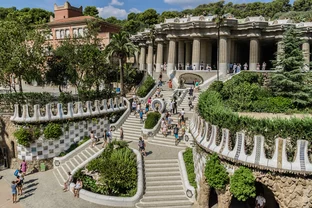
Gaudí began this magical park in Gràcia as a real-estate venture for his patron, the industrialist Eusebi Güell. Although the plan never came to fruition, Gaudí did complete several public areas of what is perhaps his most outlandish achievement. The Plaza de la Natura is fronted by… - Theme Park
Parc d'Atraccions Tibidabo
The mountain of Tibidabo has been a popular retreat for Barcelonese since 1868 when a road was built connecting it to the city. You arrive there on the creaky old funicular -- or, less dramatically, by bus -- to find an amusement park combining tradition with modernity. Cinema buffs…Outer Barcelona - Park
Parc de la Ciutadella
When Barcelona picked the losing side in the War of the Spanish Succession (1701–14), the victorious Felipe V repaid the city by leveling a neighborhood to erect a citadel. The fortification proved of little use against Napoleon, and the fort was torn down in the mid–19th century.… - Theme Park
Parc d’Atraccions
Tibidabo provides nostalgic appeal for several generations of locals and visitors because of its downright charming retro rides—a carousel, an “airplane” that spins around a pole, whirling teacups—along with modern attractions like a roller coaster, a pirate ship, and a haunted… - Architecture/Historic Site
Pavelló Mies van der Rohe
Gaudí had been dead only three years when the German architects Ludwig Mies van der Rohe and Lilly Reich created this sleek steel, glass, and marble pavilion for the 1929 World’s Fair. What could be further removed from Gaudí’s passionate ornamentation than this minimalist design… - Plaza
Plaça Reial
Barcelona’s first big urban renewal project in the 19th century, this large and harmonious square occupies the former site of the Santa Madrona Capuchin monastery, which was demolished at mid-century. Inspired by the renewal projects of Paris, architect Francesc Daniel Molina… - Neighborhood
Plaça Sant Jaume
The Plaça Sant Jaume is the political nerve center of Barcelona. Separated by a wide expanse of polished flagstones, the Casa de la Ciutat, home to the ajuntament (town hall), faces the Palau de la Generalitat, seat of Catalonia's autonomous government. The square itself frequently…Barri Gotic - Plaza
Plaça de Catalunya
Considered the heart of Barcelona, this spacious plaza and traffic circle at the top of La Rambla, where old town meets new, is the city’s transport hub and meeting place. You’re more likely to arrive on a bus from the airport or change at its multi-line Metro station than seek it… - Historic Site
Plaça de Sant Felip Neri
Hidden in the maze of streets near the cathedral, this atmospheric little square is one of the few spots in the city where Barcelona’s suffering during the Spanish Civil War remains tangible. Pockmarks on the façade of the Baroque church of Sant Felip Neri are a haunting reminder of… - Plaza
Plaça de Sant Just
This small, tranquil square just south of the cathedral may be the site of Barcelona’s oldest church. The assymetrical 14th century Basilica dels Sants Just i Pastor stands on the footprint of the original 4th-century basilica, built to honor two early Christian martyrs. Through… - Religious Site
Plaça del Pi
Three pretty contiguous plazas surround the Gothic church of Santa María del Pi, acclaimed for its rose window, one of the world’s largest. The 15th-century original was destroyed when the church, like many others, was set on fire by anti-clerical troops at the beginning of the Civil… - Historic Site
Poble Espanyol
This faux village on the hill was designed by Josep Puig i Cadalfach for the 1929 World’s Fair and remains an absorbing introduction to Spain’s wide-ranging culture. Each street or plaza simulates the architecture of a corner of Spain, from Andalucía to Zaragoza. Inside, the 100-plus… - Religious Site
Sant Maria del Pi
Three pretty contiguous plazas surround the Gothic church of Santa María del Pi, acclaimed for its rose window, one of the world’s largest. The 15th-century original was destroyed when the church, like many others, was set on fire by anti-clerical troops at the beginning of the Civil… - Architecture/Historic Site
Sant Pau Recinte Modernista
Why visit a former hospital? Because this is a medical facility like no other. It was conceived as a hospital city by Lluís Domènech i Montaner in 1901 and took nearly 30 years to complete. Created to fulfil the holistic needs of its patients—doctors a century ago had some intriguing… - Religious Site
Sant Pau del Camp
The antithesis of Gaudí’s La Sagrada Familia, the modest ancient church and monastery of Sant Pau del Camp (St. Paul of the Fields) is one of the most serene and most moving religious spaces in Barcelona. According to his gravestone, which was unearthed in 1596, the monastery was… - Religious Site
Santa Maria del Mar
St Mary’s of the Sea, dating from the 14th century, is the city’s purest example of the Catalan Gothic style. Solid and sober on the outside, the basilica’s interior is a masterpiece of space and light, and the influence on Gaudí’s Sagrada Família six centuries later is obvious.… - Archeological Site
Temple d’August
Hidden away in a Barri Gòtic alleyway, these Roman columns are one of Barcelona’s best-kept secrets. They’re easy to miss as they are ingeniously (if a little awkwardly) incorporated into the courtyard of a 19th century townhouse. They date from the 1st century b.c. and once formed… - Zoo/Aquarium
Zoo de Barcelona
A large chunk of the Parc de la Ciutadella is taken up with the city's well-matured zoo, whose age is softened by its attractive garden setting. Many of the enclosures are barless and the animals are kept in place via a moat. This seems humane until you realize how little running…La Ribera
More About Barcelona Attractions
Barcelona Shopping
From cheese and olives at La Boqueria Food Market in Las Ramblas to designer boutiques in the Born and Eixample districts, Barcelona shopping is in a league of its own. Serious shoppers enjoy late opening until 8pm or 9pm but smaller shops break for an afternoon siesta. The Shopping Line Bus is an easy option to travel from shop to shop with extra space for your bags. Take a break on Sundays when most shops close.
10 Results
- Leather Goods
Acosta
Started in the 1950s, this chain selling stylish Spanish leather belts and bags now has 37 shops all over Spain and one each in Lisbon and Brussels. It's still a family-run affair, which is perhaps why everything sold has the air of being lovingly and meticulously produced. Prices… - Antiques
Artur Ramón Art
One of the finest antiques and art dealers in Barcelona, found in a three-level emporium. Set on a narrow, flagstone-covered street near Plaça del Pi (the center of the antiques district), it stands opposite the tiny Placeta al Carrer de la Palla. The store, which has been operated… - Housewares & Furniture
BD Barcelona Design
Started by a group of prominent Catalan architects, this gorgeous gallery-shop offers the best contemporary pieces alongside reproductions of work by the likes of Gaudí, Dalí, and Mackintosh. Artwork by Oscar Tusquets, one of the shop's founders and a leading Catalan designer, is… - Food
Brunells Pastisseria i Salo de Te
The menu here is so modest it barely warrants mention—nice little “entrepans” (sandwiches on thin baguettelike rolls)—except that Brunells makes its own croissants and breads. More importantly, Brunells makes its own chocolate. On the pastry shop side that translates into some… - Food
Bubo
Pastry chef Carles Mampel has shelves full of trophies and medals, including one from Lyon in 2005 for his world champion chocolate cake. With bubó, he brings great pastry to the masses. This shop, in an alley near Santa María del Mar, in the heart of El Born, was his base for… - Shoes
Casas
If you are serious about footwear, this is the only name you need to know. With three shops in central Barcelona, Casas is a one-stop shoe store for the most prominent Spanish brands (Camper, Vialis, Dorotea) and coveted imports from Clergerie, Rodolfo Zengarini, and Mare, plus… - Food
Granja Dulcinea
Here at Barcelona's number-one chocolate mecca you can buy melindros (sugar-topped soft biscuits) and drink hot chocolate that's as richly viscous as a melted bar of the real stuff. The place is both a genial cafe and a traditional shop selling a scrumptious variety of chocs as well… - Shoes
La Manual Alpargatera
The good people at this Ciutat Vella shop have been making espadrilles here for nearly a century. As well as the classic slip-on variety, you will find the Catalan espadenya, which has ribbon ankle-ties, wedge-heeled versions in fashion colors, toasty lamb's wool slippers, and other… - Fashion
Sombrería Obach
This reassuringly old-fashioned hat shop in El Call (the old Jewish quarter) stocks the largest color range of barrets (berets) on earth, as well as Panamas, Kangol flat caps, straw sun hats, and a host of other headgear for men and women. Check out the classic Mexican sombrero:… - Wines & Liquors
Vila Viniteca
This awesome wine shop in the heart of the El Born neighborhood supplies most of the restaurants around it. The selection here can be frightening for the non-vinicultured among us, but those in the know rave about it. There are 4,500 different wines, sherries, cavas, liquors, and…
More About Barcelona Shopping
Barcelona Nightlife
Sip sparkling cava or rich Rioja among the wine casks in the Barrí Gòtic district's atmospheric bodegas (wine cellars), or cooling beer in beach-front chiringuitos huts. Or mingle with bohemian types in the Born district's chic hole-in-the-wall bars. For a taste of Catalan culture, there's a plenty of choice around Plaça Catalunya square with Palau de la Música Catalana, City Hall nightclub and Bel-Luna Jazz Club all nearby. Pace yourself for late nights; clubs get going around 2am when most bars start to close.
24 Results
- Bars & Pubs
Bar Marsella
If you're feeling adventurous, go to Bar Marsella for its specialty: Absinthe (absenta). Picasso and Dalí may have been regulars here and it looks like they haven't dusted the bottles since. The bar's said to be Barcelona's oldest and has been around since 1820, serving the homemade… - Jazz
Carpe Diem Lounge Club
People on a budget should avoid the dress-code-conscious CDLC. Prices are high and so is the snob factor at this achingly cool bar on the edge of the beach. The VIP section is a favorite of famous soccer players, but if you want to join them on the comfortable-looking white chill-out…Ciutat Vella - Bars & Pubs
Cocktail Bar Boadas
This intimate, conservative bar is usually filled with regulars. Established in 1933, it is the city's oldest cocktail bar. It's located at the top end of La Rambla, and many visitors stop in for a pre-dinner drink and snack before wandering to one of the area's many restaurants. It…Ciutat Vella - Jazz
Diobar
One of seaside Barceloneta's favorite clubs and located in the basement of a lively Greek restaurant. No bouzoukis, retsina, or plate-throwing here though. Just a chummy, packed-to-the-gills nightspot that features an enthusiasticlally ecletic range of Latin and soul sounds from…Ciutat Vella - Bars & Pubs
El Bosc de les Fades
This is the most bizarre bar/cafe in Barcelona, evoking a fairy-tale forest, or at the least trying to. It's brought to you by the same people who created the Museu de Cera (Wax Museum), which is next door. Expect "unreal trees" and the whispering sound of waterfalls, plus a "gnome"…Ciutat Vella - The Performing Arts
El Tablao de Carmen
This club presents a highly rated flamenco cabaret in the re-created imitation "typical Spanish artisan village" of Poble Espanyol on the side of the Montjuïc hill. Go early to explore the village. Though dinner is offered here, we don't recommend it. Just go for the cheapest… - Bars & Pubs
Gimlet
In this stylish uptown cocktail bar, the lights are low, the music is jazz, and the measures are generous. Sit at the tables or head for the bar at the back and chat with the bartenders as they shake and mix the drinks, pour them into retro glasses, and place them on cute little…La Ribera Harlem Jazz Club
On a quiet street in the Ciutat Vella, this is one of Barcelona's oldest and finest jazz clubs. It's also one of the smallest, with just a handful of tables that get cleared away when the set ends so that people can dance. No matter how many times you've heard "Black Orpheus" or "The…- Bars & Pubs
La Ovella Negra
An Old City classic, "The Black Sheep" is like a hidden beer hall. The crowd is young -- it's a student favorite -- and the drinks are great value. Noisy, friendly, with a beer-stained pool table and a remarkable cave-like setting, this is a fun place for young people to order jugs…Ciutat Vella - The Performing Arts
Los Tarantos
Established in 1963, this first-floor club is the oldest flamenco club in Barcelona, with a rigid allegiance to the tenets of Andalucian flamenco. Its roster of artists changes regularly. Performers often come from Seville or Córdoba, stamping out their well-rehearsed passions in… - More Entertainment
Luz de Gas
This theater is renowned for Latino jazz. The place itself is a turn-of-the-20th-century delight, with colored glass lamps, red drapery, and other details, but it's also a world-class live-music venue. It was once a theater, and its original seating has been turned into different… - Dance Clubs
Magic
Make devil horns with your hands and rock your sweaty mullet at this hard-rock/metal club. It's all harmless fun, though, and tourists are more than welcome, as long as they can mosh with the best of them.Ciutat Vella - Bars & Pubs
Mirablau
It's all about the location at Mirablau. Although there are worse disco/bars in the city, there are certainly better ones too. But you don't go for the music, the bar prices, or the crowd -- you go for the view, as Mirablau is situated right next to the funicular near the top of…Outer Barcelona - Dance Clubs
Moog
This is where lovers of techno music and hard pumping beats gather to crash heads. The music is heavy but the people are friendly. Upstairs is a much smaller space where, strangely, 1980s' disco (including a wide selection of Abba) is played and the flamboyant DJ himself is part of…Ciutat Vella - Gay & Lesbian Bars
New Chaps
Gay Barcelonese refer to this saloon-style watering hole as Catalonia's premier leather-and-denim bar, mainly patronized by "mature" clients (30- to 50-somethings). In fact, the dress code usually is leather of a different stripe: More boots and jeans than leather and chains. Behind… - Bars & Pubs
Otto Zutz
If you're anyone who's anyone in Barcelona, you'll have one of Otto Zutz's gold VIP cards, which allows you access to the bar and small dance area on the top floor, where you can watch all the trendy wannabes down below strutting their stuff and, if the whim takes you, go down and…Barrio Alto - Bars & Pubs
Pitin Bar
Easy to spot thanks to the lit-up stars over the door, this is a great place to sit with friends. The bar downstairs may not look anything special, and the patio, though nice, is fairly standard, but if you brave the small spiral staircase, upstairs is a cozy, beamed Old-City room…Ciutat Vella - Dance Clubs
Razzmatazz
Five clubs in one (Razz, Loft, Pop Bar, Rex Room, and Lolita), each with its own style of music. The venue is an enormous multilevel warehouse, and it's not unusual to have a big-name DJ playing the main stage while upstairs, oblivious, a group of goths and rock chicks mosh…Outer Barcelona - Bars & Pubs
Rita Blue
The music's good, the crowd is lively, and the cocktails are great, especially the eponymous Blue Margarita. This is the sister club to Margarita Blue. - The Performing Arts
Tablao Flamenco Cordobés
At the southern end of La Rambla, close to the harborfront, you'll hear the strum of the guitar, the sound of rhythmic clapping, and the haunting sound of flamenco, a tradition here since 1968. Head upstairs to a lovely Moorish-style performance space with tilework and arched… - The Performing Arts
Teatre Lliure
The theater has two stages, one large and one small, on which plays by the likes of Tennessee Williams and Samuel Beckett are performed. Run by the young and energetic director Alex Rigola, it's one of the most popular venues in the theater-oriented Poble Sec area, and also features… - The Performing Arts
Teatre Nacional de Catalunya
This major company is housed in a modern, mock-Roman building, inaugurated in 1997 and a little out of the center near L'Auditori. The theater adheres to a tradition of theater repertory, presenting both classic and contemporary plays, in two venues: The Sala Gran (Large Salon) and… - The Performing Arts
Teatre Victoria
Situated in the once gritty (now trendy) Poble Sec district, this lively, large-capacity theater was remodeled in 1992 on the site of the original 19th-century theater. It specializes in hosting big-scale productions, usually musical spectaculars or comedies. - Bars & Pubs
The Fastnet Bar
Out of the dozens of Irish pubs and bars in the city, this is the only one that seems to have realized that it is situated in Mediterranean climes and not wet and windy Dublin. Located on a boulevard overlooking the marina, the bar has an ample terrace, which fills up on days when…Ciutat Vella
More About Barcelona Nightlife
More To Do in Barcelona
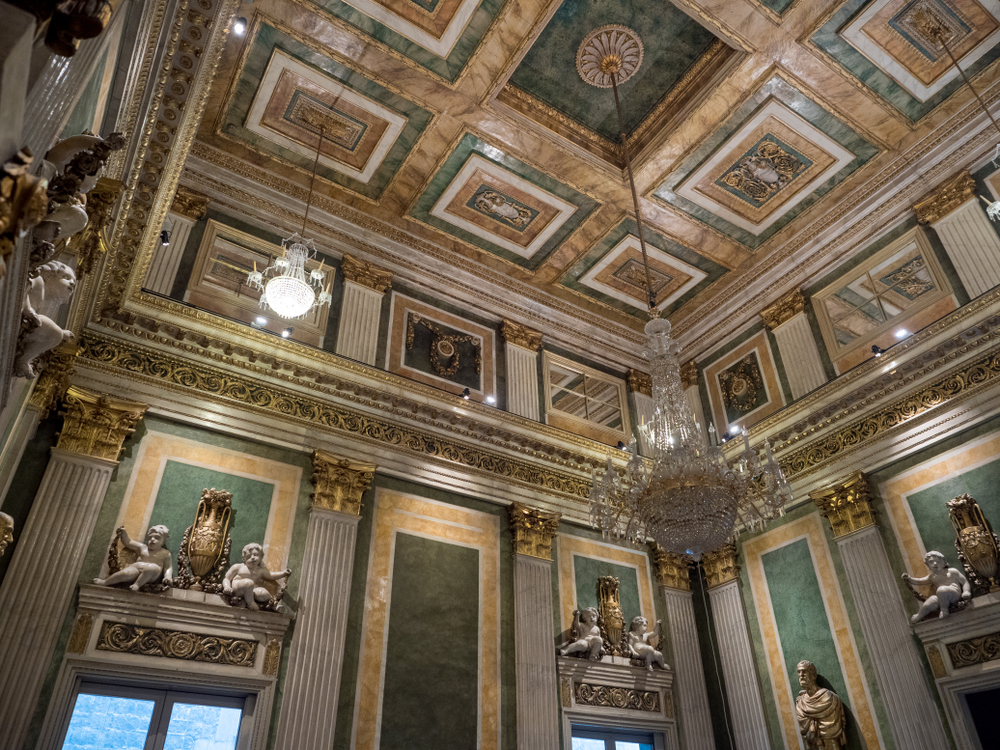
The Best Activities for Families in Barcelona
The fantastical details of Gaudí’s architectural works generally intrigue youngsters. Parents who want to see La Sagrada Familia can reward the youngsters with the tower tour, while at La Pedrera, Gaudí’s mosaic-covered rooftop chimneys may remind kids of the hooded Darth Vader of…
The Best Souvenirs in Barcelona
Leather: Leather is one of Spain's most highly valued products, and best buys range from stylish belts and handbags to handmade shoes and fine jackets. The top spot for such purchases in Barcelona is Loewe. An economy-conscious choice is Acosta at Avinguda Diagonal 262. This…