Things To Do in Merida, Spain
Bookstore

Available as paperback
and as e-book.
Merida, Spain Attractions
Mérida’s compact old city is easily explored on foot. The most economical way to see its many archaeological highlights is to buy a Conjunto Monumental ticket (teatroromanomerida.com; 17€ adults, 8.50€ seniors and students, free for children under 12) online or at the tourist office, which gives access to eight key sites including the Roman theater and amphitheater, the Circus Maximus, and the Alcazaba. Other monuments, such as the Roman bridge and the city’s two remaining aqueducts can be visited for free. You’ll often have them to yourselves.
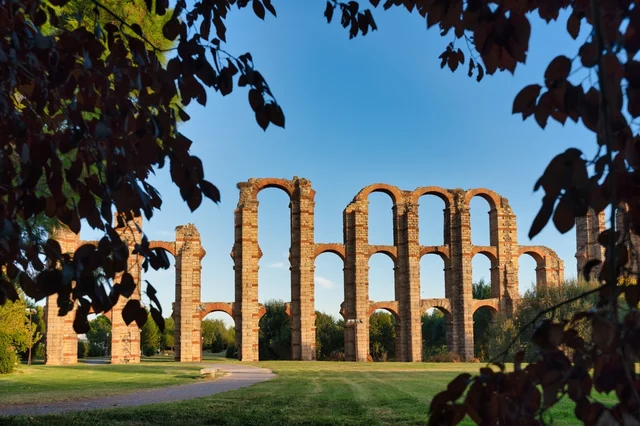
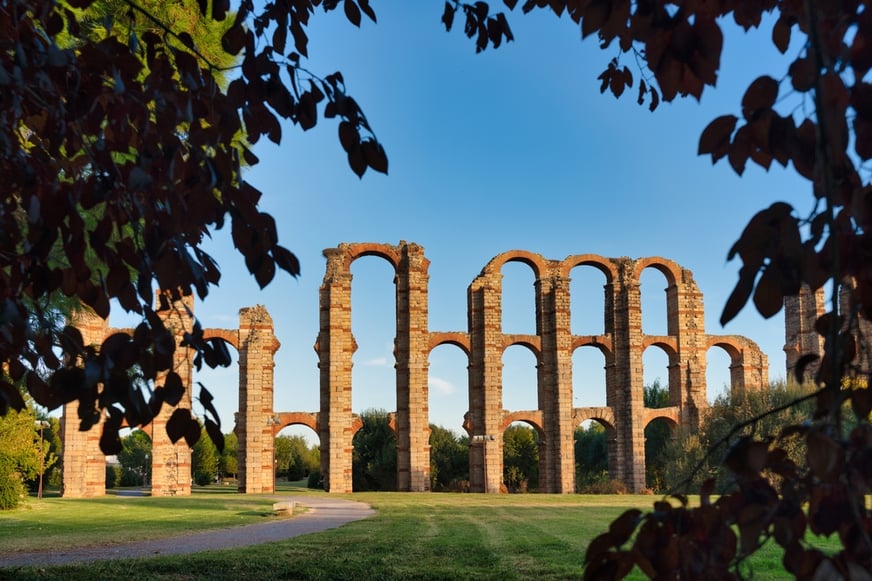
It’s worth taking a stroll through the riverside Parque del Río Albarregas to see the Acueducto de los Milagros, the more complete of the town’s two Roman aqueducts, which once brought water from Lake Proserpina 5km (3 mi.) away (see above). From the aqueducts, water was fed into two artificially created lakes, Cornalvo and Proserpina. A dozen or so complete arches still stand, 25m (82 ft.) tall, each topped with nesting storks for much of the year.
Further east, you’ll reach the three remaining columns of the Acueducto de San Lázaro, jammed up against a modern house. The lengthy aqueduct here is a 16th-century rebuild of the original Roman construction.
Nearby is the Circus Maximus, more than 400m (1,300 ft.) long, which could hold up to 30,000 spectators for chariot races. There’s not much left of the original structure, but there is a small visitor center and viewing platform that help recreate Ben-Hur in the imagination.
Back in the town center, the solid, unadorned Arco Trajano (Trajan’s Arch) was once the entrance to the Roman forum. An unadorned triumphal arch, it measures 15m (48 ft.) high and 9m (30 ft.) across. It is still a popular gathering place for an evening drink.
The Roman bridge over the Guadiana was the longest in Roman Spain -- about half a mile -- and consisted of 64 arches. It was constructed of granite under Trajan or Augustus, and then restored by the Visigoths in 686. Philip II ordered further refurbishment in 1610, and work was also done in the 19th century. The bridge crosses the river south of the center of Old Mérida, its length increased because of the way it spans two forks of the river, including an island in midstream. In 1993, it was restored yet again and turned into a pedestrian walkway. A semicircular suspension bridge was built to carry the heavy auto traffic and save the Roman bridge for future generations. Before the restoration and change, this span served as a main access road into Mérida, enduring the evolution of transportation from hooves and feet to trucks and automobiles.
Another sight of interest is the old hippodrome, or Circus Maximus, which could seat about 30,000 spectators for chariot races. The original Roman masonry was carted off for use in other buildings, and today the site looks more like a parking lot, though excavations have uncovered rooms that may have housed gladiators. The former circus is at the end of Avenida Extremadura on the northeastern outskirts of Old Town, about .8km (1/2 mile) north of the Roman bridge and a 10-minute walk east of the railway station.
Star Gazing Opportunities In and Near Merida
With such a sparse population, Extremadura enjoys some of Europe’s lowest levels of light pollution. Look up after dark and you'll be astonished at the number of stars visible in the night sky. You’ll also see shooting stars, especially in summer when the Perseid meteor showers are at their height.
Mérida-based Astroturismo por Extremadura (tel. 68-025-89-03) can guide you on a night walk by the river, beneath the arches of the aqueducts, and explain the constellations and their Greek and Roman legends.
In Monfragüe National Park to the north, the Observatorio Astronómico de Monfragüe (tel. 63-730-11-89 lets you explore the universe through powerful telescopes in a purpose-built dome.
In southern Extremadura, Entre Estrellas y Encinas (tel. 62-978-41-21)—meaning “between stars and oak trees”—offers a range of lodgings with perfect locations and equipment for stellar night views.

7 Results
- Historic Site
Alcazaba
Standing guard on the north bank of the Guadiana, the mighty Alcazaba fortress was built in the 9th century by the Umayyad ruler Abd ar-Rahman II to restore order after a rebellion, using recycled masonry from the Roman and Visigoth eras. It was perhaps the first alcazaba on the… - Historic Site
Anfiteatro Romano
Built in 8 b.c., this amphitheater could seat some 15,000 spectators at its peak. They came for wildly popular—and murderous—entertainment including gladiatorial battles and contests between humans and wild animals, a precursor to today’s bullfight. The central pit is the fossa… - Historic Site/Ruins
Casa del Mitreo
Located next to the red-painted bullring, this Roman manor house offers a vivid snapshot of the life of a wealthy family in 2nd-century Emerita Augusta. An elevated walkway lets you survey excavated mosaics, murals, and columns. In some parts, archaeological digs are still going on.… - Museum
Museo Nacional de Arte Romano
This must-see museum is Spain’s most important repository of Roman artifacts, and Mérida’s star attraction. Designed in the 1980s by Rafael Moneo and remodeled in 2025, the towering red-brick structure houses a beautifully curated collection of objects discovered in and around what… - Historic Site
Puente Romano
The 60 arches of Mérida’s Roman bridge stretch nearly half a mile from the gates of the Alcazaba across the Guadiana river. It is one of the longest Roman bridges still standing. Constructed from granite blocks and Roman concrete in 25 b.c, when the city was founded, it has been… - Historic Site
Teatro Romano
The jewel among Mérida’s ruins, the Roman theater is one of the world’s most important archaeological sites. It was built at the order of the consul Agrippa in 15 b.c. and could seat 6,000 theatergoers. The spectacular stage wall (scaenae frons), featuring Corinthian columns and… - Historic Site/Ruins
Templo de Diana
The Temple of Diana was the last of Mérida’s Roman monuments to get a major makeover, completing its restoration in 2011. Its towering Corinthian columns dominate a downtown square surrounded by contemporary concrete. The name is misleading—it was a temple dedicated to the Roman…
Merida, Spain Nightlife
The cluster of bars and restaurants around Arco Trajano are the city’s gathering place. Next door to A de Arco, Barocco, Plaza de la Constitución, 2 (tel. 61-758-49-55; daily 3:30pm–1am, until 4am in summer), does food but focuses on copas, or cocktails. By midnight, the clientele of both have merged into one big crowd filling the square.
Just around the corner, Jazz Bar, Calle Alvarado, 10 (tel. 92-431-99-00; 4pm–3am) stages live blues and jazz acts and serves drinks on its roof terrace.
On warm summer nights, the cocktail kiosks on Plaza de España carry on into the small hours, when you’ll see smartly dressed locals strolling with babies and small children in tow long past their bedtime.