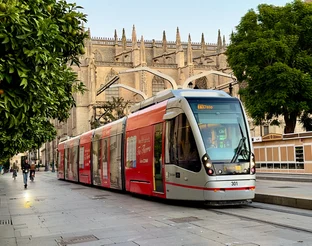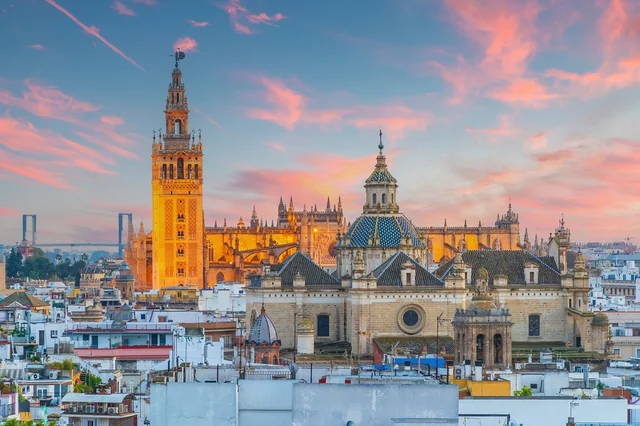
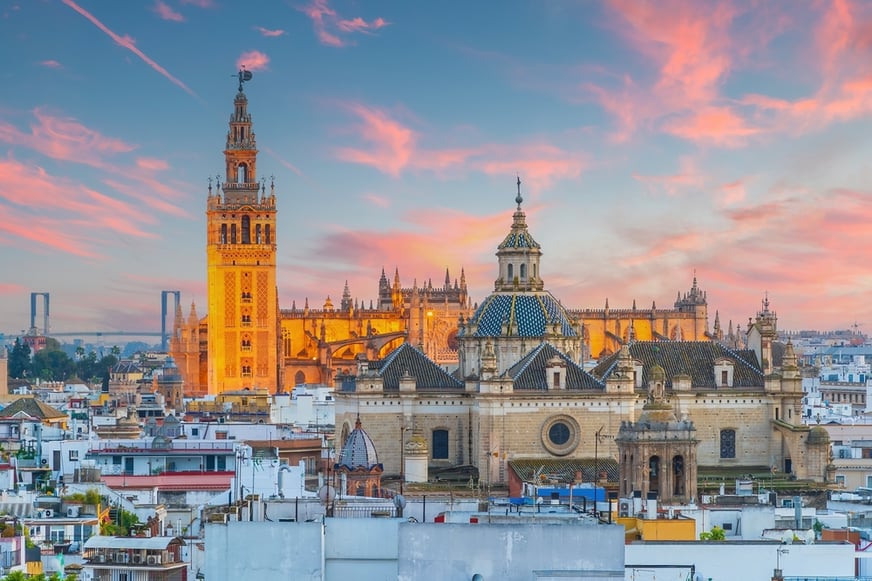
Catedral de Sevilla and La Giralda

Sevilla’s cathedral was designed with the aim that “those who come after us will take us for madmen.” It is the world’s largest Gothic building. Construction began at the beginning of the 15th century on the huge rectangular base of the Almohad mosque and took more than a hundred years to complete.
From the outside, its vast profile is rather ungainly. The British writer Laurie Lee described it as “hugging the ground like an encrusted turtle.” Inside, the scale is staggering, with some 80 side chapels closed off by wrought iron grilles (rejas). The vaulted Capilla Real (Royal Chapel) houses the remains of Fernando III, who retook Sevilla in 1248, alongside the tombs of Alfonso X and Pedro I. The Capilla de San Antonio contains one of Murillo’s finest paintings, the Vision of St Anthony.
In a portal on the south side, the tomb of Columbus is held aloft by carved pallbearers representing the four kingdoms of Spain. It was created only in 1892, long after his death. When he died in Valladolid in 1506, his remains were removed, reinterred, and lost on several occasions. The Dominican Republic—known in Columbus’s day as Hispaniola—claims them too, but DNA tests eventually confirmed a match with the bones of his son Diego, who is also buried here.
In the central nave, the bulky carved choir (coro) leads to the cathedral’s gilded highlight—the huge, Gothic altarpiece (retablo) depicting the life of Christ in 45 panels. It is the life’s work of the Flemish sculptor, Pieter Dancart, and took more than 40 years to complete. On feast days, six choirboys (Los Seises) perform a ceremonial dance at the altar dressed in Renaissance plumed hats, wielding castanets.
In the sacristies, seek out remarkable paintings by Zurbarán, Campaña, and Goya, the latter depicting Sevilla’s martyr saints Justa and Rufina with the Giralda in the background. Legend says that they were early Christian potters from Triana who were tortured and killed by the Romans after refusing to make pots for a pagan celebration. They are revered in Sevilla, especially in Triana, and are said to protect the Giralda. The oval-domed Sala Capitular (Chapter House) has more paintings by Murillo, of which the Immaculate Conception takes center stage.
After touring the cathedral’s somber interior, emerge into the sunlight of the Patio de los Naranjos (Court of the Orange Trees), originally the mosque’s courtyard where worshippers performed their ablutions before prayer. The central fountain dates from Visigoth times. Above the doorway hangs a stuffed crocodile, said to have been a gift from the Sultan of Egypt to Alfonso X. Leave via the Puerta de Perdón, the entrance to the old mosque, which retains its exquisite horseshoe arch.
La Giralda, the cathedral’s bell tower, is the city’s most emblematic and most beautiful monument. Erected as the minaret of the mosque in the 12th century, it was built on Roman and Visigoth foundations—you can see Latin inscriptions on some of the blocks at its base. Its brick latticework, different on each of its four sides, creates beautiful shadows as the sun crosses the sky. Initially, the minaret was shorter and topped with bronze spheres, which were replaced with Christian symbols in the 14th century. The Renaissance balconies, bell chamber, and pinnacle were added in 1568. The bronze statue on top, the giraldillo (weathervane), takes the tower’s height to 104m (341 ft.). There’s a replica of it in front of the cathedral’s main portal. Inside, 35 gently ascending ramps lead to the top, constructed so that the muezzin could ride up on a horse or donkey. It is also accessible by wheelchair. Admission to the Giralda is included in the combined ticket, but frankly it is better appreciated from the outside, from vantage points across Sevilla.
Tip: Tickets for the cathedral include a visit to the Iglesia del Divino Salvador.
Sevilla’s cathedral was designed with the aim that “those who come after us will take us for madmen.” It is the world’s largest Gothic building. Construction began at the beginning of the 15th century on the huge rectangular base of the Almohad mosque and took more than a hundred years to complete.
From the outside, its vast profile is rather ungainly. The British writer Laurie Lee described it as “hugging the ground like an encrusted turtle.” Inside, the scale is staggering, with some 80 side chapels closed off by wrought iron grilles (rejas). The vaulted Capilla Real (Royal Chapel) houses the remains of Fernando III, who retook Sevilla in 1248, alongside the tombs of Alfonso X and Pedro I. The Capilla de San Antonio contains one of Murillo’s finest paintings, the Vision of St Anthony.
In a portal on the south side, the tomb of Columbus is held aloft by carved pallbearers representing the four kingdoms of Spain. It was created only in 1892, long after his death. When he died in Valladolid in 1506, his remains were removed, reinterred, and lost on several occasions. The Dominican Republic—known in Columbus’s day as Hispaniola—claims them too, but DNA tests eventually confirmed a match with the bones of his son Diego, who is also buried here.
In the central nave, the bulky carved choir (coro) leads to the cathedral’s gilded highlight—the huge, Gothic altarpiece (retablo) depicting the life of Christ in 45 panels. It is the life’s work of the Flemish sculptor, Pieter Dancart, and took more than 40 years to complete. On feast days, six choirboys (Los Seises) perform a ceremonial dance at the altar dressed in Renaissance plumed hats, wielding castanets.
In the sacristies, seek out remarkable paintings by Zurbarán, Campaña, and Goya, the latter depicting Sevilla’s martyr saints Justa and Rufina with the Giralda in the background. Legend says that they were early Christian potters from Triana who were tortured and killed by the Romans after refusing to make pots for a pagan celebration. They are revered in Sevilla, especially in Triana, and are said to protect the Giralda. The oval-domed Sala Capitular (Chapter House) has more paintings by Murillo, of which the Immaculate Conception takes center stage.
After touring the cathedral’s somber interior, emerge into the sunlight of the Patio de los Naranjos (Court of the Orange Trees), originally the mosque’s courtyard where worshippers performed their ablutions before prayer. The central fountain dates from Visigoth times. Above the doorway hangs a stuffed crocodile, said to have been a gift from the Sultan of Egypt to Alfonso X. Leave via the Puerta de Perdón, the entrance to the old mosque, which retains its exquisite horseshoe arch.
La Giralda, the cathedral’s bell tower, is the city’s most emblematic and most beautiful monument. Erected as the minaret of the mosque in the 12th century, it was built on Roman and Visigoth foundations—you can see Latin inscriptions on some of the blocks at its base. Its brick latticework, different on each of its four sides, creates beautiful shadows as the sun crosses the sky. Initially, the minaret was shorter and topped with bronze spheres, which were replaced with Christian symbols in the 14th century. The Renaissance balconies, bell chamber, and pinnacle were added in 1568. The bronze statue on top, the giraldillo (weathervane), takes the tower’s height to 104m (341 ft.). There’s a replica of it in front of the cathedral’s main portal. Inside, 35 gently ascending ramps lead to the top, constructed so that the muezzin could ride up on a horse or donkey. It is also accessible by wheelchair. Admission to the Giralda is included in the combined ticket, but frankly it is better appreciated from the outside, from vantage points across Sevilla.
Tip: Tickets for the cathedral include a visit to the Iglesia del Divino Salvador.
Details
Bookstore
Available as paperback
and as e-book.