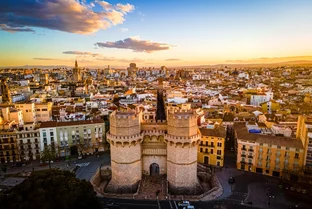
Vivvi Smak / Shutterstock
Planning a trip to Valencia, Spain
More than 25 airlines serve Valencia Airport (VLC) from more than 80 European and North African destinations. Air Nostrum (tel. 900-111-500) flies from most major Spanish cities, while Ryanair (tel. 902-585-230) and Vueling (tel. 902-808-022) have the most European connections as well as many in Spain.
The airport is 8km (5 miles) southwest of the city center. To reach downtown, take metro line 3 or 5 (4.80€ single ticket) or bus 150 (1.50€); a taxi (tel. 963-703-333) from the airport to the city center costs 20€‒25€.
Trains run to Valencia from all parts of Spain. The landmark Modernista building of Estación del Norte, Calle Játiva, 2, sits just south of the heart of the city. Its information office on Calle Renfe (tel. 90-232-03-20) is open Monday to Friday 8am‒9pm. From Barcelona, 16 trains arrive daily, including several 3.5-hour TALGO trains. At least 20 trains daily connect Madrid with Valencia; Alvia high-speed trains take about 2 hours and the AVE only 100 minutes. From Málaga, on the Costa del Sol, the trip takes 4‒7 hours, depending on connections.
Buses arrive at Valencia’s Estació Terminal d’Autobuses, Av. de Menéndez Pidal, 13 (tel. 96-346-62-66), about a 30-minute walk northwest of the city’s center. Take bus 8 to reach the Plaza del Ayuntamiento. Thirteen buses a day run from Madrid (trip time 4‒5 hr.), 10 from Barcelona (trip time 5 hr.), and five from Málaga (trip time 8 hr.).
Ferries connecting Valencia with the Balearic Islands run year-round to Palma (Mallorca) and Ibiza. (Note: There’s only one weekly ferry to Ibiza in winter.) Travel agents in Valencia sell tickets, or you can buy them from the Trasmediterránea office at the port, Estació Marítim (tel. 90-245-46-45). To reach the port, take bus 4 or 19 from the Plaza del Ayuntamiento.
From Barcelona, the easiest driving route is the express highway (AP-7) south (toll 41€). From Madrid, use national highway E-901. From Alicante, take the E-15 express highway. From Málaga, drive north to Granada and cut across southeastern Spain on the 342, which links with the 340 into Murcia; take the road to Alicante and then the E-15 highway.
The main tourist information office is at Calle Paz, 48 and Plaza del Ayuntamiento, 1 bajo (tel. 96-398-64-22), are open Monday‒Saturday 9am‒5:30pm and Sunday 10am‒2pm.
Getting Around Valencia
Valencia has completely modernized its public transit system under the EMT (Empresa Municipal de Transportes). Paper tickets (1.50€) are still sold on local buses, but a plastic digital chip pass card called MÓBILIS can be bought for 2€ at tobacconists, kiosks, and the EMT office (Calle Correo Viejo, 5; Mon–Fri 9am–2pm and 4:30–7:30pm) and loaded for multiple rides. The plastic card usually comes loaded with a 10-trip Bonobus pass (8.50€), which is valid for both bus and Metro.
Tip: If you fly into Valencia, buy a paper ticket from the Metro vending machine and load it with at least 10€. It works just like the plastic MÓBILIS. You will be charged only 2€ for the trip into the city and can recharge the ticket at any Metro vending machine. Buy tickets on board most buses, as you’ll use the bus less than the Metro.
The Metro system (tel. 90-046-10-46) is more efficient than the bus, covering the old city well and branching out to the outskirts, including the beaches. Most local buses leave from Plaza del Ayuntamiento, 22; bus 8 runs from Plaza del Ayuntamiento to the bus station at Avenida Menéndez Pidal. A bus map is available at the EMT office. For bus information, call 96-315-85-15.
The MÓBILIS card also gives you access to the city’s bike rental program, Valenbisi, at the cheap annual subscriber rate. Valencia is flat and easy to pedal around. Pick up a bike at any of 275 stations around the city and drop off at any other. The first half-hour is always free. You must register at the website and select a PIN.
If you need a taxi, call 96-370-33-33.
Special Events in Valencia
Valencia goes insane every year from March 15 to 19. That’s the only way to explain the whirlwind of parades, music, fireworks, controlled explosions outside city hall, and round-the-clock madcap revelry that accompanies the festival called Las Fallas. It’s not for the faint of heart—or the easily startled.
The origins of Las Fallas seem to lie in the 18th century, when the city’s carpenters celebrated spring by burning their winter lampposts. A century later, the lampposts had morphed into satirical figures burned in a main plaza on St. Joseph’s Day (March 19). Modern lightweight synthetic materials have allowed fallero artists to be ever more extravagant. Erected in dozens of city squares, some figures reach eight stories high and can cost up to $1 million each. Representing a wide array of political and pop cultural subjects, the satire can be biting and bawdy.
Yet solemn piety is also a part of Las Fallas. During the day, parades of characters who seem to have stepped out of a Goya painting bring bouquets of pink, white, and red carnations to the Plaza de la Virgen. The men look like 18th-century dandies, the women like ladies of the court in full-skirted silk brocade dresses, hair combs, and mantillas. After they hand over their flowers, which are affixed to the skirts of a five-story-high Madonna, they weep and take pictures.
The strangest spectacle of all is the mascletà, a pyrotechnic extravaganza whose main purpose must be to sell hearing aids. Thousands of people crowd the streets around City Hall Plaza waiting for the fuses to be lit on approximately one million firecrackers and other concussive devices. They begin exploding with an innocuous pop-pop-pop and build to bone-shaking booms. The grand finale occurs between midnight and 1am, when all but two “pardoned” figures are torched in a blazing inferno.
The Museu Faller (Plaza de Montolivet, 4; tel. 96-208-46-25) preserves “pardoned” figures from past festivals along with photos, paintings, and posters of the exuberant excess. Admission is 2€ adults, 1€ seniors; it’s open Tuesday to Saturday 10am‒6pm, Sunday 10am‒1pm. Bus: 6, 13-15, 18, 24, 25, 95; L2.
Medical Emergencies and Language
In a medical emergency, call tel. 112; or go to the Hospital Clínico Universitario, Av. Blasco Ibáñez 17 (tel. 96-386-26-00).
Don't be surprised if you see signs in a language that's not Spanish or Catalan. It is Valenciano, a dialect of Catalan. Often you'll be handed a "bilingual" menu in Castilian Spanish and in Valenciano. Most street names appear in Valenciano.