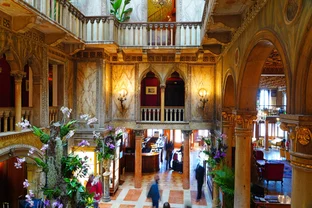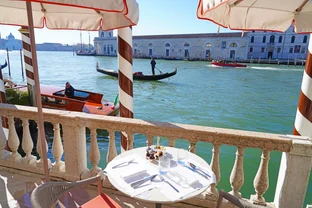

Travelling the backwaters: A gondola trip is the quintessential Venetian experience but rather than travelling the Grand Canal, ask your gondolier to take the route less travelled. The true spirit of the city is found on quiet backwaters where a lazy boat ride takes you into another…
Caterina Belova/Shutterstock
Things To Do in Venice
Jump to:
Bookstore
Available as paperback
and as e-book.
Venice Attractions
Venice is notorious for changing and extending the opening hours of its museums and, to a lesser degree, its churches. Before you begin your exploration of Venice's sights, ask at the tourist office for the season's list of museum and church hours. During the peak months, you can enjoy extended museum hours -- some places stay open until 7 or even 10pm. Unfortunately, these hours are not released until approximately Easter of every year. Even then, little is done to publicize the information, so you'll have to do your own research.
Strategies for St. Mark's Square
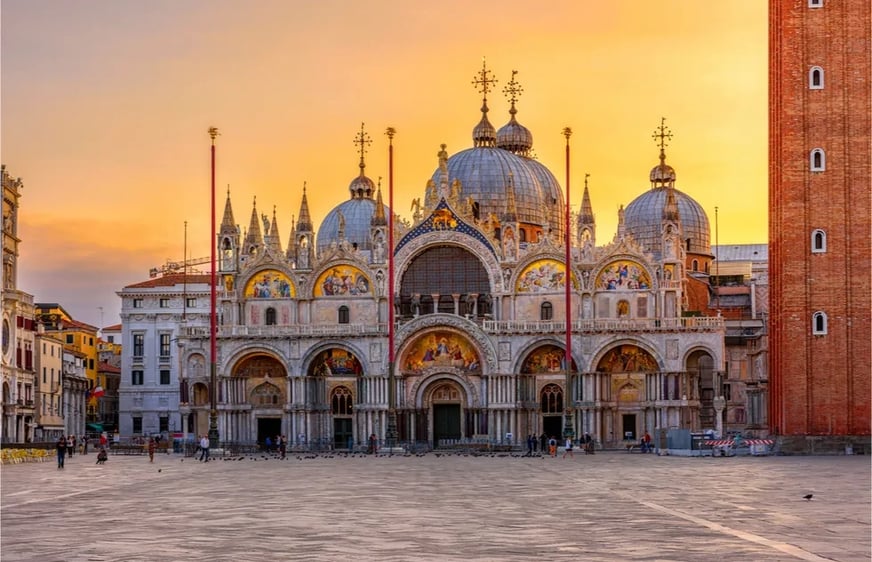
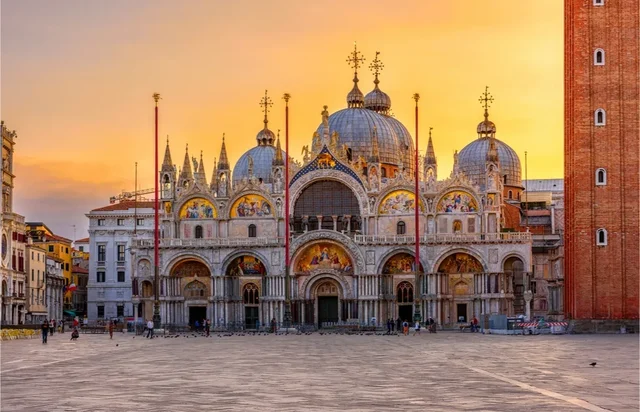
Lines can be long at the Basilica di San Marco (average 45 min), but you can avoid waiting by reserving access in advance online (www.venetoinside.com; 3€), up to 10 minutes before your chosen entry time. This service is only available April through October; at other times try to arrive 30 minutes before opening time to avoid the worst of the crush (and skip holidays altogether). You can also use the same website to skip the line at the Campanile di San Marco.
It is possible (and not too exhausting) to see the Basilica di San Marco and the Palazzo Ducale in one day. Start at the church, arriving 30 minutes before opening (ideally get an online reservation in advance). Take a break before heading across to the Doge’s Palace, where you can spend the rest of the day. You can buy palace tickets in advance online (www.vivaticket.it); there’s no express entry option, unless you book a third-party tour, but there’s not usually a wait to get inside here. Your palace ticket also includes entry to the Museo Correr and Museo Archeologico Nazionale, but it’s safe to save these for another day—tickets are valid for up to 3 months.
Note: The guards at St. Mark’s entrance are serious about forbidding entry to anyone in inappropriate attire—shorts, sleeveless shirts, cropped tops, and skirts above the knee. Note also that you cannot enter the basilica with luggage, and that photos and filming inside are forbidden. Although the basilica is open Sunday morning for anyone wishing to attend Mass, non-worshippers cannot enter merely to tour the site.
The Art of the Gondola
Putting together one of the sleek black boats is a fascinatingly exact science that is still done in the revered traditional manner at boatyards such as the Squero di San Trovaso . The boats have been painted black since a 16th-century sumptuary law -- one of many passed by the local legislators as excess and extravagance spiraled out of control. Whether regarding boats or baubles, laws were passed to restrict the gaudy outlandishness that, at the time, was commonly used to "outdo the Joneses."
Propelled by the strength of a single gondoliere, these boats, unique to Venice, have no modern equipment. They move with no great speed but with unrivaled grace. The right side of the gondola is lower because the gondoliere always stands in the back of the boat on the left. Although the San Trovaso squero, or boatyard, is the city's oldest and one of only three remaining (the other two are immeasurably more difficult to find), its predominant focus is on maintenance and repair. They will occasionally build a new gondola (which takes some 40-45 working days), carefully crafting it from the seven types of wood -- mahogany, cherry, fir, walnut, oak, elm, and lime -- necessary to give the shallow and asymmetrical boat its various characteristics. After all the pieces are put together, the painting, the ferro (the iron symbol of the city affixed to the bow), and the wood-carving that secures the oar are commissioned out to various local artisans.
Although some 10,000 of these elegant boats floated on the canals of Venice in the 16th century, today there are only around 425, .almost all catering to the tourist trade. Tthe job of gondoliere remains a coveted profession, passed down from father to son over the centuries, but nowadays it’s open to anyone who can pass 400 hours of rigorous training—Giorgia Boscolo passed the exam in 2010, becoming the first ever gondoliera; her father was also in the profession.

35 Results
- Religious Site
Basilica SS. Giovanni e Paolo
This massive Gothic church was built by the Dominican order from the 13th to the 15th century and, together with the Frari Church in San Polo, is second in size only to the Basilica di San Marco. An unofficial Pantheon where 25 doges are buried (a number of tombs are part of the… - Historic Site
Ca' d'Oro
The 15th-century Ca' d'Oro is one of the best preserved and most impressive of the hundreds of palazzi lining the Grand Canal. After the Palazzo Ducale, it's the city's finest example of Venetian Gothic architecture. Its name, the Golden Palace, refers to the gilt-covered facade that… - Icon
Campanile di San Marco (Bell Tower)
An elevator whisks you to the top of this 97m (318-ft.) brown brick bell tower where you get awe-inspiring views of St. Mark’s cupolas. With a gilded angel atop its spire, it is the highest structure in the city, offering a pigeon’s-eye panorama that includes the lagoon, neighboring… - Natural Attraction
Canal Grande (Grand Canal)
A leisurely cruise along the “Canalazzo” from Piazza San Marco to the Ferrovia (train station), or the reverse, is one of Venice’s (and life’s) must-do experiences. Hop on the no. 1 vaporetto in the late afternoon (try to get one of the coveted outdoor seats in the prow), when the… - Museum
Casanova Museum & Experience
One of the city’s newest attractions pays homage to one of its most famous sons, Giacomo Casanova (1725–1798). The absorbing, interactive exhibition features information boards and multimedia installations, set in the otherwise bare rooms of the Palazzo Pesaro Papafava (you get a… - Religious Site
Chiesa di San Salvador
The interior is classic Renaissance, built by Giorgio Spavento, Tullio Lombardo, and Sansovino between 1508 and 1534; the facade is 1663 baroque. It includes a pair of sculptures (Charity and Hope) by an elderly Jacopo Sansovino, who may also have designed the third altar, which… - Religious Site
Chiesa di San Zaccaria
Behind (east of) St. Mark's Basilica is a 9th-century Gothic church with its original 13th-century campanile and a splendid Renaissance facade designed by the Venetian architect Mario Codussi in the late 15th century. Of the interior's many artworks is the important Madonna Enthroned… - Landmark
Dogana da Mar
The eastern tip of Dorsoduro is covered by the triangular 15th-century (restructured with a new facade in 1676-82) customs house that once controlled all boats entering the Grand Canal. It's topped by a statue of Fortune holding aloft a golden ball. Now it makes for remarkable,… - Museum
Galleria Giorgio Franchetti alla Ca’ d’Oro
This magnificent palazzo overlooking the Grand Canal, the “golden house,” was built between 1428 and 1430 for the noble Contarini family. Baron Giorgio Franchetti bought the place in 1894, and it now serves as an atmospheric art gallery for his exceptional collection (mostly early… - Museum
Gallerie dell’Accademia (Academy Gallery)
Along with San Marco and the Palazzo Ducale, the Accademia is one of the highlights of Venice, a magnificent collection of European art and especially Venetian painting from the 14th to the 18th centuries. Visitors are currently limited to 300 at one time, so lines can be long in… - Ride/Activity
Gondola rides
As much a symbol of Venice as the winged lion, the gondola is one of Europe's great traditions, incredibly and inexplicably expensive but truly as romantic as it looks (detractors who write it off as too touristy have most likely never tried it). The official fixed rate is 80€ for a… - Religious Site
I Gesuati (Santa Maria del Rosario)
Built from 1724 to 1743 to mirror the Redentore across the wide Canale della Giudecca, this Dominican church counters the Palladian sobriety of the Redentore with rococo flair. The interior is graced by airy 1737–39 ceiling frescoes (some of the first in Venice) by Giambattista… - Religious Site
Il Ghetto
Jews began settling in Venice in great numbers in the 16th century, and the republic soon came to value their services as moneylenders, physicians, and traders. For centuries, the Jewish population was forced to live on an island that now encompasses the Campo Ghetto Nuovo, and… - Religious Site
Il Redentore
Perhaps the masterpiece among Palladio’s churches, Il Redentore was commissioned by Venice to give thanks for being delivered from the great plague (1575–77), which claimed over a quarter of the population (some 46,000 people). The doge established a tradition of visiting this church… - Museum/Synagogue
Museo Ebraico di Venezia (Jewish Museum of Venice)
In the heart of the Ghetto Nuovo, the Jewish Museum contains a small but precious collection of artifacts related to the long history of the Jews in Venice, beginning with an exhibition on Jewish festivities in the first room; chandeliers, goblets and spice-holders used to celebrate… - Religious Site
Palazzo Ducale and Ponte dei Sospiri (Ducal Palace and Bridge of Sighs)
The pink-and-white marble Gothic-Renaissance Palazzo Ducale, residence of the doges who ruled Venice for more than 1,000 years, stands between the Basilica di San Marco and the sea. A symbol of prosperity and power, the original was destroyed by a succession of fires, with the… - Museum
Peggy Guggenheim Collection
Though the Peggy Guggenheim Collection is one of the best museums in Italy exhibiting American and European art of the 20th century, you might find the experience a little jarring, given its location in a city so heavily associated with the High Renaissance and the baroque.… - Square
Piazza San Marco
Dubbed “the finest drawing-room in Europe” by Napoleon, San Marco Square is undeniably one of Italy’s most beautiful spaces, despite being terribly congested in high season (and often flooded during acqua alta). Today, the square is a focal point for Carnevale, as well as the… - Museum
Punta della Dogana
The eastern tip (punta) of Dorsoduro is crowned by the distinctive triangle of the 17th-century Dogana di Mare (customs house) that once monitored all boats entering the Grand Canal. Transformed by Tadao Ando into a beautiful exhibition space, it’s an engaging showcase for the… - Icon
Rialto Bridge
This graceful arch over the Grand Canal, linking the San Marco and San Polo districts, is lined with overpriced boutiques and is teeming with tourists and overflow from the daily market on the San Polo side. Until the 19th century, it was the only bridge across the Grand Canal,… - Religious Site
SS. Giovanni e Paolo
This massive Gothic church was built by the Dominican order from the 13th to the 15th century and, together with the Frari Church in San Polo, is second in size only to the Basilica di San Marco. An unofficial Pantheon where 25 doges are buried (a number of tombs are part of the… - Religious Site
San Giorgio Maggiore
Sitting on the little island of San Giorgio Maggiore across from Piazza San Marco, this church is another Andrea Palladio masterpiece (see “Il Redentore” ), designed in 1565 and completed in 1610. To impose a classical front on the traditional church structure, Palladio designed two… - Cathedral
San Marco (St. Mark’s)
One of the grandest, and certainly the most exotic of all cathedrals in Europe, Basilica di San Marco is a treasure heap of Venetian art and all sorts of booty garnered from the eastern Mediterranean. Legend has it that St. Mark, on his way to Rome in the 1st century A.D., was told… - Religious Site
San Sebastiano
Lose the crowds as you make a pilgrimage to the parish church of Paolo Veronese, home to some of his finest work. Veronese painted the coffered nave ceiling with the florid “Scenes from the Life of St. Esther.” In the 1560s he also decorated the organ shutters and panels in the… - Religious Site
Santa Maria Gloriosa dei Frari (Church of the Frari)
Known simply as “i Frari,” this immense 14th-century Gothic church is easily found around the corner from the Scuola Grande di San Rocco—make sure you visit both when you’re in this area. Built by the Franciscans (frari is a dialectal distortion of frati, or “brothers”), it is the… - Religious Site
Santa Maria dei Miracoli
Hidden in a quiet corner of the residential section of Cannaregio northeast of the Rialto Bridge, the small and exceedingly attractive 15th-century Miracoli has one side of its precious polychrome-marbled facade running alongside a canal, creating colorful and shimmering reflections.… - Religious Site
Santa Maria della Salute (Church of the Virgin Mary of Good Health)
Generally referred to as “La Salute,” this crown jewel of 17th-century baroque architecture proudly reigns at a commercially and aesthetically important point, almost directly across from the Piazza San Marco, where the Grand Canal empties into the lagoon. The first stone was laid in… - View/Landmark
Scala Contarini del Bovolo
Part of a palazzo built in the late 15th century, this multi-arch spiral staircase (a mini-Tower of Pisa) was artfully restored in 2016, featuring a belvedere with fabulous views of Venice. Halfway up, the Sala del Tintoretto (Tintoretto Room) contains the rare portrait of Lazzaro… - Religious Site
Scuola Grande dei Carmini
The former Venetian base of the Carmelites, finished off in the 18th century, is now a shrine of sorts to Giambattista Tiepolo, who painted the ceiling of the upstairs hall between 1739 and 1749. It’s truly a magnificent sight, Tiepolo’s elaborate rococo interpretation of “Simon… - Museum
Scuola Grande di San Rocco (Confraternity of St. Roch)
Like many medieval saints, French-born San Rocco (St. Roch) died young, but thanks to his work healing the sick in the 14th century, his cult became associated with the power to cure the plague and other serious illnesses. When his body was brought to Venice in 1485, this scuola… - Museum
Scuola di San Giorgio degli Schiavoni
One of the most mesmerizing spaces in Europe, the tiny main hall of this scuola once served as a meeting house for Venice’s Dalmatian community (Dalmatia is a region of Croatia, and schiavoni means “Slavs”). Venetian scuole, or schools, were Middle Age guilds that brought together… - Historic Site
Squero di San Trovaso
One of the most intriguing (and photographed) sights in Venice is this small squero (boatyard), which first opened in the 17th century. Just north of the Zattere (the wide, sunny walkway that runs alongside the Giudecca Canal in Dorsoduro), the boatyard lies next to the Church of San… - Specialty shopping
T Fondaco del Tedeschi
The Harrods of Italy? In 2016, architect Rem Koolhaas and friends converted one of the city’s great 16th-century palazzi (originally headquarters of the city’s German or Tedeschi merchants) into a posh department store, centered on an elegant courtyard (featuring cafe/restaurant AMO,… - View/Landmark
Teatro La Fenice
One of Italy’s most famous opera houses (it ranks third after La Scala in Milan and San Carlo in Naples), La Fenice was originally completed in 1792 but has been completely rebuilt twice after devastating fires; in 1837 and most recently in 2004. Self-guided tours (audioguides… - Landmark
Torre dell’Orologio (Clock Tower)
As you enter the magnificent Piazza San Marco, it's one of the first things you see, standing on the north side, the centerpiece of the stately white Procuratie Vecchie (the ancient administration buildings for the Republic). The Renaissance clock tower, with its distinctive blue…
Venice Shopping
In a city that for centuries has thrived almost exclusively on tourism, remember this: Where you buy cheap, you get cheap. Venetians, centuries-old merchants, aren’t known for bargaining. You’ll stand a better chance of getting a good deal if you pay in cash or buy more than one item.
There are two rules of thumb for shopping in Venice: If you have the good fortune of continuing on to Florence or Rome, shop for clothing, leather goods, and accessories with prudence in Venice, because most items are more expensive here. If, however, you happen on something that strikes you, consider it twice on the spot (not back at your hotel), and then buy it. In this web of alleys, you may never find that shop again.
Shopping Streets & Markets
A mix of low-end trinket stores and middle-market-to-upscale boutiques line the narrow zigzagging Mercerie running north between Piazza San Marco and the Rialto Bridge. More expensive boutiques make for great window-shopping on Calle Larga XXII Marzo, the wide street that begins west of Piazza San Marco and wends its way to the expansive Campo Santo Stefano near the Accademia. The narrow Frezzaria, just west of Piazza San Marco and running north-south, offers bars, souvenir shops, and tony clothing stores like Louis Vuitton and Versace. The non-produce part of the Rialto Market is as good as it gets for basic souvenirs, where you’ll find cheap T-shirts, glow-in-the-dark plastic gondolas, and tawdry glass trinkets.
The Mercatino dei Miracoli (tel. 041/2710022), held only six times a year in Campo Santa Maria Nova (Cannaregio), is a fabulous flea market with all sorts of bric-a-brac and antiques sold by ordinary Venetians—haggling, for once, is acceptable. It usually takes place on the second Saturday or Sunday of March, April, May, September, October, and December, from 8:30am to 8pm. The Mercatino dell’Antiquariato (www.mercatinocamposanmaurizio.it) is a professional antiques market in Campo San Maurizio, San Marco; it takes place 4 to 5 times a year (usually Mar–Apr, May, Sept, Oct, and Dec; check the website for dates). More than 100 vendors sell everything from the sublime piece of Murano glass to quirky dust collectors. Early birds might find reasonably priced finds such as Murano candy dishes from the 1950s, Venetian-pearl glass beads older still, vintage Italian posters advertising Campari-sponsored regattas, or antique postcards of Venice that could be from the 1930s or the 1830s -- things change so little here. Those for whom price is less an issue might pick up antique lace by the yard or a singular museum-quality piece of hand-blown glass from a local master.
Arts & Crafts
Venice is uniquely famous for local crafts that have been produced here for centuries and are hard to get elsewhere: the glassware from Murano, the delicate lace from Burano, and the cartapesta (papier-mâché) Carnevale masks you’ll find in endless botteghe (shops), where you can watch artisans paint amid their wares.
Now here’s the bad news: There’s such an overwhelming sea of cheap glass that buying Venetian glass can become something of a turnoff (shipping and insurance costs make most things unaffordable; the alternative is to hand-carry anything fragile). Plus, there are so few women left on Burano willing to spend countless tedious hours keeping alive the art of lace-making that the few pieces you’ll see not produced by machine in China are sold at stratospheric prices; ditto the truly high-quality glass (although trinkets can be cheap and fun). The best place to buy glass is Murano itself—the “Vetro Artistico Murano” trademark guarantees its origin, but expect to pay as much as 60€ for just a wine glass.
Books
Libreria Studium, San Marco 337 (tel. 041-522-2382), carries lots of travel guides and maps as well as books in English. For art books and other colorful hardbacks on history and Italian sights to hold down your coffee table at 40% to 50% off, head to Libreria Bertoni Mario, San Marco 3637B (Rio Terrà dei Assassini; tel. 041-522-9583), or Libreria Beronti Alberto, San Marco 4718 (Calle dei Fabbri; tel. 041-522-4615).
Foodstuffs
Food lovers will find charmingly packaged food products for themselves or friends at the well-known pasta manufacturer Giacomo Rizzo, near the major Coin department store, northeast of the Rialto Bridge at Cannaregio 5778 at Calle San Giovanni Grisostomo (tel. 041-522-2824). You'll find pasta made in the shape of gondolas, colorful carnival hats, and dozens of other imaginatively shaped possibilities (colored and flavored with squash, beet, and spinach).
Those with a sweet tooth should head in the opposite direction, to Giancarlo Vio's Pasticceria Marchini, just before Campo Santo Stefano (San Marco 2769 at Ponte San Maurizio; tel. 041-522-9109), where the selection of traditional cookies are beautifully prepackaged for traveling -- delicate baicoli, cornmeal raisin zaleti, and the S-shaped buranelli.
7 Results
- Shoes
Atelier Segalin di Daniela Ghezzo
Founded in 1932 by master cobbler Antonio Segalin and his son Rolando, this old leather shoe store is now run by Daniela Ghezzo (the star apprentice of Rolando), maker of exuberant handmade shoes and boots, from basic flats to crazy footware designed for Carnevale (shoes from… - Arts & Crafts
Ca’ del Sol Maschere
Another treasure trove of Venetian masks, run by a group of artists since 1986 (prices range from 35€–350€). They also make elaborate 18th-century costumes and even run mask-making courses. - Arts & Crafts
Il Canovaccio
Remember the creepy orgy scenes in Stanley Kubrick’s “Eyes Wide Shut”? The ornate masks used in the movie were made in this vaunted store, a relative newcomer founded in 1995. All manner of traditional, feathered and animal masks are knocked out of their on-site workshop. - Leather Goods
Il Grifone
Toni Peressin’s handmade leather briefcases, satchels, bound notebooks, belts and soft-leather purses have garnered quite a following, and justly so—his craftsmanship is truly magnificent (he makes everything in the workshop out back). Items start at around 25€. - Arts & Crafts
La Bottega dei Mascareri
High-quality, creative masks—some based on Tiepolo paintings—crafted by the brothers Sergio and Massimo Boldrin since 1984. Basic masks start at around 15€–20€, but you’ll pay over 75€ for a more innovative piece. The original branch lies at the foot of the Rialto Bridge (San Polo… - Arts & Crafts
Marco Polo International
This vast showroom, just west of the Piazza San Marco, displays quality glass direct from Murano (although it’s more expensive than going to the island yourself), including plenty of easy to carry items such as paperweights and small dishes. . - Arts & Crafts
Venini
Convenient, classy but incredibly expensive, Venini has been selling quality glass art since 1921, supplying the likes of Versace and many other designer brands. Their workshop on Murano is at Fondamenta Vetrai 50 (tel. 041-2737211). Both locations tend to open Monday to Saturday…
Venice Nightlife
If you’re looking for serious nocturnal action, you’re in the wrong town—Verona and Padua are far livelier. Your best bet is to sit in the moonlit Piazza San Marco and listen to the cafes’ outdoor orchestras, with the illuminated basilica before you—the perfect opera set—though this pleasure comes with a hefty price tag. Other popular spots to hang out include Campo San Bartolomeo, at the foot of the Rialto Bridge (although it is a zoo here in high season), and nearby Campo San Luca. In late-night hours, for low prices and low pretension, the absolute best place to go is Campo Santa Margherita, a huge open campo about halfway between the train station and the Accademia Bridge. Although Venice boasts an old and prominent university, clubs and discos barely enjoy their 15 minutes of popularity before changing hands or closing down (some are open only in the summer months). Young Venetians tend to go to the Lido or mainland Mestre. Note: Most bars are open Monday to Saturday from 8pm to midnight.
The Performing Arts
Venice has a long and rich tradition of classical music; this was, after all, the home of Vivaldi. Several churches regularly host classical music concerts (with an emphasis on the baroque) by local and international artists. People dressed in period costumes stand around in heavily trafficked spots near San Marco and Rialto passing out brochures advertising the classical music concerts, so you'll have no trouble finding up-to-date information.
The Casino
From May to October, Casino Municipale di Venezia, located at Palazzo Vendramin Calergi, Cannaregio 2040 (Fondamenta Vendramin; tel. 041-529-7111; www.casinovenezia.it; vaporetto: San Marcuola), moves to its nondescript summer location on the Lido, where a visit is not as strongly recommended as during the winter months, when it is housed in this handsome 15th-century palazzo on the Grand Canal. Venice's tradition of gambling goes back to the glory days of the republic and lives on in this august Renaissance palace built by Mauro Codussi. Though not of the caliber of Monte Carlo and, on a midweek winter's night, occasionally slow, this is one of only four casinos on Italian territory -- and what a remarkable stage setting it is! Richard Wagner lived and died in a wing of this palazzo in 1883.
Check with your hotel before setting forth; some offer free passes for their guests. Otherwise, if you're not a gambler or a curiosity seeker, it may not be worth the admission cost of 5€ to get in. Tip: If you pay a higher 10€ admission fee, the casino will provide you with a 10€ credit for gambling, so your admission could actually be free -- and perhaps, if you're lucky, better than free. Note: A passport and jacket are required for entrance (you can rent the jacket there, the passport you have to bring yourself), and the casino is open daily from 3:30pm (11am for the slots) to 2:45am (3:45am Fri and Sat).
14 Results
- Wine bar
Al Prosecco
Get acquainted with all things bubbly at this smart enoteca, a specialist, as you’d expect, in Veneto prosecco. Features plenty of tasty cichetti to wash down the various brands, and a gorgeous terrace from which to observe the campo below. Drinks 4€–6€. Open Monday to Saturday 10am… - Bars & Pubs
Caffè Centrale
Not really a cafe but a super hip bar and restaurant, located within the 16th-century Palazzo Cocco Molin, just a short walk from Piazza San Marco. Intriguing selection of local and foreign beers (5.50€–8.50€), and a huge cocktail list (10€–13€)—bellinis are 12€ here. Get a table by… - Cafe
Caffè Florian
Occupying prime piazza real estate since 1720, this is one of the world’s oldest coffee shops, with a florid interior of 18th-century mirrors, frescoes and statuary. If you sit outside expect to pay 12€ for a cappuccino and 20€ for a Bellini (spumante and fresh peach nectar; it’s 30€… - Cafe
Caffè Lavena
Said to be Wagner’s favorite cafe (look for the plaque inside), and the hangout of fellow composer Franz Liszt, Lavena lies on the opposite side of the piazza to Cafe Florian and was founded just a few decades later in 1750. Expect the same high prices and surcharges here (I've seen… - Coffee Houses
Caffè dei Frari
Established in 1870, this inviting bar and cafe overlooking the Frari church has walls adorned with original murals, an antique wooden bar, and a wrought-iron balcony upstairs. The seafood is especially good here, and at least three excellent German beers are usually on tap. The… - Cafe
Gran Caffè Quadri
The final member of the San Marco “big three,” Quadri opened in 1638 as “Il Rimedio” (“The Remedy”), but it was more of a retail coffee operation at first, with the restaurant upstairs added in 1830. It’s been revitalized by chef Max Alajmo of Le Calandre restaurant in Padua, with a… - Bars & Pubs
Harry’s Bar
Possibly the most famous bar in Venice (and now a global chain), established in 1931 by Giuseppe Cipriani and frequented by the likes of Ernest Hemingway, Charlie Chaplin and Truman Capote. The Bellini was invented here in 1948 (along with carpaccio 2 years later), and you can sip… - Cafe
Il Caffè (aka Caffe Rosso)
Established in the late 19th century, Il Caffè has a history almost as colorful as its clientele, a mixture of students, aging regulars and lost tourists. This is an old-fashioned, no-nonsense Venetian cafe/bar, with reasonably priced drinks and sandwiches, and plenty of seating on… - Coffee Houses
Marchini Time
Plush modern cafe that acts as the outlet for the famed Marchini pasticcerie (almost 50 years old), offering a range of addictive pastries, biscotti, chocolates, coffees, cakes and savory pizzette. It’s open Monday to Saturday 7am to 8:30pm. - Bars & Pubs
Margaret DuChamp
This popular student and fashionista hangout has plenty of chairs on the campo for people-watching, cocktails, and a spritz or two (spritz is just 3€). It also serves decent panini (from 5€) and tramezzini (2€ at the table/1.50€ at the bar) and has free Wi-Fi. - Bars & Pubs
Paradiso Perduto
“Paradise Lost” is the most happening bar in this neighborhood, crammed with students most nights and featuring the occasional live music set (full concerts every Mon and every first Sun of the month), great cichetti (piled in mountains at the bar) and cheap(ish) wine. Some people… - Coffee Houses
Pasticceria Nobile
The most happening cafe in this section of town, founded in the 1930s and celebrated for its tempting range of sweets, snacks, pizzette, pastries, and chocolate. Locals congregate here for breakfast and for aperitivo after work. Open Tuesday to Sunday 7am to 8:30pm (closed July). - The Performing Arts
Santa Maria della Pietà
The so-called “Vivaldi Church”, built between 1745 and 1760, holds concerts throughout the year; check the website for specific dates. Lauded ensemble I Virtuosi Italiani gives a concert series here every September. Full price tickets are usually around 30€. - The Performing Arts
Teatro La Fenice
One of Italy’s most famous opera houses (it officially ranks third after La Scala in Milan and San Carlo in Naples), La Fenice opened in 1836, but was rebuilt after a devastating fire and reopened in 2003. The opera season runs late November through June, but there are also ballet…