Ako Photography / Shutterstock
Planning a trip to Venice
- Avoid the lines: It pays to book ahead (online) for the Palazzo Ducale and the Accademia, which guarantees you an entry time. Venice offers several discount cards that also let you skip ticketing lines (the Museum Pass is recommended).
- Plan your sightseeing around lunch: Some sights do close for lunch in Venice (12:30–3pm), but most (including the churches) stay open, meaning a lot fewer people at each location.
- Walk: Aside from on boats, the only way to explore Venice is on foot. Though the layout of the city is confusing, getting lost in its streets is part of the fun. Indeed, explore the far reaches of the city and you’ll be guaranteed to lose the crowds, even in summer—most folks rarely stray beyond the main routes.
- Be prepared for Sunday closures: While most sights in Venice are open every day (some museums close on Tuesday), much of the city’s art is in churches, and many of those are closed to tourists on Sundays, either for the morning or all day. There’s one way to get around this: Attend a Sunday service as a worshipper. You may not be able to study the art at length, but it’s the best way to put this great religious art in context.
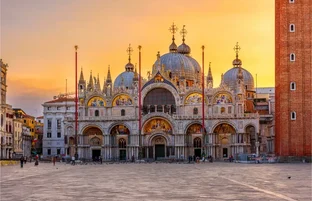
- Avoid the crowds: Late February and March, just after Carnevale, is a great time to visit; it can be cool and misty, but you’ll have the streets and canals (largely) to yourself. Otherwise, get up at sunrise in summer at least once, just to wander the city before the crowds emerge—it’s a magical experience.
- Save money on meals: Eating in Venice can be expensive, but there are plenty of budget options. You’ll save loads by frequenting neighborhood bars known as bacari (normally 5–7pm), where you can stand or sit with small plates of “cicchetti” (tapaslike finger foods), washed down with a small glass of wine. Anywhere near Piazza San Marco is likely to be expensive; it’s best to avoid places with "menù turistico" options altogether.
Parking
Central Venice is divided by Venice's longest (4km/2 1/2 miles) and widest (30-70m/98-230 ft.) waterway, the Grand Canal. Its 118 islands are separated by approximately 170 canals and connected by some 430 footbridges, mostly stone with iron balustrades added in the 19th century.
Only four bridges cross the Grand Canal: the Ponte degli Scalzi, just outside and to the left of the train station; the elegant white marble Ponte Rialto (by far the most recognizable bridge and, for centuries, the only one), connecting the districts of San Marco and San Polo; the wooden Ponte Accademia, connecting the Campo Santo Stefano area of the San Marco neighborhood with the Accademia museum across the way in Dorsoduro; and, since late 2008, the futuristic Ponte della Costituzione (also known as the Calatrava bridge, after famed Spanish architect Santiago Calatrava, who designed it), which you will see around the corner to your right when you exit the train station.
City Layout
Venice lies 4km (2 1/2 miles) from terra firma, connected to the mainland burg of Mestre by the Ponte della Libertà, which leads to Piazzale Roma. Snaking through the city like an inverted S is the Canal Grande (Grand Canal), the wide main artery of aquatic Venice. Central Venice refers to the built-up block of islands in the lagoon's center, including St. Mark's, the train station, and everything else in the six main sestieri that make up the bulk of the tourist city. Greater Venice includes all the inhabited islands of the lagoon -- central Venice plus Murano, Burano, Torcello, and the Lido. The Lagoon comprises everything, from the city to the mud flats to the fish farms to the dozens of abandoned or uninhabited islets.
Keep in mind as you wander seemingly hopelessly among the calli (streets) and campi (squares) that the city wasn't built to make sense to those on foot but rather to those plying its canals. No matter how good your map and sense of direction, time after time you'll get lost (GPS directions are notoriously unreliable here). Just view it as an opportunity to stumble across Venice's most intriguing corners and vignettes.
The city is divided into six sestieri ("sixths," or districts or wards). Cannaregio stretches north and east, from the train station to the Jewish Ghetto and on to the vicinity of the Ca' d'Oro north of the Rialto Bridge. To the east beyond Cannaregio (and skirting the area north and east of Piazza San Marco) is Castello, whose ritzy canal-side esplanade, Riva degli Schiavoni, is lined with deluxe accommodations. The central San Marco shares this side of the Grand Canal with Castello and Cannaregio, anchored by the magnificent Piazza San Marco and St. Mark's Basilica to the south and the Rialto Bridge to the north; it's the city's commercial, religious, and political heart. On the other side of the Grand Canal, San Polo is north of the Rialto Bridge, stretching west to just beyond Campo dei Frari and Campo San Rocco. The residential Santa Croce is next, moving north and west, stretching all the way to Piazzale Roma. Finally, the residential Dorsoduro is on the opposite side of the Accademia Bridge from San Marco. It's the largest sestiere and something of an artists' haven, though escalating rents make it hardly bohemian these days.
Venice shares its lagoon with several other islands. Opposite Piazza San Marco and Dorsoduro is La Giudecca, a tranquil working-class place with mostly residential neighborhoods. The Lido di Venezia is the city's sandy beach; it's a popular summer destination and holds a concentration of seasonal hotels. Murano, Burano, and Torcello are popular destinations northeast of the city and easily accessible by public transport vaporetto. Since the 13th century, Murano has exported its glass products worldwide; it's an interesting half-day trip for those with the time, but you can do just as well in "downtown" Venice's myriad glass stores. Colorful fishing village-style Burano was and still is equally famous for its lace, an art now practiced by so few island women that its prices are generally unaffordable. Torcello is the most remote and least populated. The 40-minute boat ride is worthwhile for history and art buffs, who'll be awestruck by the Byzantine mosaics of the cathedral (some of Europe's finest outside Ravenna), whose foundation dates to the 7th century, making this the oldest Venetian monument in existence. San Michele is the cemetery island where such celebrities as Stravinsky and Diaghilev are buried.
Finally, the industrial city of Mestre, on the mainland, is the gateway to Venice and holds no reason for exploration. In a pinch, its host of inexpensive hotels is worth consideration when Venice's hotels are full, but that's about all.
A Note on Addresses -- Within each sestiere is a most original system of numbering the palazzi, using one continuous string of 6,000 or so numbers. The format for addresses in this chapter is the official mailing address: the sestiere name followed by the building number in that district, followed by the name of the street or campo on which you'll find that address -- for example, San Marco 1471 (Salizzada San Moisè) means the mailing address is San Marco 1471, and you'll find it in the San Marco district on Salizzada San Moisè. Be aware that San Marco 1471 may not necessarily be found close to San Marco 1475 and that many buildings aren't numbered at all.
Visitor Information
Tourist Offices
The most central tourist office lies in the arcade at the western end of Piazza San Marco (Calle Larga de l’Ascensione 71F), near Museo Correr (daily 9am–7pm; tel. 041/2424). There are also offices at Piazzale Roma (inside the Autorimessa Comunale garage; daily 7am–8pm), the train station (opposite platform 2; daily 7am–9pm), and in the arrivals hall at Marco Polo Airport (daily 8:30am–7pm).
When to Go
Weather
It's tough to identify the wettest season in Venice. There is more rain in the summer and later in the year—the most rainfall traditionally come in June, August, and November—but there is more water coming from below the city in the winter. Temperature-wise, Venice can climb to 25°C (77°F) in the summer and temperatures hover just above freezing in the winter. You'll need a jacket in the spring and fall.
The acqua alta, or periodic flooding, can begin as early as late September or October, but usually takes place November to March (there is no way to predict them in advance). Venice’s lagoon rises until it engulfs the city, leaving up to 1.5 to 1.8m (5–6 ft.) of water in the lowest-lying streets. Piazza San Marco, as the lowest point in the city, goes first. As many as 50 floods a year have been recorded since they first started keeping track in the late 1700s. Remember, though, the waters usually recede after just a few hours—–there is no need to get wet and the city doesn’t shut down. Walkways are set up along the main routes, but if you intend to wander around, do as the locals do and buy rubber wading boots, available from most stores from 20€ (souvenir shops and stands in Piazza San Marco also sell disposable knee-high plastic waterproof slippers for about 10€, good for a couple of days). A complex system of hydraulic gates—the Modulo Sperimentale Elettromeccanico or just “MOSE”—is being built out in the lagoon to cut off the highest of these tides (controversial because of its environmental impact and the seemingly endless delays that have plagued construction); it is expected to be operational sometime in 2022.
Venice calendar
The masks, costumes and galas that have become so synonymous with Venice ring in the season of Lent during the pageantry of Carnevale (www.carnivalofvenice.com) in late February/early March. In July, Redentore, the Feast of the Redeemer, is a giant party on the water with fireworks and hundreds of illuminated boats. Oarsmen show their prowess in the Historic Regatta, a centuries-old race that takes to the water in September. The world-renowned contemporary art exhibit that includes the Venice Film Festival, the Venice Biennale (www.labiennale.org) completely takes over the city in the summer and fall of each odd numbered year while thousands of worshippers parade to the looming Salute church for the Madonna della Salute in November.
Getting Around
By Foot -- Aside from traveling by boat, the only way to explore Venice is by walking—and by getting lost repeatedly. You’ll navigate many twisting streets whose names change constantly and don’t appear on any map, and streets that may very well end in a blind alley or spill abruptly into a canal. You’ll also cross dozens of footbridges. Treat getting bewilderingly lost in Venice as part of the fun, and budget more time than you’d think necessary to get wherever you’re going.Street Maps & Signage: The map sold by the tourist office (5€) and free maps provided by most hotels don’t always show—much less name or index—all the calli (streets) and pathways of Venice. For that, pick up a more detailed map (ask for a pianta della città at news kiosks—especially those at the train station and around San Marco or most bookstores). The best (and most expensive) is the highly detailed Touring Club Italiano map, available in a variety of forms (folding or spiral-bound). Almost as good, and easier to carry, is the simple and cheap 1:6,500 folding map put out by Storti Edizioni. If using your phone, note that GPS directions are often unreliable in Venice, though Google Maps has definitely improved in recent years (and has added its “streetview” option to the city).
Still, Venice’s confusing layout confounds even the best maps and navigators. You’re often better off just stopping and asking a local to point you in the right direction (always know the name of the campo/square or major sight closest to the address you’re looking for, and ask for that).
As you wander, look for the ubiquitous yellow signs (well, usually yellow) whose destinations and arrows direct you toward five major landmarks: Ferrovia (the train station), Piazzale Roma (the parking garage), Rialto (one of the four bridges over the Grand Canal), San Marco (the city’s main square), and the Accademia (the southernmost Grand Canal bridge).
By Vaporetto -- The various sestieri are linked by a comprehensive vaporetto (water bus/ferry) system of about a dozen lines operated by the Azienda del Consorzio Trasporti Veneziano (ACTV; actv.avmspa.it; tel. 041/5287886). Transit maps are available at the tourist office and most ACTV ticket offices. It’s easier to get around the center on foot, as the vaporetti principally serve the Grand Canal, the outskirts, and the outer islands. The crisscross network of small canals is the province of delivery vessels, gondolas, and private boats.A vaporetto ticket (good for 75 minutes after validation) is a steep 7.50€, while the 24-hour ACTV travel card is 20€—it only takes three rides to begin saving money with the card. (For even more savings, there are also ACTV travel cards for 48 hours [30€] and 72 hours [40€]). Most lines run every 10 to 15 minutes from 7am to midnight, and then hourly until morning. Most vaporetto docks have timetables posted. You can buy tickets at Venezia Unica offices, authorized retailers displaying the ACTV/Venezia Unica sticker, and usually at the dock itself, though not all have machines or kiosks that sell tickets. If you haven’t bought a pass or tickets beforehand, you can pay the conductor onboard (find immediately him upon boarding—he won’t come looking for you) or risk a stiff fine of at least 60€ plus ticket price and admin fees, no excuses accepted. You must validate (stamp) all tickets in the yellow machines at the docks before getting aboard. Tip: If you’re staying in Venice for a week and intend to use the vaporetto service a lot, it makes sense to get a Venezia Unica city pass, which lets you buy vaporetto tickets for 1.50€.
By Traghetto -- Just four bridges span the Grand Canal, and to fill in the gaps, traghetti skiffs (oversize gondolas rowed by two standing gondolieri) cross the Grand Canal at several intermediate points (during daylight hours only). You’ll find a station at the end of any street named Calle del Traghetto on your map (though not all of them have active ferries today; ask a local before walking to the canal), indicated by a yellow sign with the black gondola symbol. These days only a handful operate regularly, primarily at San Tomà, Santa Maria del Giglio and Santa Sofia (check with a local if in doubt). The fare is 2€ for non-residents (locals pay 0.70€), which you hand to the gondolier when boarding. Most Venetians cross standing up. For the experience, try the Santa Sofia crossing (daily: 7:30am–6:30pm Oct–Mar, 7:30am–7pm Apr–Sep) that connects the Ca’ d’Oro and the Pescheria fish market, opposite each other on the Grand Canal just north of the Rialto Bridge—the gondoliers expertly dodge water traffic at this point of the canal, where it’s the busiest and most heart-stopping.
By Water Taxi -- Taxi acquei (water taxis) charge high prices and aren’t for visitors watching their euros. Trips in town are likely to cost at least 50€ to 90€, depending on distance, time of day, and whether you’ve booked in advance or just hired on the spot. Each trip includes allowance for up to four to five pieces of luggage—beyond that there’s a surcharge of 3€ to 5€ per piece (rates differ slightly according to company and how you reserve a trip). Plus there’s a 20€ supplement for service from 10pm to 7am, and a 5€ charge for taxis on-call. Those rates cover up to four people; if any more squeeze in, it’s another 5€ to 10€ per extra passenger (maximum 10 people). Taking a taxi from the train station to Piazza San Marco or any of the hotels in the area will put you back about 90€ (the Lido is 100€), while fixed fees to the airport range 112–120€ (for up to four people). Taxis to Burano or Torcello will be at least 140€. Note that only taxi boats with a yellow strip are the official operators sanctioned by the city. You can book trips with Consorzio Moscafi Venezia online at www.motoscafivenezia.it or call tel. 041/5222303. Six water-taxi stations serve key points in the city: the Ferrovia, Piazzale Roma, the Rialto Bridge, Piazza San Marco, the Lido, and Marco Polo Airport.
By Gondola -- If you've come all this way and don’t indulge in a gondola ride, you might be kicking yourself long after you have returned home. Yes, it’s touristy, and, yes, it’s expensive, but only those with a heart of stone will be unmoved by the quintessential Venetian experience. Don’t initiate your trip, however, until you have agreed on a price and synchronized watches. Oh, and don’t ask them to sing. For complete info on pricing, hours and where to gondola boarding statsion, click here.
Place Names in Venetian Dialect
Even Italians (non-Venetian ones) look befuddled when trying to decipher street names and signs in Venice (given that you can ever find any), thanks to the peculiarities of the local Venetian dialect. Here are a few basics to help you navigate the town.
ca' -- The abbreviated use of the word casa is used for the noble palazzi, once private residences and now museums, lining the Grand Canal: Ca' d'Oro, Ca' Pesaro, and Ca' Rezzonico. There is only one palazzo, the Palazzo Ducale, the former doge's residence. However, as time went on, some great houses gradually began to be called "palazzi," so today you'll also encounter the Palazzo Grassi or the Palazzo Labia.
calle -- Taken from the Spanish (though pronounced as if Italian, ca-lay), this is the most commonplace word for "street," known as via or strada elsewhere in Italy. There are numerous variations. Ruga, from the French word rue, once meant a calle flanked with stores, a designation no longer valid. A ramo (literally "branch") is the offshoot of a street and is often used interchangeably with calle. Salizzada once meant a paved street, implying that all other, less important calles were once just dirt-packed alleyways. A stretto is a narrow passageway.
campo -- Elsewhere in Italy it's piazza. In Venice, the only piazza is the Piazza San Marco (and its two bordering piazzette); all other squares are campi or the diminutive, campielli. Translated as "field" or "meadow," these were once small, unpaved grazing spots for the odd chicken or cow. Almost every one of Venice's campi carries the name of the church that dominates it (or once did), and most have wells, no longer used, in the center.
canale -- There are three wide, principal canals: the Canal Grande (affectionately called "il Canalazzo," the Canal), the Canale della Giudecca, and the Canale di Cannaregio. Each of the other 160-odd smaller canals is called a rio. A rio terrà is a filled-in canal -- wide and straight -- now used as a street. A piscina is a filled-in basin, now acting as a campo or piazza.
fondamenta -- Referring to the foundations of the houses lining a canal, this is a walkway along the side of a rio (small canal). Promenades along the Grand Canal near the Piazza San Marco and the Rialto are called riva, as in the Riva del Vin or Riva del Carbon, where cargo such as wine and coal were once unloaded.
ramo -- Literally "branch," a small side street.
sottoportego -- An alley that ducks under a building.
Fast Facts
Business Hours -- Standard hours for shops are 9am to 12:30pm and 3 to 7:30pm Monday to Saturday. In winter, shops are closed on Monday morning, while in summer it's usually Saturday afternoon. Most grocers are closed on Wednesday afternoon year-round. In Venice, just about everything is closed on Sunday, though tourist shops in the tourist spots such as the San Marco area are permitted to stay open during high season. Restaurants are required to close at least 1 day a week, called il giorno di riposo, though the particular day varies from one trattoria to another. Many are open for Sunday lunch but close for Sunday dinner. Restaurants that specialize in fish and seafood also typically close Monday, when the fish market is closed. Restaurants will close for holidays, translated as chiuso per ferie, sometime in July or August, frequently over Christmas, and sometime in January before the Carnevale rush.
Consulates -- The nearest U.S. Consulate is in Milan at Via Principe Amedeo 2/10 (tel. 02-290-351). It's open Monday to Friday 8:30am to 12:30pm and 1:30 to 5:30pm. The U.K. Consulate in Venice is on the mainland in Mestre, at Piazzale Donatori di Sangue 2 (tel. 041-505-5990); it's open Monday to Friday 10am to 1pm. Like the U.S., Australia and New Zealand have consulates in Milan, about 3 hours away by train; all also maintain embassies in Rome. The Canadian Consulate closed its office in Milan in 2007; emergencies can be directed to the embassy in Rome (tel. 06-854-441).
Doctors & Hospitals -- The Ospedale Civile Santi Giovanni e Paolo (tel. 041/5294111), on Campo Santi Giovanni e Paolo, has English-speaking staff and provides emergency service (go to the emergency room, pronto soccorso) 24 hours a day (vaporetto: Ospedale).
Emergencies -- In Venice and throughout Italy, dial tel. 113 to reach the police. Some Italians will recommend that you forgo the police and try the military-trained Carabinieri (tel. 112). For an ambulance, phone tel. 523-0000. To report a fire, dial tel. 115, 041-520-0222, or 041-520-0223.
Internet Access -- Venice offers citywide Wi-Fi through the VeniceConnected (www.veneziaunica.it) network of 200 hotspots. Buy packages online (5€/24 hr., 15€/3 days, or 20€/7 days); access codes are then sent via e-mail.
Luggage Storage: Secure luggage storage facilities are available through Radical Storage, which acts as an agent for businesses prepared to look after your bags throughout the city.
Mail -- The most convenient post offices are: Venezia Centro at Calle de la Acque, San Marco (tel. 041/2404149; Mon–Fri 8:25pm–7:10pm and Sat 8:25am–12:35pm); Venezia 4 at Calle de l'Ascension 1241 (tel. 041/2446711), off the west side of Piazza San Marco (Tues–Fri 8:25am–1:35pm, Sat 8:25am–12:35pm); and Venezia 3 at Campo San Polo 2012 (tel. 041/5200315; same hours).
Pharmacies -- Venice’s pharmacies take turns staying open all night. To find out which one is on call in your area, ask at your hotel or check the rotational duty signs posted outside all pharmacies.
Police -- In an emergency, dial tel. 112 or 113.
Safety -- Be aware of petty crime like pickpocketing on the crowded vaporetti, particularly the tourist routes, where passengers are more intent on the passing scenery than on watching their bags. Venice’s often deserted back streets are virtually crime-free, though occasional tales of theft have circulated. Generally speaking, Venice is one of Italy’s safest cities.
Getting There
From North America, the cheapest flights to Venice tend to route through Rome or Milan via Alitalia, though Swissair (via Zurich), Lufthansa (via Frankfurt), KLM (via Amsterdam), and Air France (via Paris) usually offer cheap fares in low season (code-sharing with US carriers). If traveling in the peak spring and summer seasons, however, it’s worth considering far more convenient seasonal non-stop flights, which are often priced competitively (assuming you buy far enough in advance). Delta Airlines (www.delta.com) flies from Atlanta (late June–Aug) and New York-JFK (Apr–Sept); United Airlines (www.united.com) from Newark (June–late Sept); and American Airlines (www.aa.com) from Chicago and Philadelphia (May–Oct). For those already in Europe, numerous budget airlines serve Venice, offering rock-bottom prices. No-frills easyJet (www.easyjet.com) flies from Amsterdam, Berlin, London-Gatwick, Manchester, Paris, and Zurich; while Ryanair (www.ryanair.com) flies from Bristol, Barcelona, and London Southend, with many other flights routed through nearby Treviso (a 1-hr. bus ride to Venice).
Flights land at the Aeroporto di Venezia Marco Polo, 7km (4 1/4 miles) north of the city on the mainland (www.veniceairport.it; tel. 041/2609260). There are several alternatives for getting into town. The cheapest is by bus, though this is not recommended if you have heavy luggage; buses can’t drive into Venice itself, so you’ll have to walk to or from the final stop, Piazzale Roma, to the nearby vaporetto (water bus) stop for the final connection to your hotel. It’s rare to find porters who’ll help with luggage, so pack light.
The ATVO airport shuttle bus (www.atvo.it; tel. 0421/594672) runs between Piazzale Roma and the airport about every 20 minutes, costing 8€ (15€ roundtrip); the trip takes about 20 minutes. Buy tickets at the automatic ticket machines in the arrivals baggage hall, or the Public Transport ticket office (daily 8am–midnight). The local ACTV bus no. 5 (actv.avmspa.it; tel. 041/2424) also costs 8€, also takes 20 minutes, and runs between two and four times an hour depending on the time of day; the best option here is to buy the combined ACTV and “Nave” ticket for 14€ (valid for 90 min.), which includes your first vaporetto ride at a slight discount (the vaporetto is the seagoing streetcar of Venice, which goes to all parts of the city). Buy tickets at machines just outside the airport terminal.
It’s also possible to take a land taxi (www.radiotaxivenezia.com; tel. 041/5964) from the airport to Piazzale Roma (where you get the vaporetto) for about 40€, but while this is more convenient and a bit faster (15 min.) than the bus, it still doesn’t take you to your hotel (unless it’s right by Piazzale Roma)—you are better off spending the extra euros on water transport.
The most evocative and traditional way to arrive in Venice is by sea. For 15€ (14€ online), the Cooperative San Marco/Alilaguna (www.alilaguna.it; tel. 041/2401701) operates a large motoscafo (shuttle boat) service from the airport boathouse (a short, covered walk from the terminal) with two primary routes. The Linea Blu (blue line) runs almost every 30 minutes from 6:15am to 12:30am, stopping at Murano (8€) and the Lido before arriving, after about 1 hour and 30 minutes, in Piazza San Marco (this service continues on to the cruise ship terminal, the “Terminal Crociere”). The Linea Arancio (orange line) runs almost every 30 minutes from 7:45am to midnight, taking 1 hour and 15 minutes to arrive at San Marco, but gets there through the Grand Canal, which is much more spectacular and offers the possibility to get off at one of the stops along the way. This might be convenient to your hotel and could save you from having to take another means of transportation. If you arrive at Piazza San Marco and your hotel isn’t in the area, you’ll have to make a connection at the vaporetto launches. (If you’re booking a hotel in advance, ask for specific advice how to get there.)
A good alternative is the Venice Shuttle (www.venicelink.com; daily 8am–10:30pm; minimum two people for reservations), a shared water taxi (they carry 6–eight people) that will whisk you directly from the airport to many hotels and most of the major locations in the city for 25€ to 32€ (add 6€ after 8pm). You must reserve online in advance.
A private water taxi (20–30 min. to/from the airport) is the most convenient option but costly—a trip to the city costs 110–120€ (discounted rates at www.venicelink.com) for up to four passengers with one bag each (10€ more for each extra person up to a maximum of 10, 5€ for each extra suitcase, and another 20€ for trips 10pm–7am). It’s worth considering if you’re pressed for time, have an early flight (taxis run 24 hr.), are carrying a lot of luggage (a Venice no-no), or can split the cost with a friend or two. It may be able to drop you off at the front (or side) door of your hotel or as close as it can maneuver given your hotel’s location (check with the hotel before arriving). Your taxi captain should be able to tell you before boarding just how close he can get you. Try Corsorzio Motoscafi Venezia (www.motoscafivenezia.it; tel. 041/5222303) or Venezia Taxi (www.veneziataxi.it; tel. 041/723112).
BY TRAIN
Trains from Rome (3 3/4 hr.), Milan (2 1/2 hr.), Florence (2 hr.), and all over Europe arrive at the Stazione Venezia Santa Lucia. To get there, all must pass through (although not necessarily stop at) a station marked Venezia-Mestre. Don’t be confused: Mestre is a charmless industrial city that’s the last major stop on the mainland (some trains also stop at the next station, Venezia Porto Marghera, before continuing to Venice proper). Occasionally trains end in Mestre, in which case you’ll have to catch one of the frequent 10-minute shuttles connecting with Venice; it’s inconvenient, so when you book your ticket, confirm that the final destination is Venezia Santa Lucia.
BY BUS
Although rail travel is more convenient and commonplace, Venice is serviced by long-distance buses from all over mainland Italy and some international cities. Most regional buses terminate at Piazzale Roma, where you’ll need to pick up vaporetto no. 1 or no. 2 to connect you with stops in the heart of Venice and along the Grand Canal. Eurolines (www.eurolines.eu) buses drop off on the adjacent island of Tronchetto, which is a much longer walk from the action. Buses stop at the Tronchetto People Mover station where a light railway whisks you to Piazzale Roma in just 3 minutes (1.50€ one-way), though you will mostly likely need onward transportation from there. Vaporetto line 2 does stop at Tronchetto (facing the water, boats depart left to the train station and Grand Canal, right to San Marco).
BY CAR
The only wheels you’ll see in Venice are those attached to luggage. No cars are allowed, or more to the point, no cars could drive through the narrow streets and over the footbridges—even the police, fire department, and ambulance services use boats. You can drive across the Ponte della Libertà from Mestre to Venice, but you can go no farther than Piazzale Roma at the Venice end, where many garages eagerly await your euros (and in high season are often full). The Autorimessa Comunale garage (www.avmspa.it; tel. 041/2727301) charges 26€ for a 24-hour period (23.40€ on-line), while Garage San Marco (www.garagesanmarco.it; tel. 041/5232213) costs 32€ for 24 hours. From Piazzale Roma, you can catch vaporetti lines 1 and 2, which go down the Grand Canal to the train station and, eventually, Piazza San Marco. Cheaper (and in some cases free) parking is available on the adjacent island of Tronchetto (see “By Bus,” above), first right as you cross the Ponte della Libertà.
Neighborhoods in Brief
Based on a tradition dating from the 12th century, for tax-related purposes, the city has officially been divided into six sestieri (literally, "sixths," or wards) that have basically been the same since 1711. The Canalazzo or Canale Grande (Grand Canal) neatly divides them into three on each bank.
San Marco -- The central sestiere is anchored by the Piazza San Marco and the Basilica di San Marco to the south and the Rialto Bridge to the north. This is the most visited (and, as a result, the most expensive) of the sestieri. It's the commercial, religious, and political heart of the city and has been for more than a millennium. It is also its musical heart, home to the legendary La Fenice Opera House. Although you'll find glimpses and snippets of the real Venice here, ever-rising rents have nudged resident Venetians to look for housing in the outer neighborhoods: You'll be hard-pressed to find a grocery store or dry cleaner here. But if you're looking for Murano glass trinkets and mediocre restaurants, you'll find an embarrassment of choices. This area is laced with first-class hotels -- so we give you suggestions for staying here in the heart of Venice without going broke.
Cannaregio -- Sharing the same side of the Grand Canal with San Marco, Cannaregio stretches north and east from the train station to include the Jewish Ghetto and into the canal-hugging vicinity of the Ca' d'Oro and the Rialto Bridge. Its outer reaches are quiet, unspoiled, and residential ("What high-season tourist crowds?" you may wonder); one-third of Venice's ever-shrinking population of 60,000 is said to live here. Most of the city's one-star hotels are clustered about the train station -- not a dangerous neighborhood but not one known for its charm, either. The gloss and dross of the tourist shop-lined Lista di Spagna strip continues as it morphs into the Strada Nuova in the direction of the Rialto Bridge.
Castello -- This quarter, whose tony Riva degli Schiavoni follows the Bacino di San Marco (St. Mark's Basin), is lined with first-class and deluxe hotels. It begins just east of Piazza San Marco, skirting Venice's most congested area to absorb some of the crowds and better hotels and restaurants. But if you head farther east in the direction of the Arsenale or inland away from the bacino, the people traffic thins out, despite the presence of such major sights as Campo SS. Giovanni e Paolo and the Scuola di San Giorgio.
San Polo -- This mixed-bag sestiere of residential corners and tourist sights stretches northwest of the Rialto Bridge to the principal church of Santa Maria dei Frari and the Scuola di San Rocco. The hub of activity at the foot of the bridge is greatly due to the Rialto market that has taken place here for centuries -- some of the city's best restaurants have flourished here for generations, alongside some of its worst tourist traps. The spacious Campo San Polo is the main piazza of Venice's smallest sestiere.
Santa Croce -- North and northwest of the San Polo district and across the Grand Canal from the train station, Santa Croce stretches all the way to Piazzale Roma. Its eastern section is generally one of the least-visited areas of Venice -- making it all the more desirable for curious visitors. Less lively than San Polo, it is as authentic and feels light-years away from San Marco. The quiet and lovely Campo San Giacomo dell'Orio is considered to be its heart.
Dorsoduro -- You'll find the residential area of Dorsoduro on the opposite side of the Accademia Bridge from San Marco. Known for the Accademia and Peggy Guggenheim museums, it is the largest of the sestieri and was known as an artists' haven until rising rents forced much of the community to relocate elsewhere. Good neighborhood restaurants, a charming gondola boatyard, the lively Campo Santa Margherita, and the sunny quay called le Zattere (a favorite promenade and gelato stop) all add to its character and color.
La Giudecca -- Located opposite the Piazza San Marco and Dorsoduro, La Giudecca is a tranquil working-class residential area where you'll find a youth hostel and a handful of hotels (including the deluxe Cipriani, one of Europe's finest).
Lido di Venezia -- This slim, 11km-long (6 3/4-mile) area is the city's beach; separating the lagoon from the open sea and permitting car traffic, its concentration of seasonal hotels (its landmark hotels serving as home base for the annual Venice Film Festival) makes it a popular summer destination, but it is also quite residential.