Things To Do in Zaragoza
Bookstore
Available as paperback
and as e-book.
Zaragoza Attractions
A few words on the building blocks of the Mujedar architecture you'll see in Zaragoza:
BRICKS: Most Mudéjar buildings in Aragón are constructed of brick, which lends itself well to sophisticated geometric decoration. Walls of Romanesque and Gothic churches tended to be very thick, allowing the craftsmen to configure the surface bricks with protruding corners that create complex decorative patterns.
WOOD: Sophisticated combinations of carved panels and geometrically arrayed beams and boards characterize Mudéjar wooden ceilings. They are usually found in rooms where the ceiling span does not exceed 20 feet, such as private chambers in palaces, small rooms in convents and monasteries, and anterooms in churches. A major exception is the coffered ceiling of the main nave of the Teruel cathedral.
PLASTER: Plaster carving figured prominently in many Islamic architectural styles in Andalucía, and adaptations of those techniques decorate doorways, windows, and even entire walls in Mudéjar buildings in the Christian-dominated north.
TILES: Muslim craftsmen introduced tile artistry to Sevilla in the 8th century, and their abstract geometric tiles still persist as a popular decorative element in Spanish buildings. Mudéjar buildings often feature tiled floors, half-tiled walls, and tile decorations on their exteriors. The tower of San Salvador in Teruel is often cited as one of the most harmonious combinations of Mudéjar tile- and brickwork.

7 Results
- Religious Site
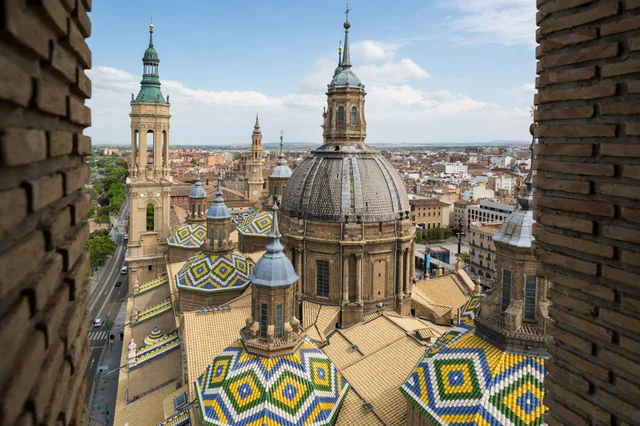
Basílica de Nuestra Señora del Pilar
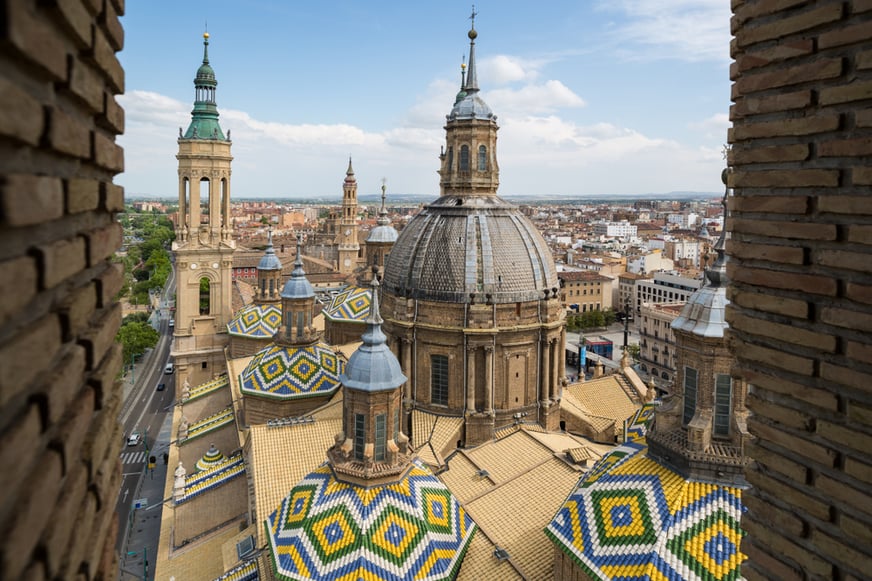
This grandiose 16th- and 17th-century basilica on the bank of the Río Ebro has an almost Byzantine aspect with its domes and towers. Thousands of the faithful travel here annually to pay homage to the tiny statue of the Virgen del Pilar in the Holy Chapel. The basilica is consider a… - Cathedral
La Seo del Salvador
This Gothic-Mudéjar church, built between 1316 and 1319 and enlarged and renovated into the 18th century, is in many ways even more impressive than El Pilar. The rich white facade is a fine example of the Aragonese Mudéjar style, and the structure is an exemplar of Aragonese Gothic… - Art museum
Museo Goya-Colección Ibercaja
Set in a marvelous Renaissance home in the middle of the city, this small museum focuses on the region’s most famous native son, Francisco de Goya. The first floor features mostly Spanish religious paintings from the 15th to 18th centuries, while a few Goya paintings, including a… - Museum
Museo Ibercaja Camón Aznar
The regional savings bank Ibercaja is one of northern Spain’s most active patrons of the arts. This small museum, which augments several Ibercaja exhibition spaces in Zaragoza, fills a marvelous Renaissance home in the middle of the city. The upper-floor galleries are arranged… - Museum
Museo Pablo Gargallo
Pablo Gargallo (1881–1934) was Aragón’s contribution to the artistic avant-garde of the early 20th century. A great friend of Picasso and Juan Gris, he was born in Maella, Aragón, but spent his most productive years in Paris. He introduced Cubism’s jarring dimensional changes into… - Museum
Museo de Zaragoza
There’s a marvelously old-fashioned feel about this museum of local antiquities, beginning with its flamboyant Beaux-Arts building, which was constructed for the Hispano-French Exposition of 1908 (commemorating the centenary of Napoleon’s siege of the city). The building survived… - Historic Site
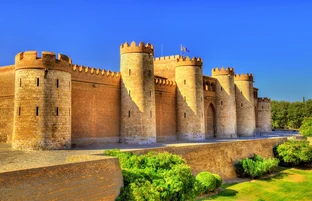
Palacio de la Aljafería
Built in the latter half of the 11th century, this monumental fortress is one of Spain’s finest Moorish palaces. It originally was a summer palace for Muslim rulers; through the centuries, the building was altered to serve as a residence for Aragonese Catholic monarchs, then a…
Zaragoza Nightlife
Zaragoza is a university town so things perk up around 11pm. A good place to begin an evening’s bar- and pub-crawl is Plaza Santa Cruz.
Some popular affordable tapas bars around the plaza include El Viejo Negroni (C. de la Sta. Cruz, 13, 15; tel. 87-601-96-99) and Casa Juanico (C. de la Sta. Cruz, 21; tel. 97-639-72-52). The hottest bar for a gay and drag scene enhanced by creative cocktails is Café Septimo Arte (C. del Olmo, 14).