Frommers.com Frommers.com
Most Recent New York City Forum Posts
Most Recommended Articles
Most Commented Articles
  Print This Article Print Get Frommer's RSS Feed RSS

Getting Around (By Subway)

Run by the Metropolitan Transit Authority (MTA; www.mta.info/nyct/subway), the much-maligned subway system is actually the fastest way to travel around New York, especially during rush hours. Some 4.5 million people a day seem to agree with me, as it's their primary mode of transportation. The subway is quick, inexpensive, relatively safe, and efficient, as well as being a genuine New York experience.

The subway runs 24 hours a day, 7 days a week. The rush-hour crushes are roughly from 8 to 9:30am and from 5 to 6:30pm on weekdays; the rest of the time the trains are much more manageable.

Paying Your Way -- The subway fare is $2 (half-price for seniors and those with disabilities), and children under 44 inches tall ride free (up to three per adult).

Tokens are no longer available. People pay with the MetroCard, a magnetically encoded card that debits the fare when swiped through the turnstile (or the fare box on any city bus). Once you're in the system, you can transfer freely to any subway line that you can reach without exiting your station. MetroCards also allow you free transfers between the bus and subway within a 2-hour period.

MetroCards can be purchased from staffed token booths, where you can only pay with cash; at the ATM-style vending machines now located in every subway station, which accept cash, credit cards, and debit cards; from a MetroCard merchant, such as most Rite Aid drugstores; Hudson News, at Penn Station and Grand Central Terminal; or at the MTA information desk at the Times Square Information Center, 1560 Broadway, between 46th and 47th streets.

MetroCards come in a few different configurations:

Pay-Per-Ride MetroCards can be used for up to four people by swiping up to four times (bring the entire family). You can put any amount from $4 (two rides) to $80 on your card. Every time you put $7 or more on your Pay-Per-Ride MetroCard, it's automatically credited 15% -- that's one free ride for every $15 you spend. You can buy Pay-Per-Ride MetroCards at any subway station; most stations have automated MetroCard vending machines, which allow you to buy MetroCards using your major credit card or debit card. MetroCards are also available from many shops and newsstands around town in $10 and $20 values. You can refill your card at any time until the expiration date on the card, usually about a year from the date of purchase, at any subway station.

Unlimited-Ride MetroCards, which can't be used for more than one person at a time or more frequently than 18-minute intervals, are available in four values: the daily Fun Pass, which allows you a day's worth of unlimited subway and bus rides for $7; the 7-Day MetroCard, for $25; a 14-day MetroCard for $47; and the 30-Day MetroCard, for $81. Seven-, 14- and 30-day Unlimited-Ride MetroCards can be purchased at any subway station or from a MetroCard merchant. Fun Passes, however, cannot be purchased at token booths -- you can only buy them at a MetroCard vending machine; from a MetroCard merchant; or at the MTA information desk at the Times Square Information Center. Unlimited-Ride MetroCards go into effect the first time you use them -- so if you buy a card on Monday and don't begin to use it until Wednesday, Wednesday is when the clock starts ticking on your MetroCard.

A Fun Pass is good from the first time you use it until 3am the next day, while 7- and 30-day MetroCards run out at midnight on the last day. These MetroCards cannot be refilled. (At press time there were strong rumors that the 7-Day Metro Card and 30-Day Metro Card rates were going up).

Tips for using your MetroCard: The MetroCard swiping mechanisms at turnstiles are the source of much grousing among subway riders. If you swipe too fast or too slow, the turnstile will ask you to swipe again. If this happens, do not move to a different turnstile, or you may end up paying twice. If you've tried repeatedly and really can't make your MetroCard work, tell the token booth clerk; chances are good, though, that you'll get the movement down after a couple of uses.

If you're not sure how much money you have left on your MetroCard, or what day it expires, use the station's MetroCard Reader, usually located near the station entrance or the token booth (on buses, the fare box will also provide you with this information).

To locate the nearest MetroCard merchant, or for any other MetroCard questions, call tel. 800/METROCARD (out of NYC only) or 212/METROCARD (212/638-7622) Monday through Friday between 7am and 11pm, Saturday and Sunday from 9am to 5pm. Or go online to www.mta.nyc.ny.us/metrocard, which can give you a full rundown of MetroCard merchants in the tri-state area.

Using the System

The subway system basically mimics the lay of the land aboveground, with most lines in Manhattan running north and south, like the avenues, and a few lines east and west, like the streets.

To go up and down the east side of Manhattan (and to the Bronx and Brooklyn), take the 4, 5, or 6 train.

Subway Service Interruption Notes -- Service is always subject to change, for reasons ranging from "a sick passenger" to regularly scheduled construction. Your best bet is to contact the Metropolitan Transit Authority (MTA) for the latest details; call tel. 718/330-1234 or visit www.mta.nyc.ny.us, where you'll find system updates that are thorough, timely, and clear. (You can also sign up online to receive service advisories by e-mail.) Also read any posters that are taped up on the platform or notices written on the token booth's whiteboard. Once in town, you can stop at the MTA desk at the Times Square Information Center, 1560 Broadway, between 46th and 47th streets (where Broadway meets Seventh Ave.) to pick up the latest subway map. (You can also ask for one at any token booth, but they might not always be stocked.)

Help Mapping Your Subway Route -- If you're not sure how to get, say, from the Museum of Natural History to the Brooklyn Bridge, you might want to visit www.hopstop.com. Offering navigation help on several major U.S. subway systems, the useful widget can tell you how to get from one place to the other underground. (It also gives you a comparison for time/cost using a taxi or car service). You can modify your request by specifying "more walking" or "fewer transfers."

To travel up and down the West Side (and also to the Bronx and Brooklyn), take the 1, 2, or 3 line; the A, C, E, or F line; or the B or D line.

The N, R, Q, and W lines first cut diagonally across town from east to west and then snake under Seventh Avenue before shooting out to Queens.

The crosstown S line, the Shuttle, runs back and forth between Times Square and Grand Central Terminal. Farther downtown, across 14th Street, the L line works its own crosstown magic.

Lines have assigned colors on subway maps and trains -- red for the 1, 2, 3 line; green for the 4, 5, 6 trains; and so on -- but nobody ever refers to them by color. Always refer to them by number or letter when asking questions. Within Manhattan, the distinction between different numbered trains that share the same line is usually that some are express and others are local. Express trains often skip about three stops for each one that they make; express stops are indicated on subway maps with a white (rather than solid) circle. Local stops are usually about 9 blocks apart.

Directions are almost always indicated using "uptown" (northbound) and "downtown" (southbound), so be sure to know what direction you want to head in. The outsides of some subway entrances are marked UPTOWN ONLY or DOWNTOWN ONLY; read carefully, as it's easy to head in the wrong direction. Once you're on the platform, check the signs overhead to make sure that the train you're waiting for will be traveling in the right direction. If you do make a mistake, it's a good idea to wait for an express station, such as 14th Street or 42nd Street, so you can get off and change to the other direction without paying again.

The days of graffiti-covered cars are gone, but the stations -- and an increasing number of trains -- are not as clean as they could be. Trains are air-conditioned (move to the next car if yours isn't), though during the dog days of summer the platforms can be sweltering. In theory, all subway cars have PA systems to allow you to hear the conductor's announcements, but they don't always work well. It's a good idea to move to a car with a working PA system in case sudden service changes are announced that you'll want to know about.

For More Bus & Subway Information -- For additional transit information, call the Metropolitan Transit Authority's MTA/New York City Transit's Travel Information Center at tel. 718/330-1234. Extensive automated information is available at this number 24 hours a day, and travel agents are on hand to answer your questions and provide directions daily from 6am to 9pm. Customers who don't speak English can call tel. 718/330-4847. For online information that's always up-to-the-minute, visit www.mta.nyc.ny.us.

To request system maps, call the Map Request Line at tel. 718/330-3322 (although realize that recent service changes may not yet be reflected on printed maps). Riders with disabilities should direct inquiries to tel. 718/596-8585; hearing-impaired riders can call tel. 718/596-8273. For MetroCard information, call tel. 212/METROCARD (638-7622) weekdays from 7am to 11pm, weekends 9am to 5pm, or go online to www.mta.nyc.ny.us/metrocard.

You can get bus and subway maps and additional transit information at most information centers. A particularly helpful MTA transit information desk is located at the Times Square Information Center, 1560 Broadway, between 46th and 47th streets, where you can also buy MetroCards. Maps are sometimes available in subway stations (ask at the token booth), but rarely on buses.

Subway Stops for New York's Top Attractions

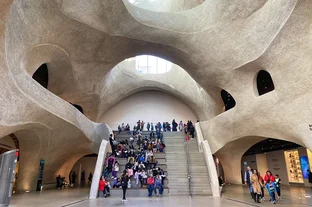
American Museum of Natural History B, C to 81st Street

The Cloisters A to 190th Street

Ellis Island 4, 5 to Bowling Green or N, R to Whitehall Street 1 to South Ferry

Guggenheim Museum 4, 5, 6 to 86th Street

Intrepid Sea-Air-Space Museum A, C, E to 42nd Street-Port Authority

Metropolitan Museum of Art 4, 5, 6 to 86th Street

Museum of Modern Art E, V to Fifth Avenue or B, D, F to 47-50th streets-Rockefeller Center.

Brooklyn Bridge 4, 5, 6 to Brooklyn Bridge-City Hall

Chrysler Building 4, 5, 6, 7, S to Grand Central-42nd Street

Empire State Building B, D, F, V, N, R, Q, W to 34th Street-Herald Square

Grand Central Terminal 4, 5, 6, 7, S to Grand Central-42nd Street

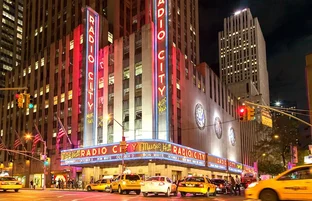
Rockefeller Center B, D, F, V to 47-50th streets-Rockefeller Center

Staten Island Ferry 1 to South Ferry (first five cars)

United Nations 4, 5, 6, 7, S to Grand Central-42nd Street

Yankee Stadium 4, B, D to 161st River Avenue-Yankee Stadium

Chinatown 6, J, M, Z, N, R, Q, W to Canal Street

Greenwich Village A, C, E, B, D, F, V to West 4th Street

Times Square 1, 2, 3, 7, N, R, W, S to 42nd Street-Times Square

Wall Street 4, 5 to Wall Street or N, R to Rector Street

Cathedral of St. John the Divine 1 to Cathedral Parkway (110th St.)

St. Patrick's Cathedral B, D, F, V to 47-50th streets-Rockefeller Center or E, V to Fifth Avenue-53rd Street


Back to Top


Click the names below for more detailed information.

Note: This information was accurate when it was published, but can change without notice. Please be sure to confirm all rates and details directly with the companies in question before planning your trip.


  Print This Article Print Get Frommer's RSS Feed RSS
Destination Guide
Destination Guide Destination Guide Destination Guide
Destination Guide Destination Guide Frommer's New York City 2010 Destination Guide Frommer's New York City 2010

Author: Brian Silverman
Pub Date: November 02, 2009
Price: $19.99

Add to Cart
Destination Guide Destination Guide Destination Guide Related Titles:
Frommer's 24 Great Walks in New York, 1st Edition
Destination Guide
Frommer's NYC Free & Dirt Cheap, 3rd Edition
Destination Guide
Frommer's New York City 2009
Destination Guide
Destination Guide Destination Guide
Destination Guide Destination Guide Destination Guide
Destination Guide
Destinations
Destinations