
Bookstore
Available as paperback
and as e-book.
Toledo Attractions
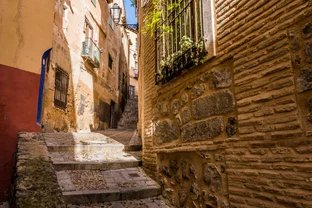
Once you’ve made it up the hill to the old city, Toledo is easy to get around on foot, though you’re bound to get lost in its medieval alleyways at some stage. There are so many interesting things to see that, unless you’re staying several days, it doesn’t make sense to try to do everything. Better to pick a handful of gems and go deeper. If you’re interested in the city’s religious heritage, the pulsera turística—a wristband giving access to seven historic sites for 14€ (www.toledomonumental.com)—offers savings of 50%. But note that it doesn’t include the cathedral, and if your time is limited you may struggle to get around enough sites to make it pay off. For most, it will be more enjoyable not to tie yourself to a tight agenda.
To get your bearings, consider taking an entertaining 2-hour tour in English with FollowMe Toledo (tel. 67-079-61-24). Book your slot online and meet your guide, who’ll be carrying a blue umbrella, in Plaza de Zocodover. You can then go back and explore in more detail the sights that most interest you. Although there’s no charge, most people tip around 10€-15€ for the 90-minute tour.
While Christian art and architecture dominate Toledo, there are many opportunities to explore the other cultures upon which the city is built. Dating from the 12th century, the Sinagoga de Santa María la Blanca, Calle Reyes Católicos, 4 (tel. 92-522-72-57; 4€; daily 10am–5:45pm, until 6:45pm in summer), is believed to be the oldest synagogue in Europe. Its horseshoe arches and intricate moldings echo Córdoba’s Mezquita.
Like the synagogue, the mosque of Cristo de la Luz, Calle Cristo de la Luz, 22 (toledomonumental.com; 📞 92-525-41-91; 4€; daily 10am–5:45pm, until 6:45pm in summer), received a name change after the Christian reconquest. Legend claims that a shaft of light (luz) guided King Alfonso XII to a crucifix hidden since Visigoth times in the mosque’s walls.
The Museo de la Cultura Visigoda, Calle de San Román s/n (cultura.castillalamancha.es; 📞 92-522-78-72; 2€; Tues–Sat 10am–2pm and 4–6pm, Sun 9am–3pm), exhibits Visigoth artifacts from the 6th to 8th centuries in the beautiful 13th-century church of San Román, itself a mishmash of Roman, Muslim, and Christian design.
The small Taller del Moro museum, Calle Taller del Moro (cultura.castillalamancha.es; 📞 92-578-82-70; 2€; Tues–Sat 10am–2pm and 4–6pm, Sun 9am–3pm), in a beautifully restored 14th-century palace, focuses on Mudéjar craftsmanship, while the Museo Sefardí tells the story of the Jews on the Iberian peninsula. You’ll hear plenty of talk about how Christianity, Judaism, and Islam lived in harmony in Toledo. Sadly, the historical facts suggest otherwise.
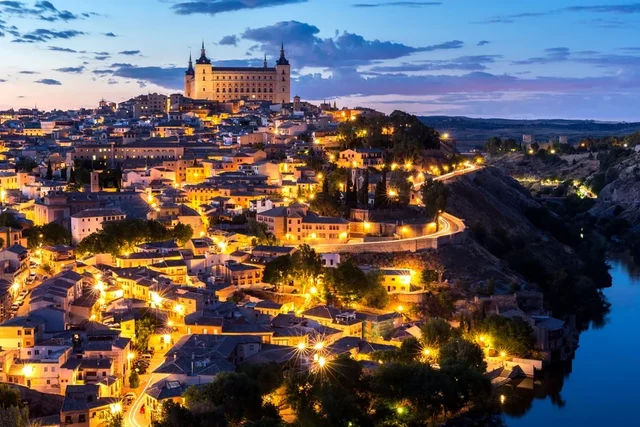
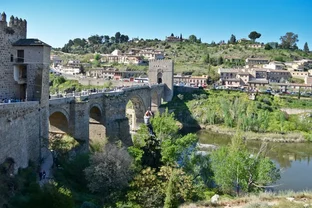
While wandering through the heart of old Toledo is delightful, you mustn’t miss the extraordinary view of the city from afar. It still looks much as it did when El Greco painted it at the beginning of the 17th century. If you don’t have a car, hop aboard the motorized tourist train that runs every half hour from Cuesta de Carlos V next to the Alcázar. It makes a circular loop of the city, passing the ancient Alcántara and San Martín bridges, and stops at Mirador del Valle de Toledo, the perfect spot for El Greco style photographs. The tour, including a headphone audio guide, costs 9€ for adults and 6€ for children and lasts around 45 minutes. If you have a car, take the Carretera de Circunvalación, the road that runs 3km (1 3/4 miles) on the far bank of the Río Tajo. This road makes a circular loop of the river from the Alcántara to the San Martín Bridge. Clinging to the hillsides are farmsteads (cigarrales) with rustic dwellings and extensive olive groves. The cigarrales of the Imperial City were immortalized by Tirso de Molina, the 17th-century dramatist, in his trilogy Los Cigarrales de Toledo.

14 Results
- Religious Site
Catedral de Toledo
Filled with treasures of religious art and freighted with history as the first cathedral to reclaim central Spain for Christianity, this cathedral remains the ecclesiastical seat of the Roman Catholic church in Spain, long after the political capital moved to Madrid. Set at the… - Museum
Hospital de Tavera
Cardinal Juan Pardo de Tavera, the 16th-century Toledo archbishop who was a close confident of Emperor Carlos V, was not one to hide his light beneath a bushel. He had this elegant Renaissance palace with beautiful arcaded twin courtyards built in a style far more grandiose than… - Religious Site
Iglesia de Santo Tomé
This modest church with a fine Mudéjar bell tower was restored in the 14th century with funds donated built by the Count of Orgaz, a wealthy mayor of Toledo. The compelling reason to visit is to see El Greco’s masterpiece, The Burial of the Count of Orgaz, painted in 1586. The story… - Arts
Mariano Zamoraño Fábrica de Espadas y Armas Blancas
Medieval Toledo craftsmen rediscovered the ancient techniques for making weapons of hardened steel, making a sword of “Toledo steel” the gold standard for a crusading knight going to do battle in the Holy Land. The ubiquitous modern souvenir swords are a waste of money, but… - Religious Site
Monasterio de San Juan de los Reyes
There are no El Grecos in this early Renaissance monastery, but the cloisters work their own kind of magic. Fernando and Isabel had the convent built to mark their 1476 victory over the Portuguese and originally intended to be buried here—until the symbolic importance of being buried… - Religious Site
Museo Convento de Santo Domingo el Antiguo
This quiet convent church has the distinction of having first lured Doménikos Theotokópoulos—later known as El Greco—to Toledo in 1577 with a commission for nine paintings. His The Assumption, which still sits above the altar, is not his finest work but it helped make the authorities… - Museum
Museo Sefardí (Sephardic Museum)
It only took 500 years after the expulsion of the Jews from Spain for this museum to open, in an attempt to explain Judaism and Jewish history to a city where the Jewish population was essential to the functioning of the court and the country for centuries. In the years since it… - Museum
Museo de Santa Cruz
If you want to get close to masterpieces by El Greco, make this museum your first stop. The museum is the repository for dozens of 16th- and 17th-century paintings that once decorated Toledo-area churches and convents. About a dozen of them are by El Greco, and the greatest of the… - Museum
Museo del Ejército
At the time of writing parts of the building were closed for major renovation work, and while that continues entry to the museum is free.Toledo’s Alcázar, or fortress, dominates the city’s famous skyline.It has been destroyed and rebuilt many times throughout its history, most… - Art museum
Museo del Greco
In the early 20th century, the Marquis de Vega-Inclán, a wealthy patron of the arts, bought this old house in Toledo’s Jewish quarter under the misapprehension that it had once belonged to El Greco. The museum he founded, to promote the painter’s work and show how life was led in his… - Museum
Real Fundación de Toledo
You probably didn’t come to Toledo to see contemporary art, but this impressive space is well worth a visit. It is housed in Roca Tarpeya, the home and studio of Victorio Macho, one of Spain’s finest 20th-century sculptors. Macho fled at the outbreak of the Civil War and made his… - Specialty shopping
Santo Tomé Obrador de Mazapán
Whether or not they invented it (some say it was originally an Arab treat), the nuns of Toledo began making the confection of ground almonds, sugar, and eggs known as mazapán in the 13th century. A flour shortage following the battle of las Navas de Tolosa forced them to improvise to… - Religious Site
Sinagoga de Santa María la Blanca
This small synagogue is believed to be the oldest standing European synagogue. It was built in 1203 in the Almohad style with horseshoe arches and intricately carved moldings. The style echoes La Mezquita in Córdoba, the grandest of the Iberian mosques. When it was converted to a… - Religious Site
Sinagoga del Tránsito
One block west of the El Greco home and museum stands this once-important house of worship for Toledo's large Jewish population. A 14th-century building, it is noted for its superb stucco Hebrew inscriptions, including psalms inscribed along the top of the walls and a poetic…
More About Toledo Attractions
Toledo Shopping
If Toledo has a downside, it’s the tacky souvenir shops. From the time of the Crusades, the swordsmiths of Toledo have been renowned for their high-quality blades, but the tourist versions for sale today are almost all factory-made and the city’s traditional sword-making industry is all but extinct. Artesanía Morales (Plaza de Conde 3; tel. 92-522-35-86) is the exception. It is determined to keep the tradition alive, and at the family workshop you can sometimes see artisans heating steel bars red-hot on a bed of charcoal, then stretching and shaping them into blades. Artesanía Morales, Plaza de Conde, 3 (artesaniamorales.com; 📞 92-522-35-86), produces culinary "swords"—high quality kitchen knives and can ship them to your home.
Toledo was equally renowned for its damasquinado, or damascene work: the Moorish art of inlaying gold, copper, or silver threads against a matte black-steel backdrop. Today Toledo is filled with souvenir shops hawking damascene, much of it inferior machine-made work that can still serve as a cheap souvenir. But you can find fine handmade damascene jewelry at Damasquinados Suárez (Circo Romano 8 (tel. 92-528-00-27).
Marzipan (called mazapán locally) is a Toledo specialty and boxes of the sugary sweets in all shapes and sizes are widely available across the old town. It’s fun to buy from local nuns but the best and most affordable sweets are sold by Santo Tomé.
The province of Toledo is also renowned for its pottery, which is sold in so many shops at competitive prices that it’s not necessary to single any out. Over the years we’ve found that the large roadside emporiums on the outskirts of town on the main road to Madrid offer better bargains than shops within the city walls.
A Shopping Trip to Talavera de la Reina
Want to delve deeper into the Spanish ceramic tradition? Consider a trip to Talavera de la Reina, 80km (50 miles) west of Toledo, where the finest pottery and tiles have been produced for centuries. The blue-and-white azulejos on the walls of the royal apartments at the Escorial and at many other royal palaces were made in Talavera.
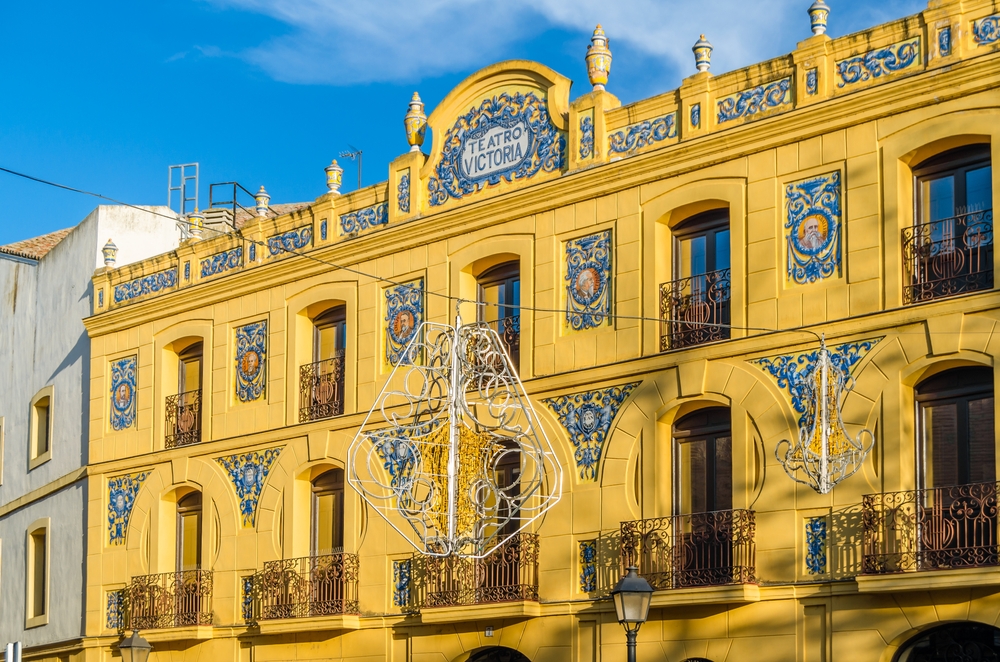
A ceramics-laden facade in Talavera de la Raina (Vali.Lung / Shutterstock)
This is Toledo province’s second city, so don’t expect a quaint potter’s village. Many factories are on or around the main strip, Avenida de Portugal, where store after store sells the distinctive multi-colored designs. Artesanía Talaverana, Avenida de Portugal, 32 (tel. 92-580-29-09), is among the most picturesque.
You’ll see tiled panels at every turn, including on the city’s churches. The Basílica de Nuestra Señora del Prado, Av. Extremadura (tel/ 92-580-14-45), is nicknamed the ceramic Sistine Chapel.
You can learn more about the history of Talavera’s ceramic craft going back to the 16th century, and admire many beautiful examples, at Museo Ruiz de Luna, Calle San Agustín, 13 (tel. 92-580-01-49; 3€ adults, free for seniors and students; Tues–Sat 10am–2pm and 4pm–6pm, Sun 9:30am–2:30pm).
Toledo Nightlife
Come nightfall, the throngs of day-trippers vanish, and locals seek out nightlife mainly in the modern town, far from the historic attractions. In the old city, Bar La Abadía, Calle Núñez de Arce, 3 (abadiatoledo.com; tel. 92-519-22-51), is a beautiful stone and brick bar and restaurant where Toledans jostle for the house-brand beer. The friendly local Bar Ludeña, Plaza Magdalena, 10 (tel. 92-522-33-84), is a great place to try traditional carcamusa pork stew, which bubbles behind the bar. Sala Pícaro, Calle Cadenas, 6 (picarotoledo.com; tel. 92-522-13-01), has regular live events with Spanish indie bands and DJs, while Taberna El Botero, Calle Ciudad, 5, is the place for cocktails.
For concerts, clubbing, or just a drink, it’s worth seeking out El Circulo de Arte, Plaza San Vicente, 2 (tel. 92-521-29-81). Occupying a converted former church, this vibrant multidisciplinary space serves as concert hall, cinema, and nightclub with impressive light shows that illuminate its historic horseshoe arches.