Alcázar

The oldest European royal residence still in use—the king and queen stay here when in Sevilla—this complex of palaces and fortifications dates from the rule of the Abbadid dynasty in the 11th century. It was largely rebuilt after the Christian reconquest of Sevilla in 1248 and has been much tinkered with by successive kings and queens.
Enter via the Puerta del León (Lion’s Gate), with its striking red wall and ceramic panel depicting a lion. It leads to a magnificent series of courtyards, royal residences, and gardens. The older, more austere building is the Palacio Gótico, built by Alfonso X soon after the Reconquest. Carlos V modified its halls to celebrate his wedding in 1526 to his Habsburg cousin, Isabel of Portugal (an unfortunate union that triggered the genetic problems of the dynasty). Huge tapestries celebrate his conquest of Tunisia.
The larger and far more beautiful Palacio Mudéjar, built in the 14th century by Pedro I, is perhaps Spain’s finest example of Mudéjar architecture, the style of decoration created by Muslim artisans working under Christian rule. The term means “those who stayed on”, and indeed the palace employed some of the same craftsmen who had worked on the Alhambra in Granada. It’s a masterpiece of delicate calligraphic friezes, tooled wooden ceilings, and decorative tiles.
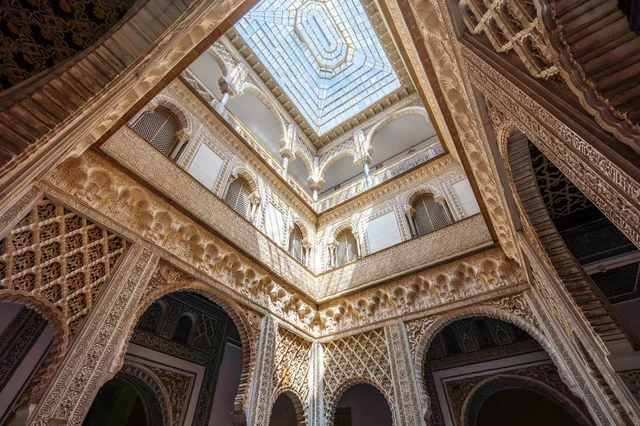
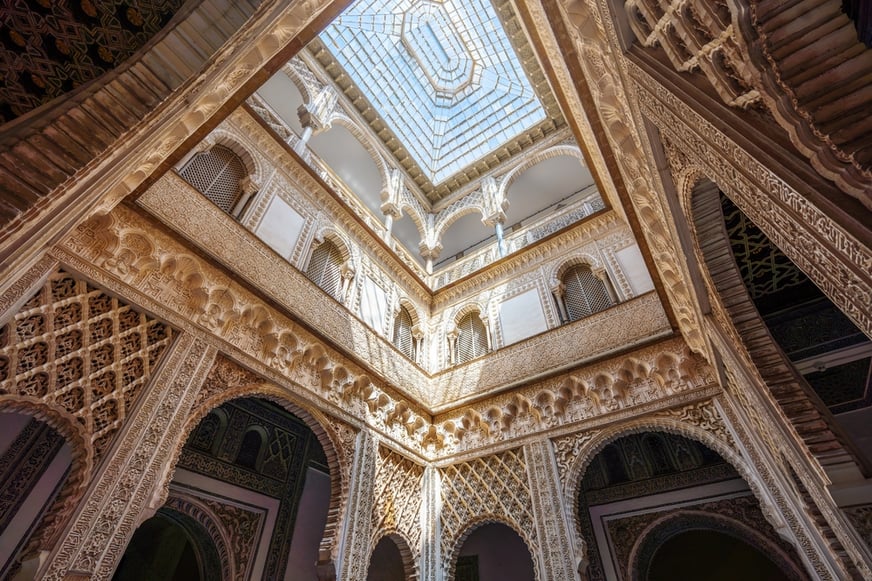
The Patio de las Doncellas (Court of the Maidens) most clearly resembles the Alhambra. Some inscriptions here refer to Pedro as “the sultan”, others proclaim “there is no conqueror but Allah.” The patio’s upper arches, added by Carlos V, bear his motto “Plus Ultra” (Further Beyond). The Patio de las Muñecas (Court of the Dolls, see above) is a fine example of architectural recycling. The columns come from the Roman settlement of Itálica just outside Sevilla, the capitals from Madinat al-Zahra near Córdoba, and friezes on the upper tier are from the Alhambra. Look for the tiny children’s faces that peer out from one of its arches, giving the patio its name.
The exquisitely decorated Salón de Embajadores (Hall of Ambassadors) was Pedro I’s throne room. Its cupola of carved and gilded wood—representing the heavens—is the palace’s most spectacular sight. It is known as the media naranja, or half orange. Subsequent monarchs added the incongruous wrought-iron balconies and a frieze of 16th-century royal portraits.
The Catholic Monarchs Isabel and Fernando also spent time at the Alcázar—they received Columbus here on his return from America. The Casa de la Contratación (House of Trade) was founded by Isabel in 1503 as the crown agency to oversee Sevilla’s monopoly on commerce with the New World. Inside you’ll see the Virgin of the Navigators by Alejo Fernández, one of the first European paintings to depict native Americans—sheltering under the Virgin’s mantle.
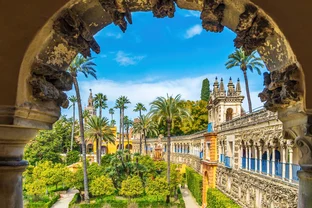
For an additional 5.50€ you can visit the Cuarto Real Alto, the upper quarters still used by the royal family. Round off your visit by wandering in the gardens, a rambling collection of terraces, fountains, and pavilions that reflect centuries of alteration. Fans of the TV show Game of Thrones will know them as the Water Gardens of Dorne. And don’t miss the Baños de Doña María de Padilla, a placid subterranean cistern where Pedro I’s mistress was said to have bathed.
Tip: Access the audio guide on your phone and download the free map before your visit.
The oldest European royal residence still in use—the king and queen stay here when in Sevilla—this complex of palaces and fortifications dates from the rule of the Abbadid dynasty in the 11th century. It was largely rebuilt after the Christian reconquest of Sevilla in 1248 and has been much tinkered with by successive kings and queens.
Enter via the Puerta del León (Lion’s Gate), with its striking red wall and ceramic panel depicting a lion. It leads to a magnificent series of courtyards, royal residences, and gardens. The older, more austere building is the Palacio Gótico, built by Alfonso X soon after the Reconquest. Carlos V modified its halls to celebrate his wedding in 1526 to his Habsburg cousin, Isabel of Portugal (an unfortunate union that triggered the genetic problems of the dynasty). Huge tapestries celebrate his conquest of Tunisia.
The larger and far more beautiful Palacio Mudéjar, built in the 14th century by Pedro I, is perhaps Spain’s finest example of Mudéjar architecture, the style of decoration created by Muslim artisans working under Christian rule. The term means “those who stayed on”, and indeed the palace employed some of the same craftsmen who had worked on the Alhambra in Granada. It’s a masterpiece of delicate calligraphic friezes, tooled wooden ceilings, and decorative tiles.
The Patio de las Doncellas (Court of the Maidens) most clearly resembles the Alhambra. Some inscriptions here refer to Pedro as “the sultan”, others proclaim “there is no conqueror but Allah.” The patio’s upper arches, added by Carlos V, bear his motto “Plus Ultra” (Further Beyond). The Patio de las Muñecas (Court of the Dolls, see above) is a fine example of architectural recycling. The columns come from the Roman settlement of Itálica just outside Sevilla, the capitals from Madinat al-Zahra near Córdoba, and friezes on the upper tier are from the Alhambra. Look for the tiny children’s faces that peer out from one of its arches, giving the patio its name.
The exquisitely decorated Salón de Embajadores (Hall of Ambassadors) was Pedro I’s throne room. Its cupola of carved and gilded wood—representing the heavens—is the palace’s most spectacular sight. It is known as the media naranja, or half orange. Subsequent monarchs added the incongruous wrought-iron balconies and a frieze of 16th-century royal portraits.
The Catholic Monarchs Isabel and Fernando also spent time at the Alcázar—they received Columbus here on his return from America. The Casa de la Contratación (House of Trade) was founded by Isabel in 1503 as the crown agency to oversee Sevilla’s monopoly on commerce with the New World. Inside you’ll see the Virgin of the Navigators by Alejo Fernández, one of the first European paintings to depict native Americans—sheltering under the Virgin’s mantle.
For an additional 5.50€ you can visit the Cuarto Real Alto, the upper quarters still used by the royal family. Round off your visit by wandering in the gardens, a rambling collection of terraces, fountains, and pavilions that reflect centuries of alteration. Fans of the TV show Game of Thrones will know them as the Water Gardens of Dorne. And don’t miss the Baños de Doña María de Padilla, a placid subterranean cistern where Pedro I’s mistress was said to have bathed.
Tip: Access the audio guide on your phone and download the free map before your visit.
Details
Bookstore
Available as paperback
and as e-book.