Things To Do in Trujillo, Spain
Bookstore
Available as paperback
and as e-book.
Trujillo, Spain Attractions
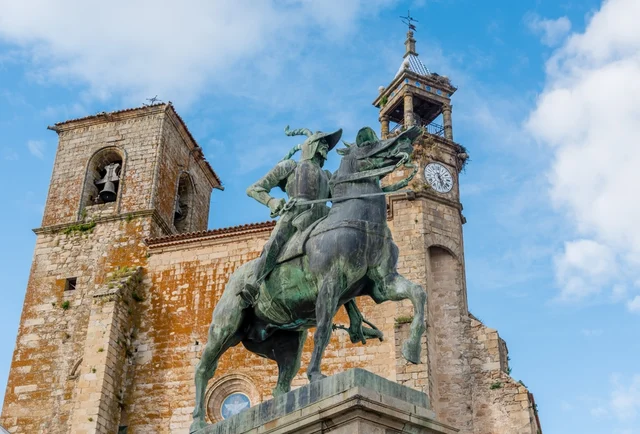
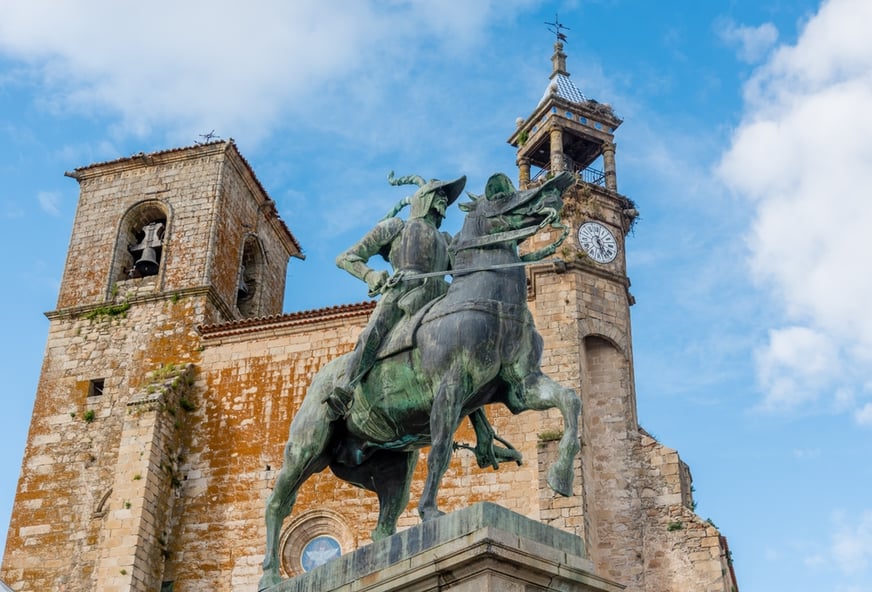
Trujillos' main square, which lies above the modern city, is a group of irregular historic buildings and monuments that together approach perfection. Overlooking the scene is a huge equestrian statue of Francisco Pizarro by the American sculptor Charles Rumsey, presented to the town in the 1920s. Although portrayed as magnificent in his plumed helmet, Pizarro was in truth a thuggish illiterate whose conquest of Peru remains controversial.
Behind the statue stands the Iglesia de San Martín, a solid Renaissance church where Emperor Carlos V stopped to pray on his way to Sevilla to marry Isabel of Portugal in 1526. Inside is an impressive, vaulted nave and a still-functioning Baroque 18th century organ.
In the opposite corner of the square stands the Palacio de la Conquista, built in 1562 according to instructions in Pizarro’s will. The work was undertaken by Pizarro’s brother Hernando for his wife (and niece) Francisca Pizarro Yupanqui. She was daughter of Francisco Pizarro and his lover Inés Huaylas Yupanqui, sister of the Incan emperor Atahualpa. The palace’s corner wall is embellished with an enormous coat of arms featuring carvings of this complex foursome—a striking example of conquistador bling. Sadly, the mansion is rarely open to the public.
The square's most prominent structure is the Ayuntamiento Viejo (Old Town Hall), with three tiers of arches, each tier squatter than the one below.
There are plenty of other sights of interest in the square, including Casa de la Cadena, a mansion with a heavy chain above its entrance. Its purpose was to show that Felipe II, who stayed here, had granted the Orellana family immunity from taxes. After exploring the square, you’ll have earned a cold drink at one of the square’s open-air cafés, where the awnings spray a cooling mist on hot afternoons.
An economical way to get around the main points of interest is to sign up for the guided tour offered by the tourist office at 11am and 4:30pm daily. It costs 8€(children under 13 go free) and gives access to several sites, including the main churches, castle, and the Casa-Museo de Pizarro. The tour is usually in Spanish but if you book online in advance (trujilloteespera.com) you can request an English-speaking guide. A number of local companies, including Turismo Trujillo, Plaza Mayor, 20 (turismotrujillo.es; 📞 92-732-05-10), offer tours in English from 10€.
- Museum
Casa-Museo de Pizarro
This small museum occupies a house at the top of the old town where the young Francisco Pizarro is said to have lived. It doesn’t tell you a great deal about the early life of Trujillo’s most famous son, but the ground floor is an interesting recreation of a modest 15th-century… - Historic Site
Castillo
Trujillo’s medieval castle—high on the hilltop above the old town—certainly looks the part. Its crenelated ramparts, horseshoe arches, and dungeons doubled as Casterly Rock in the TV epic Game of Thrones. It was built by the Moors on the site of a Roman fortress in the 9th century… - Religious Site
Iglesia de Santa María la Mayor
This Romanesque-Gothic structure is the town’s largest and most important church. It was built atop a former mosque in honor of the Virgin Mary, who was credited with helping the Christian reconquest of the town in 1232. The undoubted highlight is its altarpiece (retablo) featuring…
Trujillo, Spain Shopping
The best shopping in town involves edible, and drinkable, Extremaduran specialties. At mouthwatering delicatessens on Calle Tiendas, products such as Ibérico ham and sausage, goat and sheep cheese, honey, olive oil, and wine can all be packaged up to take home.
If you’re visiting at the beginning of May, you’re sure to encounter the National Cheese Festival that overruns Plaza Mayor, offering some of the world’s finest cheeses. And don’t miss Pastelería Basilio ♥♥♥, Calle Herreros, 1 (tel. 92-73-01-63), with its photogenic windowful of traditional cakes such as yemas and técula mécula, made with eggs, almond, and sugar. For more lasting souvenirs, look out for shops selling wickerwork and ceramics. Many are in the streets that ring the Plaza Mayor; many also stock stonework, leather, brass, copper, and ironwork.
Wine Shopping and a Tour Just Outside Trujillo
Ask for a glass of red wine at any of Trujillo’s better restaurants and you’ll likely be offered the local superstar, Habla del Silencio. It’s made in the slatey vineyards a 10-minute drive south of the city at Bodegas Habla, Autovía del Suroeste (tel. 92-765-91-80), an avant-garde winery that looks more like a Bond villain’s lair than a bodega. Habla’s philosophy since launching in 2000 has been to reject the rigid traditions of Spanish winemaking and focus instead on quality. Its intensely purple, organic blend of varietals has frequently been named among Spain’s best—and best-value—red wines. You can book a slot for a tour and tasting (from 30€ adults, 15€ children, free for children under 8) via the website and buy a distinctive black bottle of Habla for a very reasonable 12€ in the shop.