Home > Destinations > Europe > Spain > Barcelona > Suggested Itineraries > In Three Days
Bookstore Community Tips and Tools Book a Trip Deals and News Trip Ideas, Activities, Lifestyles Hotels Destinations Frommers.com Home
Frommer's - The best trips start here. Frommer's - The best trips start here.
Sign up for our FREE Newsletters! Win a FREE Trip
  Email This Article Email Print This Article Print Get Frommer's RSS Feed RSS

In Three Days

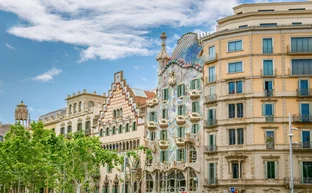
Spend the first two days as described in the other two itineraries. On Day 3, make a leisurely morning exploration of L'Eixample, the 19th-century district that expanded the city away from the congested Barri Gòtic and Ciutat Vella. This is where you'll find Barcelona's widest avenue, the Passeig de Gràcia, and the greatest concentration of moderniste (Art Nouveau) architecture, highlighted by the Manzana de la Discordia, where Gaudí's Casa Batlló, Puig i Cadafalch's Casa Amatller, and Domènech i Muntaner's Casa Lleo Morera are all very close to one another. Most famous of all is another Gaudí gem, Casa Milà (popularly known as La Pedrera), farther along the paseo. Pop into Vinçon, the city's famed design emporium and then continue up to the villagelike district of Gràcia at the northern edge of the Eixample. Return to the lower Eixample area to have lunch in Casa Calvet, a restaurant housed in one of Gaudí's early buildings.

In the afternoon catch the Metro up to Pedralbes and visit its monastery and palace. Then continue up to up to Tibidabo by funicular for the best panoramic views of the city and coast stretching north toward the Costa Brava. In the evening, wander into the adjoining Collserola Park.

1. Passeig de Gràcia

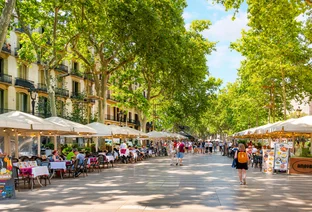
Compared with the color and life of La Rambla, this 60m-wide (197-ft.) avenue -- with its traffic-filled center, two pedestrian mini-paseos, and four rows of trees -- is both more urban and more cosmopolitan. Known locally as the "Queen of Paseos," and lined with elegant buildings, trendy shops, and wonderful eating spots, it rises gently from Plaza Cataluña through the heart of the 19th-century Eixample, ending at the villagelike district of Gràcia.

2. Manzana de la Discordia

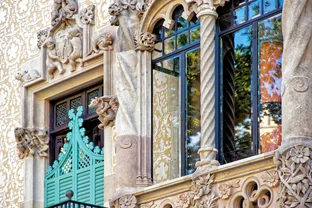
A short way up the paseo you'll find this remarkable block, with its trio of architectural standouts of the moderniste movement: the inimitable Gaudí's frilly and curvaceous Casa Batlló, Puig i Cadafalch's staid Flemish style Casa Amatller, and Domènech i Muntaner's decidedly eccentric Casa Lleo Morera, compared by some to a collapsed wedding cake. Manzana means both "block" and "apple" in Spanish, so the double-meaning could also refer to the mythical golden Apple of Discord, which was to be given to the winner of a beauty contest judged by Paris. Here you can decide for yourself which building comes out on top.

Take A Break

Casa Alfonso, Roger de Llúria 6 (tel. 93-301-97-83), is great tapas bar that serves a wide enough variety of mouthwatering snacks and raciones to satisfy anyone with an early-morning appetite. Their Jabugo ham from Huelva province is considered by many to be Spain's best. At this hour, though, you may simply prefer to settle for a café con leche and admire the aromatic rows of hanging pork.

4. Casa Milà (La Pedrera)

You've not finished with moderniste architecture by a long shot. On its own, a bit farther up the avenue, is what many feel to be the most striking building of all: Casa Milà (by Gaudí again), also known as "La Pedrera" or the Rock quarry, since its twisted verandas and frivolous chimneys are all made of bizarrely sculptured limestone from Montjuïc. It's really a block of apartments, the most original in the entire city, and the high point of any visit comes when you get on to the roof and enjoy the Mary Poppins-like cityscape that's visible past those astonishing chimneys.

5. Gràcia

This cosily intimate district at the northern end of the Passeig de Gràcia, just past the Avinguda Diagonal, started out as a small village built round an 18th-century convent; then, during Barcelona's Industrial Revolution, it became a working-class zone where a famed revolt over the re-introduction of military drafting is commemorated by a tall bell tower that stands in Plaça Ruis i Taulet. Today it's a sought-after and slightly gentrified corner of the city in which many traditional features, such as vintage herbolarios (homeopathic shops) and fortunetellers, have attractively lingered on amid the abundance of tiny squares and narrow lanes. Its mood is vaguely bohemian and many artists have chosen to establish their homes and workshops here. The August festival is a riot of street fun that lasts a week. Don't miss it if you're here then.

Take A Break

Head back down into the lower Eixample for an indulgent (but not too indulgent if you want to get through the afternoon) lunch at Casa Calvet, Carrer Casp 48 (tel. 93-412-40-12). A Gaudí-designed ground-floor restaurant, its moderniste setting is complemented by a new-and-old blend of top Catalan cuisine.

7. Monestir de Pedralbes

Situated high up in one of the city's classiest suburbs alongside a Catalan Gothic church, this 14th-century gem founded by Queen Elisenda is one of Barcelona's oldest and most attractive religious buildings. Once inside, take a peek at its secluded garden and fountain, explore the beautiful three-floored cloister, and visit the pharmacy, kitchen, and high-vaulted refectory with restored artifacts of daily convent life. An attraction added in 1993 is the superb Thyssen-Bornemisza art collection of European masters highlighted by Fra Angelico's moving Madonna of Humility and Ferrer Bassa's murals in the tiny Sant Miquel chapel.

8. Tibidabo

You can arrive at this strange mixture of the ecclesiastic and the brassy either by Tramvia Blau ("Blue Tram"; weekends only in winter) and funicular lift, or -- less dramatically -- take a bus all the way up from Plaça Dr. Andreu. At the top, 488m (1,600 ft.) above the sea with sensational views of the city and coast, is one of the few places in the world you'll find a church next to a fun-fair. The church, named Sagrat Cor (or Holy Heart), is an unattractive, gray neo-Gothic, and its silhouette can be seen from so many miles away that it's become one of the city's most familiar landmarks. The fun-fair's been in operation for over 80 years and its truly vintage attractions include the wheezy Aeromàgic mountain ride and a 1928 flight simulator. The name is said to come from the Devil's words to Christ: "ti dabo," meaning "I give to you," signifying Satan's offering to Jesus all he could see before him if he would follow the fallen angel. Tempting enough when you consider the panorama below.

Take A Break

Merbeyé, Plaça Doctor Andreu, Tibidabo (tel. 93-417-92-79), is a showy and colorful cocktail bar-cum-cafe. It has a plush jazz-oriented lounge, with cool background music, plus a more tranquil open-air terrace where you can sit and unwind after the day's sightseeing over a daiquiri or café con leche and enjoy the great view.

10. Collserola Park

To the southwest of Tibidabo, on the same high massif, is this splendid 8,000-hectare (19,768-acre) area of wild countryside, where footpaths wind amid the oak forests and offer occasional spectacular vistas. Within the park are farmhouses, chapels, and springs, including the charming Font de la Budellera. Along the way you'll also see plaques with verses by the Catalan poet Jacint Verdaguer. (See the small museum dedicated to him inside the 18th-c. Villa Joana.) A far more recent eye-catcher is the 15-year-old Norman Foster-designed Torre de Collserola, shaped like a giant syringe, which is just 5 minutes' stroll away from Tibidabo . There's an unbeatable view from the top, accessible by a vertigo-inducing elevator. At night you can see its lights flashing from way below.


Back to Top


Maps

Note: This information was accurate when it was published, but can change without notice. Please be sure to confirm all rates and details directly with the companies in question before planning your trip.


  Email This Article Email Print This Article Print Get Frommer's RSS Feed RSS
Frommer's Barcelona, 2nd Edition Frommer's Barcelona, 2nd Edition

Author: Peter Stone
Pub Date: May 07, 2007
Price: $16.99

Buy Now!
Related Titles:
Frommer's Barcelona Day by Day, 1st Edition
Frommer's Madrid, 2nd Edition
Frommer's Madrid, 3rd Edition
Add Frommers.com RSS Feed  Add Frommers.com RSS Feed (What's This?)
Add Frommers.com Deals & News to Your Web Site
Add to My Yahoo!     Add to My MSN     More RSS Readers
Add Frommers.com Podcast Add Frommers.com Podcast (What's This?)
Home > Destinations > Europe > Spain > Barcelona > Suggested Itineraries > In Three Days