Bookstore
Available as paperback
and as e-book.
Seville Attractions
Sevilla sprawls in every direction from its historic heart. But the old city, where you’re likely to spend most of your time, occupies a small area.
The cathedral, Giralda, and Alcázar huddle around Plaza del Triunfo. The ancient, narrow streets of Barrio de Santa Cruz spread north from there, the green spaces of the Parque María Luisa to the south. Along the eastern bank of the river is the Arenal, the former shipbuilding district now dominated by the bullring.
Across the bridges to the west is Triana, the old fisherman’s and Romani quarter, famous for its bullfighters, flamenco artists, and painted ceramics.
The city’s commercial center runs north from Plaza Nueva along the pedestrianized streets of Calles Sierpes and Cuna toward Plaza de la Encarnación and Sevilla’s newest landmark, Las Setas.
The neighborhood to the north is named La Macarena after the basilica at the heart of Sevilla’s Holy Week. It stretches past the once seedy, now fashionable, Alameda de Hercules to the Moorish walls at the edge of the old city.
Across the river, north of Triana, the rather desolate Isla de Cartuja was the site of Expo '92 and now contains a contemporary art museum, concert hall, and amusement park.
Wherever you wander in Sevilla, you’ll see the city’s curious municipal emblem, which appears to read NO8DO. It is a clever play on words with a long history. The figure of eight represents a skein of thread, madeja in Spanish. So, the motto reads no-madeja-do, meaning “she [Sevilla] has not abandoned me.” The words are attributed to Alfonso X the Wise, who died here in 1282, forever grateful to the city that had stuck by him throughout his reign.
Saving Money and Time on Sightseeing in Seville
The last thing you want to do during your stay in Sevilla is queue for an hour in the hot sun. The lines for the Alcázar often stretch across Plaza del Triunfo. Skip them by booking online in advance and aim for an early slot. At 9:15am you can usually walk straight in, ahead of the tour groups.
Don’t queue for the cathedral either. You’ll save a euro if you book online, and you can avoid long waits by using the entrance at the horseshoe arch of Puerta del Lagarto. You can still buy tickets at the door at most of Sevilla’s museums and private palaces, but many have limited capacity. It will save time and possible disappointment to reserve a slot in advance.
River Sailing in Seville
As the Guadalquivir river silted up in the 17th century, Sevilla’s pre-eminence as Spain’s main port came to an end. But the river remains one of the city’s great assets and a boat trip is an enjoyable way to explore it. Cruceros Torre del Oro (tel. 95-456-16-92; 17€ adults, 5€ children aged 6–12, free for children under 6) operate from the embankment next to Torre del Oro. For centuries there was no permanent structure across the river to Triana, only a boat bridge built by the Almohads in the 12th century. In the 1850s, the queen commissioned the iron-built Puente de Isabel II, almost identical to the Pont du Carrousel she had admired in Paris. Further along the river you’ll reach the striking, harp-like Puente Alamillo designed by Santiago Calatrava for the 1992 Expo held on Isla de la Cartuja. Cruises last 60 minutes and depart on the hour between 11am and 7pm from October to April, until 10pm in summer. You can book a slot in advance online.
Seville's Second Most Famous Painter, and Where to See His Works
Sevilla’s most famous artist is undoubtedly Diego Velázquez, born here in 1599. In his early twenties, he left for Madrid with his portraits of the city’s street sellers and was promptly snapped up by Felipe IV as court artist. He, and most of his paintings, never returned to Sevilla. Today, El Prado in Madrid is the place to see Velázquez.
Sevilla is the place to admire the prolific output of Bartolomé Esteban Murillo. Born in 1618, he also went to Madrid as a young man but returned in 1645 and dedicated his life to decorating Sevilla’s churches, convents, and monasteries with his huge Baroque paintings of religious subjects. His rosy-cheeked style, seen by some as overly sentimental, fell out of favor during the 19th century, but Sevilla has once again clasped the painter to its bosom. You can see numerous examples of Murillo’s florid paintings in the Museo de Bellas Artes, the cathedral, and the church of Santa María la Blanca, among others.

31 Results
- Historic Site
Alcázar
The oldest European royal residence still in use—the king and queen stay here when in Sevilla—this complex of palaces and fortifications dates from the rule of the Abbadid dynasty in the 11th century. It was largely rebuilt after the Christian reconquest of Sevilla in 1248 and has… - Historic Site
Archivo General de Indias
Sevilla’s monopoly trade with the New World generated a mountain of paperwork that eventually ended up here. This austere, 16th-century building was designed by the architect of the Escorial, Juan de Herrera, originally as the Stock Exchange (Lonja de Mercaderes). The chains that… - Landmark
Archivo de Indias
The Archivo de Indias is said to contain some four million antique documents, including letters exchanged between patron Queen Isabella and explorer Columbus (he detailing his discoveries and impressions). These documents are locked in air-conditioned storage to keep them from… - Neighborhood
Barrio de La Macarena
The district around the Basilica de la Macarena, once one of Spain’s poorest slums, is now an appealing blend of working-class tradition and hipster creativity. Its cobbled streets feature quirky cafés and vintage clothing shops alongside traditional bars and lots of churches. The… - Neighborhood
Barrio de Santa Cruz
The narrow, whitewashed streets of the old Jewish quarter are Sevilla’s main tourist zone. There are tacky souvenir shops and some tourist trap restaurants here, but despite the crowds, the district retains plenty of medieval character. After the reconquest of Sevilla in 1248, the… - Neighborhood
Barrio de Triana
Located across the river from the city center, Triana is fiercely independent. You’ll see souvenir shops here that never mention the name Sevilla. Traditionally home to Romani people (gitanos), it has produced many famous bullfighters and flamenco artists. Triana is also known for… - Religious Site
Basilica de la Macarena
On the northern tier of the central city, this church possesses the most revered image in Seville, "the Virgin of Hope," which locals call La Macarena. It is strictly for Madonna worshipers (of Catholic, not Kabbalah, ilk). She is the patron saint of matadors and a favorite of… - The Performing Arts
Casa Anselma
Casa Anselma ★ [find] -- If you're bored with touristy flamenco shows, seek out this little hideaway deep in the heart of Triana on the western bank of the river. The building, which is completely covered in decorative tiles called azulejos, is hard to miss. Inside it's wildly… - Historic home/museum
Casa Fabiola
This city-owned mansion near the cathedral houses the extensive art collection of Mariano Bellver, a wealthy businessman who donated it to Sevilla in 2015. Alongside sculpture and ceramics, it is dominated by 19th-century costumbrista painting. Long out of fashion, this folkloric… - Historic Site
Casa de Pilatos
The residence of the dukes of Medinaceli was the first of Sevilla’s private palaces to be opened to the public. It owes its grandeur to the first Marquis of Tarifa, who traveled through Italy on a pilgrimage to Jerusalem in 1518 and returned to Sevilla buzzing with architectural… - Historic home/museum
Casa de Salinas
Behind an unassuming red façade, Casa Salinas is a beautifully restored example of a Golden Age mansion, with patios decorated in lavish Mudéjar plasterwork, Roman mosaics, and decorative tiles. You might glimpse members of the Salinas family who still live here slipping into their… - Cathedral
Catedral de Sevilla and La Giralda
Sevilla’s cathedral was designed with the aim that “those who come after us will take us for madmen.” It is the world’s largest Gothic building. Construction began at the beginning of the 15th century on the huge rectangular base of the Almohad mosque and took more than a hundred… - Religious Site
Convento de Santa Paula
There are 17 cloistered women's convents still functioning (in some cases, flourishing) in Seville today. Some are very small, some are in steep decline, and some are so obscure that their doors are almost always closed to casual visitors. But if a peek into this medieval lifestyle… - The Performing Arts
El Arenal
The singers clap, the guitars strum, the tension builds, and the room fills with the ancient and mysterious magic of the flamenco. In the rear of a 17th-century structure, two shows are performed nightly at 10pm. Drinks and food are served at minuscule tables in a sweltering back… - The Performing Arts
El Patio Sevillano
In central Seville on the Guadalquivir riverbank between two historic bridges, El Patio Sevillano is a showcase for Spanish folk song and dance, performed by exotically costumed dancers. The presentation includes a wide variety of Andalusian flamenco and songs, as well as classical… - Historic Site
Hospital de la Caridad
Don Juan was the creation of the dramatist Tirso de Molina, whose parable inspired many versions including Mozart’s opera Don Giovanni. Some claim the model for Don Juan was the local nobleman Miguel Mañara, whose mansion still stands on Calle Levíes. In fact, the play was published… - Landmark
Hospital de la Santa Caridad
This 17th-century hospital is intricately linked to the legend of Miguel Manara, portrayed by Dumas and Mérimée as the scandalous Don Juan. It was once thought that he built this institution to atone for his sins, but this has been disproven. The death of Manara's beautiful young… - Religious Site
Iglesia del Divino Salvador
After the marathon of the cathedral, you may feel you’ve had your fill of religious sight-seeing for one day, but your ticket to the cathedral also entitles you to visit this red-fronted Baroque church built around 1700. If it looks solid, that’s because the first attempt to build… - Historic Site
Museo Palacio de la Condesa de Lebrija
Regla Manjón Mergelina, the Countess of Lebrija, owned this 16th-century palace between 1901 and 1914, and boy, did she get the decorators in. She was an avid archaeologist and cultural magpie who installed a collection of ancient mosaic floors described as the finest of any palace… - Museum
Museo de Bellas Artes de Sevilla
Built in the early 17th century, this beautiful former convent became a museum following the dissolution of the monasteries in 1835 and now holds the finest collection of Spanish Golden Age masters outside of the Prado. Although Madrid has most of the great Velázquez paintings, the… - Museum
Museo del Baile Flamenco
Sevilla’s Cristina Hoyos, who founded this museum, is one of Spain’s most celebrated flamenco dancers and choreographers. The darkly lit galleries are relatively short on artifacts and long on interactive exhibits that immerse you in the styles, movements, and rhythms of flamenco.…$$ - Historic home/museum
Palacio de las Dueñas
Sevilla has an abundance of privately-owned palaces built in the 16th century when the city was the wealthiest in Europe. While some, like Casa de Pilatos, have been museums for decades, others have recently opened to the public. In some cases, the aristocratic families who own them… - Park/Garden
Parque María Luisa
Once owned by Isabel II’s sister, the Infanta María Luisa, these green, open spaces to the south of the city were originally the gardens of the Palacio de San Telmo. The 17th-century palace, with its foaming Churrigueresque façade, was built as a school for navigators. Donated to the… - Landmark
Plaza de América
This oblong plaza at the south of Parque María Luisa was designed by Aníbal González for the 1929 Expo and contains some of its grandest pavilions. Two have been converted into museums. The Museo Arqueológico Provincial (tel. 95-478-64-74) in the Renaissance pavilion was closed for a… - Landmark
Plaza de España
One of Sevilla’s most iconic landmarks, this huge red-brick crescent was built as the centerpiece of the 1929 Exposición Iberoamericana. It was designed by the city’s great architect Aníbal González—whose statue stands nearby—in a style known as Regionalism, intended to reinvent… - Historic Site
Real Fabrica de Tabacos
One of Seville's mostt famous citizens was a fictional characters, but she is linked to real people and places. The novella Carmen, the basis of Bizet’s famous opera, was written by the French novelist Prosper Mérimée in 1845 after a visit to Sevilla. He claimed it was a true story.… - Landmark
Real Plaza de Toros
The Plaza de Toros de la Real Maestranza de Caballería de Sevilla is neither Spain’s oldest bullring (that’s in Ronda) nor the largest (that’s in Madrid), but it is considered the most important. Construction began in 1761 to replace earlier wooden rings, and was completed in stages… - Attraction
Setas de Sevilla
Completed in 2011, the world’s largest wooden structure—resembling a hobbyist’s model on an enormous scale—fills Plaza de la Encarnación. It was originally named Metropol Parasol, but everyone calls it Las Setas (The Mushrooms). While it is not universally loved by locals, it has… - The Performing Arts
Tablao Los Gallos
Negotiating the labyrinth of narrow streets of the Barrio Santa Cruz somehow contributes to the authenticity of this intimate and high-energy flamenco club. The location is 2 blocks south of Ximénez de Enciso along Santa Teresa. No food is served during the shows, which begin every… - The Performing Arts
Teatro de la Maestranza
It wasn't until the 1990s that Seville got its own opera house, but it quickly became one of the world's premier venues for operatic performances. Naturally, the focus is on works inspired by Seville itself, including Verdi's La Forza del Destino and Mozart's Marriage of Figaro.… - Museum
Torre del Oro
The Almohad rulers of Sevilla erected this tower and another just like it across the river in 1220 as a defensive mechanism. A stout chain linked the two, preventing ships from moving in and out of the port without authorization. The system proved fruitless when a Castillian admiral…
More About Seville Attractions

Seville Shopping
The pedestrianized streets around Calles Sierpes and Cuna are Sevilla’s main shopping district. Although there are a few tacky souvenir stores here, you’ll also find picturesque emporia selling classic Andalucian goods. Founded in 1896, Sombrería Maquedano, Calle Sierpes, 40 (tel/ 95-456-47-71), sells beautiful men’s felt hats ranging from classic Borsalinos to the flatter, wide-brimmed caballero’s hat. Juan Foronda, Calle Sierpes, 33 (tel. 95-422-76-61), sells investment-quality embroidered silk shawls (mantones) and veils (mantillas), as well as more modestly priced fans (abanicos). Lina, Calle Álvarez Quintero, 11 (tel. 60-833-88-81), is the place for flamenco dresses, beautifully blending traditional and contemporary designs.
Confitería La Campana, Calle Sierpes, 1 (tel. 95-422-35-70), sells traditional polvorón pastries in old-fashioned tins and is a lovely place for a coffee and a sticky cake. The beautifully packaged confectionery at Despensa del Palacio, Calle Villegas, 1 (tel. 95-591-45-25) makes an ideal gift. For top-of-the-range regional hams, cheeses, and wine to take home, head to Flores Gourmet, Calle San Pablo, 24 (tel. 95-421-61-60).
It’s almost impossible to leave Sevilla without buying a piece of pottery. For ceramics, head across the bridge to Triana and the tile-encrusted façades of Cerámica Santa Ana, Calle San Jorge, 31 (tel. 63-524-00-19), and Cerámica Ruiz, Calle San Jorge, 27 (tel. 95-518-69-41). The factory and showroom of Santa Ana opened in 1870. Both have a broad selection of painted tiles, pots, tableware, and decorative items in the azulejo tradition. A serving bowl for olives with a separate compartment for pits makes an authentic Spanish souvenir. Just around the corner, the shop of the Centro Cerámica de Triana, Calle Callao, 16 (tel. 95-547-42-93) has a good selection of pieces by local artisans. La Cartuja de Sevilla, founded by the Englishman Charles Pickman in 1841, still makes classic dinner services of the kind owned by many a sevillano family. The factory is on the outskirts of Sevilla, but you can buy the famous dishes at El Corte Inglés department store, Plaza del Duque de la Victoria, 8 (tel. 95-459-70-00). Back in Barrio Santa Cruz, Populart, Pasaje de Vila, 4 (tel. 95-422-94-44), has antique ceramic tiles and pottery at uptown prices.
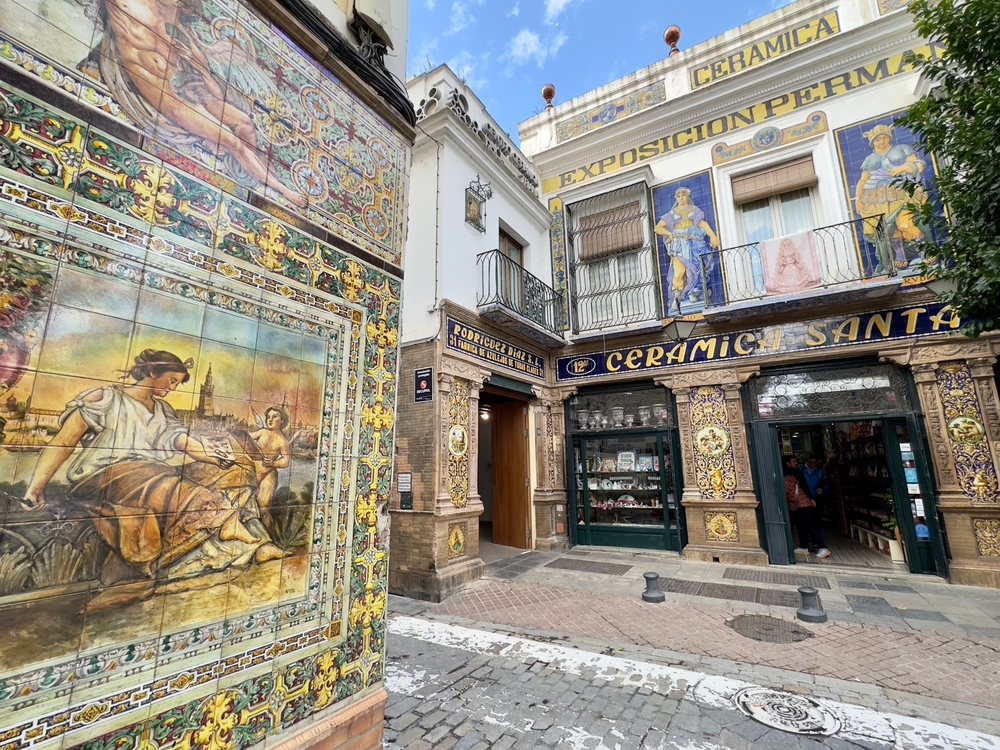
Cerámica Santa Ana (Nigel J. Harris / Shutterstock)
Sevilla’s ancient flea market, El Mercadillo de Jueves, takes place on Calle Feria in the Macarena district every Thursday from 8.30am to 2.30pm. It has plenty of interesting vintage items and quite a bit of junk, but mercifully few tacky imports. On Sunday mornings there is a stamp and collectibles market on Plaza del Cabildo.
Seville Nightlife
Flamenco
If you only have one night in Sevilla, you should go to flamenco. Along with Jerez and Cádiz it is the cradle of the art form, and many of Spain’s most famous performers grew up in the Romani quarter of Triana. Apart from Madrid, the city has the busiest performance schedule in the country. There are different formats to choose from.
Two cultural centers offer very pure flamenco in a style intended to be as educational as it is entertaining. The Museo del Baile Flamenco, Calle Manuel Rojas Marcos, 13 (tel. 95-434-03-11), offers daily dance-oriented performances in its courtyard at 5pm, 7pm, and 8:45pm. Admission is 25€ adults, 18€ seniors and students, and 12€ children. Casa de la Memoria, Calle Cuna, 6 (casadelamemoria.es; 📞 95-456-06-70), hosts shows nightly at 7:30pm, usually featuring a small troupe focusing on early 20th-century styles. Admission is 22€ adults, 18€ students, and 12€ children aged 6–11.
The flamenco nightclub spectacle, or tablao, is more obviously aimed at tourists, but may feel more accessible. It can get expensive, and purists grumble about the quality. Most offer a drink with the admission price and dinner or tapas on top. The dinner is rarely worth it, but you may get better seats. Flamenco Las Setas, Plaza de la Encarnación (tel. 68-477-69-81), stages four evening shows within the spectacular structure of Las Setas. Admission is 35€ with a cocktail, 60€ with dinner, 20€ children aged 6–12. Tablao El Arenal, Calle Rodó, 7 (tel. 95-421-64-92), offers one of the most highly rated shows in an atmospheric location close to the bullring. Shows are at 7pm and 9:30pm. Admission is 43€, 84€ with dinner. For flamenco on a budget, head to La Carbonería, Calle Céspedes, 21 (tel. 95-422-99-45), set in a former coal warehouse with a student bar feel. Admission is free, charcuterie and cheese plates cost 10€, and the beer comes in English-style pint mugs. A series of short sets starts around 10pm.
Triana is famous for its raucous and sometimes spontaneous flamenco bar scene. Two of the liveliest are side by side on the riverfront. Sala Rejoneo, Calle Betis, 31B (tel. 65-880-90-03) and Lo Nuestro, Calle Betis, 31A (tel. 65-880-90-03) with shows on Friday and Saturday nights. Admission is free, but drinks are pricey. Shows start around 11pm and the bars often stay open until dawn. For more serious flamenco, in a theater setting without drinks, seek out Teatro Flamenco Triana, Calle Pureza, 76 (tel. 61-100-23-30). It hosts three evening shows, at 5:30pm, 7:30pm and 9pm. Tickets cost 25€ adults, 20€ students and seniors, and 15€ children aged 4–12.
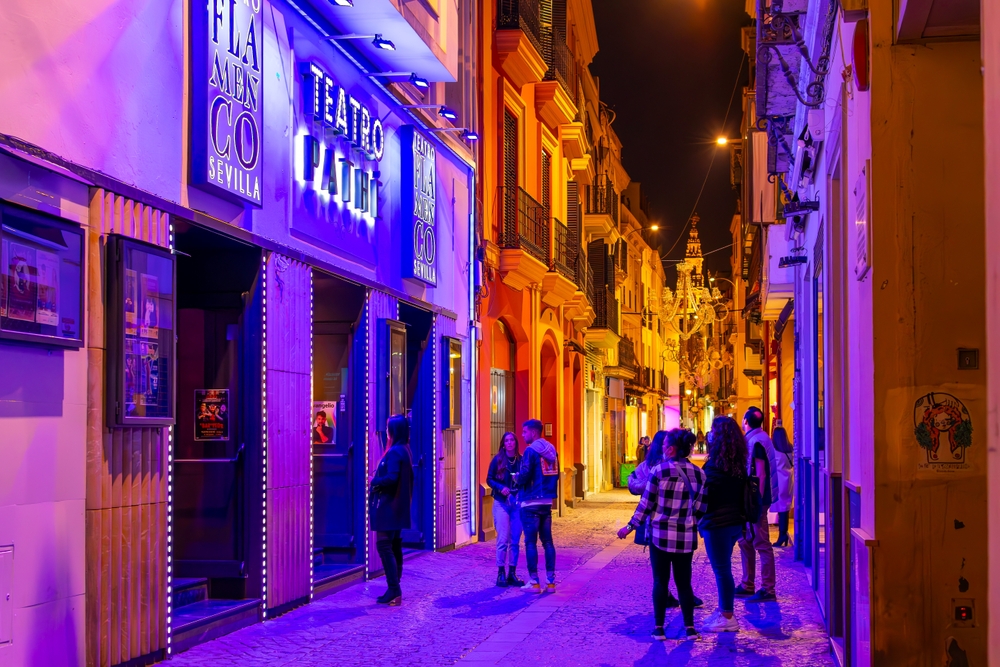
Casco Antiguo District (Kirk Fisher / Shutterstock)
Drinks & Tapas
For most sevillanos there is little or no distinction between going out to eat and going out for a drink. You simply do both, and the bars listed on this website are also recommended for a drink. As the evening wears on, beer and tapas give way to copas, usually enormous goblets of gin and tonic.
To barhop like a local, kick off at the tables outside the two crowded bars on Plaza de San Salvador, La Antigua Bodeguita and Los Soportales, and take it from there. Taberna Álvaro Peregil is an atmospheric hole in the wall on touristy Calle Mateos Gago for a glass of vino de naranja (orange wine) and chicharrones—salty, thinly sliced pork belly from Cádiz. From there it’s a short hop to the Barrio Santa Cruz favorites Las Columnas and the ham-laden Las Teresas, Calle Santa Teresa, 2. For cocktails, seek out Bar Garlochí, Calle Boteros, 26, which is marvelously decorated like a Baroque chapel, or book a spot on the terrace at Hotel Inglaterra, Plaza Nueva, 7 (tel. 95-422-49-70) for spectacular views of the illuminated cathedral. As evening turns to night, head to Alameda de Hercules for its late bars and dance clubs, which get going after 11pm.
Performing Arts
In addition to Carmen and Don Giovanni, around 150 librettos have been inspired by Sevilla. Built for the 1992 Expo, the Teatro de la Maestranza, Paseo de Colón, 22 (teatrodelamaestranza.es; 📞 95-422-33-44),
Though often the setting for operas, Sevilla didn’t get its own opera house until the 1990s. The Teatro de la Maestranza, Paseo de Colón, 22 (tel. 95-422-33-44) has established itself as one of the world’s leading operatic venues. Its season focuses on works inspired by the city and flamenco, jazz, and zarzuelas (operettas) are also performed. Buy tickets online or from the box office in front of the theater, open Monday to Saturday from 10am to 2pm and 5 to 8pm.
11 Results
- Nightlife
Casa de la Guitarra
Flamenco at its best needs no stage decoration, no razzle-dazzle. The emotional charge of the song and dance should be enough to transport you to another place. You can do all-singing-all-dancing shows with dinner thrown in elsewhere in Seville if that's your thing, but I prefer it…$$ - Nightlife
DadáBar
Right now this is the club to go to—well, at least it is for my friends in Seville. Don't even think of showing up before midnight, and come ready to dance until dawn. Inside, there are a couple of bars and a cramped and noisy stage area at the back with an iron and…$$El Arenal
- Nightlife
Fun Club
While places such as Groucho and Dada cater to the well-heeled and stylish night owl, Fun Club is much more for the jeans, beer, and indie music lover. It's located in the town's funky alternative district, the Alameda—and you'd do just fine having a few drinks in the bars nearby…$Alameda - Bars & Pubs
Garlochí
Tucked away down a side street off Plaza Alfalfa, this little bar almost defies description. Walk inside and you might feel as if you've set foot in a church, as wall-to-ceiling it's stuffed with religious statues and artifacts. It's genuinely surreal— cherubs look down on you from…$ - Nightlife
Groucho Bar
Groucho Bar is the place where Seville's young sophisticates go to see and be seen. Assuming you can get past the bouncers who like to play at "style police" (they once almost turned me away because my shoes looked too much like sneakers), it's friendly, flirty, and heaps of fun. It…$$ - Bars & Pubs
La Antigua Bodeguita
For as long as any of its neighbors in Seville can remember, the young and the restless have congregated every evening on the plaza outside of the pink-brick baroque facade of the San Salvador church. The bar that attracts the majority of them is Antigua Bodeguita, a mellow place…$ - Nightlife
La Carbonería
La Carbonería is the one all the guidebooks talk about for "authentic" flamenco. So, if you visit, don't expect to be rubbing shoulders with locals—chances are you'll be sharing a bench with someone from a Japanese tour group. But, despite the fact that it’s a bit…$San Bartolomé - Bars & Pubs
Le XIX
The blurb on the menu says this trendy new coffee and cocktail bar takes its inspiration from the Art Nouveau literary cafés of Paris and the speakeasy jazz bars of New York. I'm not sure the owners have ever set foot in either, but it's certainly one of Seville's coolest spots at…$$ - Bars & Pubs
Merchant's Malt House
Every city has an Irish bar somewhere, but Central Seville actually has three. If you're yearning for a pint of the black stuff and some hearty Irish cheer, then this is the best of them. It's been serving the finest pint of Guinness in town since 1999 and you'll find sports…$Casco Antiguo - Nightlife
Tablao El Arenal
Flamenco comes in many guises in Seville. I prefer it simple and laid bare, and places to experience it this way include Casa de la Guitarra and the Flamenco museum. Several spots offer a big all-singing, all-dancing stage show, which usually includes dinner and is more like a…$$ - Bars & Pubs
The Second Room
Open since 2012, this small, stylish, and comfy coffee and cocktail bar is an ideal place to rest your feet after a day of sightseeing, as it's moments away from the cathedral. What's nice about it is that it's right in the thick of the action, but it's tucked down a side street so…$$