


Home > Destinations > Europe > France > Paris > Attractions > Musée du Louvre
Frommers.com Frommers.com
Most Recent Paris Forum Posts
Most Recommended Articles
Most Commented Articles
  Print This Article Print Get Frommer's RSS Feed RSS

Paris Map: Musée du LouvreMusée du Louvre Frommer's Exceptional

Hours Sat-Mon and Thurs 9am-6pm; Wed and Fri 9am-10pm
Address
34-36 quai du Louvre, 1e
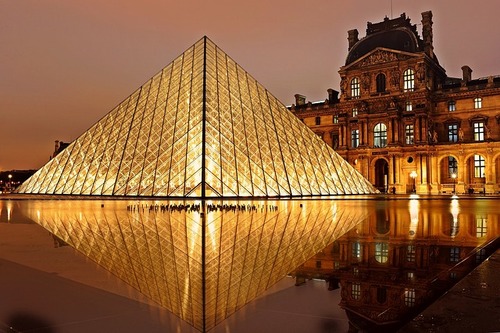
Location Main entrance in the glass pyramid, Cour Napoléon
Transportation Métro: Palais Royal-Musée du Louvre
Phone 01-40-20-53-17, 01-40-20-50-50 for operator, or 08-92-68-46-94 for advance credit card sales
Web site www.louvre.fr
Prices Admission 9€, children 17 and younger free, free to all 1st Sun of every month. 1 1/2-hr. English-language tours (Mon and Wed-Sun) 6€, free for children 12 and younger with museum ticket
Season Closed Tues

Frommer's Review

The Louvre is the world's largest palace and museum. As a palace, it leaves us cold except for the Cour Carrée. As a museum, it's one of the greatest art collections ever. To enter, pass through I. M. Pei's controversial 21m (69-ft.) glass pyramid -- a startling though effective contrast of the ultramodern against the palace's classical lines. Commissioned by the late president François Mitterrand and completed in 1989, it allows sunlight to shine on an underground reception area with a complex of shops and restaurants. Ticket machines relieve the long lines of yesteryear.

People on one of those "Paris-in-a-day" tours try to break track records to get a glimpse of the Louvre's two most famous ladies: the beguiling Mona Lisa and the armless Venus de Milo. The herd then dashes on a 5-minute stampede in pursuit of Winged Victory, the headless statue discovered at Samothrace and dating from about 200 B.C. In defiance of the assembly-line theory of art, we head instead for David's Coronation of Napoleon, showing Napoleon poised with the crown aloft as Joséphine kneels before him, just across from his Portrait of Madame Récamier, depicting Napoleon's opponent at age 23; she reclines on her sofa agelessly in the style of classical antiquity.

Then a big question looms: Which of the rest of the 30,000 works on display would you like to see?

Between the Seine and rue de Rivoli, the Palais du Louvre suffers from an embarrassment of riches, stretching for almost a kilometer (half a mile). In the days of Charles V, it was a fortress, but François I, a patron of Leonardo da Vinci, had it torn down and rebuilt as a royal residence. Less than a month after Marie Antoinette's head and body parted company, the Revolutionary Committee decided the king's collection of paintings and sculpture should be opened to the public. At the lowest point in its history, in the 18th century, the Louvre was home for anybody who wanted to set up housekeeping. Laundry hung in the windows, corners were pigpens, and families built fires to cook their meals in winter. Napoleon ended all that, chasing out the squatters and restoring the palace. In fact, he chose the Louvre as the site of his wedding to Marie-Louise.

So where did all these paintings come from? The kings of France, notably François I and Louis XIV, acquired many of them, and others were willed to or purchased by the state. Many contributed by Napoleon were taken from reluctant donors: The church was one especially heavy and unwilling giver. Much of Napoleon's plunder had to be returned, though France hasn't yet seen its way clear to giving back all the booty.

The collections are divided into seven departments: Egyptian Antiquities; Oriental Antiquities; Greek, Etruscan, and Roman Antiquities; Sculpture; Painting; Decorative Arts; and Graphic Arts. A number of galleries devoted to Italian paintings, Roman glass and bronzes, Oriental antiquities, and Egyptian antiquities were opened in 1997 and 1998. If you don't have to do Paris in a day, you might want to visit several times, concentrating on different collections or schools of painting. Those with little time should take a guided tour.

Acquired by François I to hang above his bathtub, Leonardo's La Gioconda (Mona Lisa) has been the source of legend for centuries. Note the guard and bulletproof glass: The world's most famous painting was stolen in 1911 and found in Florence in 1913. At first, both the poet Guillaume Apollinaire and Picasso were suspected, but it was discovered in the possession of a former Louvre employee, who'd apparently carried it out under his overcoat. Two centuries after its arrival at the Louvre, the Mona Lisa in 2003 was assigned a new gallery of her own. Less well known (but to us even more enchanting) are Leonardo's Virgin and Child with St. Anne and the Virgin of the Rocks.

After paying your respects to the "smiling one," allow time to see some French works stretching from the Richelieu wing through the entire Sully wing and even overflowing into the Denon wing. It's all here: Watteau's Gilles with the mysterious boy in a clown suit staring at you; Fragonard's and Boucher's rococo renderings of the aristocracy; and the greatest masterpieces of David, including his stellar 1785 The Oath of the Horatii and the vast and vivid Coronation of Napoleon. Only Florence's Uffizi rivals the Denon wing for its Italian Renaissance collection -- everything from Raphael's Portrait of Balthazar Castiglione to Titian's Man with a Glove. Veronese's gigantic Wedding Feast at Cana, a romp of Venetian high society in the 1500s, occupies an entire wall (that's Paolo himself playing the cello).

Of the Greek and Roman antiquities, the most notable collections, aside from the Venus de Milo and Winged Victory, are fragments of a Parthenon frieze (in the Denon wing). In Renaissance sculpture, you'll see Michelangelo's Esclaves (Slaves), originally intended for the tomb of Julius II but sold into other bondage. The Denon wing houses masterpieces such as Ingres's The Turkish Bath, the Botticelli frescoes from the Villa Lemmi, Raphael's La Belle Jardinière, and Titian's Open Air Concert. The Sully wing is also filled with old masters, such as Boucher's Diana Resting After Her Bath and Fragonard's Bathers.

The Richelieu wing reopened in 1993 after lying empty for years. Now, with an additional 69,000 sq. m (743,000 sq. ft.) of exhibition space, it houses northern European and French paintings, along with decorative arts, sculpture, Oriental antiquities (including a rich collection of both Islamic and Far Eastern Art), and the Napoleon III salons. One of its galleries displays 21 works that Rubens painted in a space of only 2 years for Marie de Médicis's Palais de Luxembourg. The masterpieces here include Dürer's Self-Portrait, van Dyck's Portrait of Charles I of England, and Holbein the Younger's Portrait of Erasmus of Rotterdam.

When you tire of strolling the galleries, you may like a pick-me-up at the Richelieu Wing's Café Richelieu (tel. 01-47-03-99-68) or at Café Marly, 93 rue de Rivoli, 1er (tel. 01-49-26-06-60). Boasting Napoleon III opulence, the Marly is a perfect oasis. Try a café crème, a club sandwich, a pastry, or something from the bistro menu.

Leaping Over the Louvre Line -- If you don't want to wait in line at the entrance to the Louvre pyramid or use the automatic ticket machines, you can order tickets over the phone (tel. 08-92-68-46-94) with a credit card. You can also order advance tickets and take a virtual tour at www.louvre.fr. Tickets can be mailed to you in the U.S., or you can pick them up at any Paris branch of the FNAC electronics chain.

The Secret of Her Smile -- Nat King Cole sang of the secret of her smile. For centuries, the most famous painting in the world, Leonardo da Vinci's Mona Lisa, has dazzled viewers with her enigmatic smile. Since 1804 the artist's masterpiece has been hanging in the Louvre. Now researchers feel they have solved the riddle of Mona Lisa's smug look. Using three-dimensional technology to study the masterpiece, they conducted the most extensive examination ever made of the painting. For the first time, they discovered a very fine gauze veil worn over the dress. Such a veil was worn by women who were either pregnant or had just given birth. Incidentally, the lady depicted in the painting is not named Mona. Mona is the equivalent of Madame, so she is "Madame Lisa." The model was actually Lisa Gherardini, the wife of an obscure Florentine merchant.

Note: This information was accurate when it was published, but can change without notice. Please be sure to confirm all rates and details directly with the companies in question before planning your trip.


Back to Top


  Print This Article Print Get Frommer's RSS Feed RSS


Destination Guide
Destination Guide Destination Guide Destination Guide
Destination Guide Destination Guide Frommer's Paris 2010 Destination Guide Frommer's Paris 2010

Author: Darwin Porter
Pub Date: September 28, 2009
Price: $19.99

Add to Cart
Destination Guide Destination Guide Destination Guide Related Titles:
Frommer's 24 Great Walks in Paris, 1st Edition
Destination Guide
Frommer's Bordeaux and The Wine Region Day by Day
Destination Guide
Frommer's Brittany with Your Family: From Rural Charm to Seaside Fun, 1st Edition
Destination Guide
Destination Guide Destination Guide
Destination Guide Destination Guide Destination Guide
Destination Guide
Destinations
Destinations
Home > Destinations > Europe > France > Paris > Attractions > Musée du Louvre

Frommer's Star Ratings

Frommer's Recommended 0 stars Frommer's Recommended
Frommer's Highly Recommended 1 stars Frommer's Highly Recommended
Frommer's Very Highly Recommended 2 stars Frommer's Very Highly Recommended
Frommer's Exceptional 3 stars Frommer's Exceptional

About Our System

Frommer's ranks every hotel, restaurant, attraction, shop, and nightlife establishment it reviews for quality, value, service, amenities, and special features using a star-rating scale, an expression of the strong compare-and-contrast opinions that are a brand hallmark.

Other ratings provide stars based primarily on price and amenities; the Frommer's star rating is meant to quantify the kind of intangible, experiential elements that help travelers make informed decisions.

The "baseline" recommendation is zero stars--every hotel, restaurant, attraction, shop, and nightlife establishment that Frommer's chooses to review is recommended; otherwise, we simply wouldn't include it.

Close Window